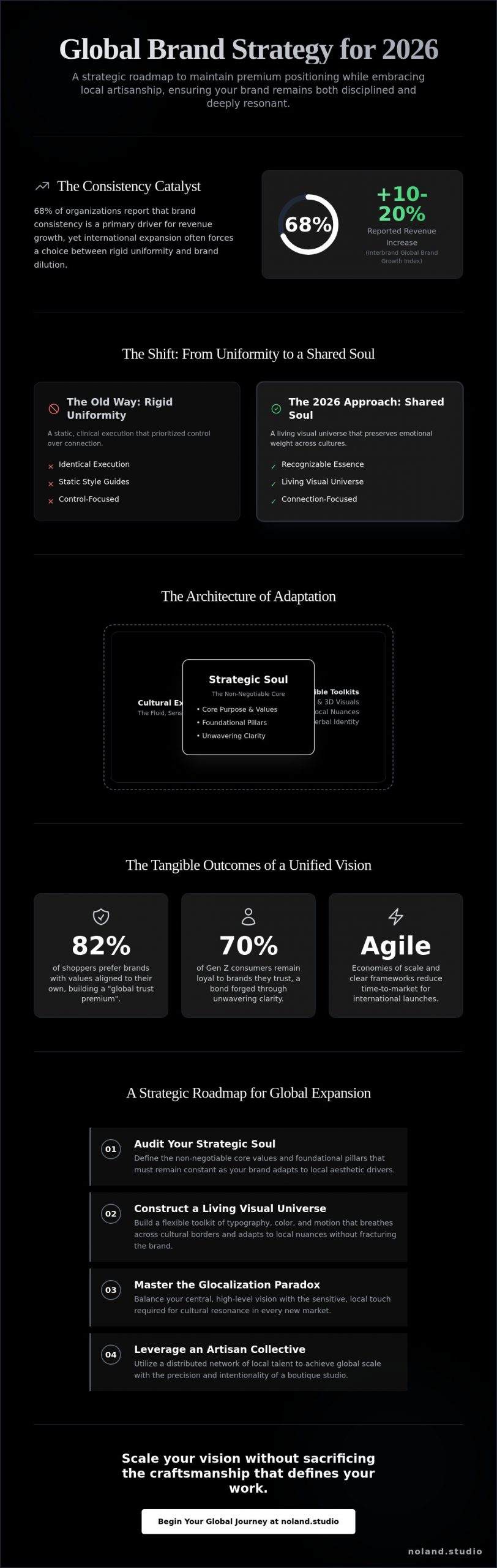
68% of organizations report that brand consistency fuels a revenue increase of up to 20%, yet the path to international expansion often feels like a choice between rigid uniformity and total dilution. You understand that a premium identity is a delicate alchemy of emotion and intent, something meant to be felt as much as seen. Crafting a global brand strategy for 2026 requires more than a static style guide; it demands a living visual universe that breathes, adapts, and evolves across borders.
It’s natural to fear that your brand’s soul might vanish as you adapt to the EU’s AI Act, arriving in August 2026, or navigate rising trademark fees in the UK and Canada. We’ll show you how to scale your vision without sacrificing the expert-led craftsmanship that defines your work. This guide provides a strategic roadmap to maintain premium positioning while embracing local artisanship, ensuring your brand remains both disciplined and deeply resonant in every market it enters. We will explore the foundations of efficient governance and the art of shaping a presence that speaks the language of now.
Key Takeaways
- Distinguish between rigid uniformity and a shared brand soul to protect your premium identity as you expand into new markets.
- Construct a living visual universe with a flexible toolkit of typography and motion that breathes across cultural borders.
- Master a roadmap for global brand strategy that balances your central vision with the sensitive, local touch required for cultural resonance.
- Audit your strategic soul to define the non-negotiable core values that must remain constant as your brand adapts to local aesthetic drivers.
- Leverage the power of a distributed artisan collective to achieve global scale with the precision and intentionality of a boutique studio.
Beyond Uniformity: What is Global Brand Strategy in 2026?
A global brand strategy is no longer a rigid manual of rules. It is the intentional shaping of a brand’s essence to resonate across diverse cultural landscapes. In 2026, we must distinguish between uniformity and consistency. Uniformity is the identical, clinical execution of a logo across every touchpoint. Consistency is the preservation of a shared soul. While the visual details may shift to respect local sensibilities, the emotional weight remains constant. This is the alchemy of modern branding: creating a presence that is both recognizable and deeply personal.
Premium brands are evolving from static identities into living visual universes. These systems breathe, adapt, and evolve. They move beyond the traditional brand management principles that prioritized control over connection. To succeed, you must separate the Strategic Soul from Cultural Expression. The Strategic Soul is your non-negotiable core; it’s the foundation of your purpose. Cultural Expression is the fluid, sensory layer that allows your brand to speak the local language of now without losing its heritage.
The Shift from Multinational to Global
The era of regional silos is fading. By 2026, digital touchpoints have created a borderless experience where a consumer in Tokyo expects the same aesthetic excellence as one in Paris. This requires an integrated approach. A truly global brand strategy ensures that every digital interaction reinforces long-term brand equity. It’s about building a singular, high-level vision that guides every local decision, ensuring the brand’s story unfolds with intention rather than by accident.
The ROI of a Unified Vision
Efficiency is the silent partner of creativity. 68% of companies report that brand consistency contributes to a 10-20% increase in revenue growth according to the Interbrand Global Brand Growth Index 2026. A unified vision creates tangible outcomes:
- Economies of Scale: Centralized foundations reduce the cost of creative production and asset management.
- Agility: Clear strategic frameworks lead to a reduced time-to-market for international product launches.
- The Trust Premium: 82% of shoppers prefer brands with values aligned to their own, a sentiment that requires a consistent global message to maintain.
By September 27, 2026, the EU’s Empowering Consumers for the Green Transition Directive will be in full effect. Brands with a unified, transparent strategy will find it easier to navigate these complex regulations while maintaining a “global trust premium” among discerning consumers who demand authenticity and soul.
The Architecture of a Living Visual Universe
Architecture defines the difference between a collection of files and a coherent identity. Designing a successful global brand strategy means constructing a framework that organizes, categorizes, and clarifies your vision. This process gives shape to ideas, transforming abstract purpose into a tangible presence that can be felt across borders. It’s about building a foundation that allows your brand to unfold with grace, ensuring that aesthetic excellence is never compromised by the complexities of scale.
Foundational Pillars: The Brand Book as a Compass
A brand book should never be a static PDF that gathers digital dust. It must be a living document, a compass that guides every creative decision. Within these foundations, we define the non-negotiables: the core elements of Brand Strategy & Positioning that anchor your global vision. 70% of Gen Z consumers remain loyal to brands they trust, and that trust is born from the unwavering clarity of these foundational pillars. By identifying what must never change, you create the freedom for everything else to evolve.
Visual Flexibility: Designing for Adaptation
Designing for the world requires a modular visual system. A flexible toolkit of typography, color, and motion allows for local cultural nuances without fracturing the brand’s soul. In 2026, motion-first design and 3D visualization have become the universal languages of premium storytelling. When crafting a strategic roadmap for global branding, you must balance high-level aesthetic excellence with technical performance. A luxury experience must load with the same fluid elegance on a high-speed urban network as it does on a remote mobile device.
Verbal identity is equally critical. A robust global brand strategy ensures that naming and tone of voice don’t just translate; they transform. A sophisticated brand might speak with a different rhythmic flow in Tokyo than it does in New York, yet it remains fundamentally the same. Digital alchemy brings these elements together, ensuring an immersive experience that feels premium on every screen. If you’re ready to see how your vision can take shape internationally, exploring a tailored brand evolution can provide the clarity you need to move forward with confidence.
Standardisation vs. Soul: Navigating the Glocalization Paradox
The fear that expansion dilutes excellence is the primary barrier to a successful global brand strategy. It’s a valid concern. When a brand loses its unique touch, it becomes a commodity, a hollow shell of its former self. We resolve this tension through the Glocalization Framework: act global, think local, and feel artisanal. While standardisation offers the comfort of a unified vision, localization respects the cultural tactility of a specific place. Authority is silent; it’s felt through the discipline of a brand that maintains its standards anywhere in the world. In the luxury sector, consistency is the ultimate signal of high-level craftsmanship and intentionality.
A brand’s soul isn’t found in a logo, but in the emotional resonance it creates. According to the 2026 Edelman Trust Barometer, 64% of global consumers will boycott brands that don’t align with their beliefs. This makes cultural resonance a financial imperative rather than a creative luxury. By allowing your living visual universe to adapt, you show respect for local heritage while keeping your strategic foundations intact. It’s an alchemy of a fixed strategic soul and a fluid, local expression. Developing a robust luxury brand strategy that evolves into a living visual universe is essential for premium brands navigating a contracted global market. For brands entering the Iberian market, working with a specialized luxury brand strategy agency Barcelona offers the precise cultural intelligence needed to bridge physical craftsmanship and digital presence in Spain’s rapidly growing luxury sector.
The Myth of the One-Size-Fits-All Strategy
Rigid standardisation often leads to brand fatigue in local markets. When every storefront and digital interface looks identical across different continents, the sense of discovery vanishes. We must identify Cultural Friction Points, such as color symbolism or typographic hierarchy, that require sensitive adjustment. Glocalization is the strategic marriage of global authority and local intimacy.
Maintaining Aesthetic Excellence in Translation
Adapting packaging or naming requires a sensitive hand. It’s not just about translation; it’s about transformation. Expert judgment must override automated brand rules to ensure the sensory impact remains premium across both physical and digital realms. This human-led approach ensures that your brand speaks the language of now, regardless of the territory. 82% of shoppers in 2026 prefer brands with values aligned to their own, a goal only achieved when the global brand strategy allows for authentic, local storytelling that feels human and real.
A Strategic Roadmap for Global Brand Expansion
A successful global brand strategy unfolds through a disciplined, five-step journey. This roadmap transforms abstract vision into a tangible reality, ensuring that your brand’s presence is felt with equal intensity in every corner of the world. It’s an intentional process of shaping foundations that allow for both scale and soul. By following a structured path, you move from the philosophical “why” to the strategic “how” with confidence and clarity.
- Step 1: Audit the Strategic Soul. Identify the non-negotiable core of your identity. These are the elements that must remain fixed to preserve your heritage and emotional weight.
- Step 2: Map the Cultural Landscape. Understand the local aesthetic and emotional drivers. 61% of consumers state that trust in a brand directly affects their purchase decisions, making cultural sensitivity a vital component of trust.
- Step 3: Build the Living Toolkit. Develop flexible visual and verbal systems that breathe. This toolkit acts as a bridge between your global vision and local execution, providing a flexible framework for typography and motion.
- Step 4: Deploy the Artisan Network. Leverage a distributed collective of local experts. They provide the sensitive, local touch that traditional, centralized agencies often lack, ensuring precision in every market.
- Step 5: Monitor and Evolve. Use AI-enhanced tools to track global resonance. By August 2026, the EU’s AI Act will mandate transparency for AI systems, making ethical, expert-led monitoring essential for maintaining brand authority.
Mapping the Last Mile of Brand Management
The gap between global headquarters and local teams is where many premium visions falter. Closing this distance requires deep employee alignment with the brand’s core purpose. 58% of purpose-driven brands experienced double-digit growth in 2026, proving that internal clarity translates to external success. Partnering with a specialized luxury branding agency provides the expert judgment needed to navigate these complexities. This partnership ensures your global brand strategy is executed with precision, regardless of geographical distance or cultural complexity.
Technology as an Enabler, Not a Master
In 2026, AI is a tool for alchemy, not a replacement for the artist. We use it to scale content while maintaining the expert hand that defines luxury. Digital Experience Design must create high-performance touchpoints that feel immersive on every device. This requires a governance framework that encourages creativity rather than stifling it. By treating technology as an extension of human intelligence, brands can maintain aesthetic excellence at scale. If you’re ready to give shape to your international vision, you can connect with our studio to begin your transformation.
The Artisan Collective: Shaping Global Brands with Local Precision
Traditional agency models often struggle with the weight of their own structures. They offer a standardized, clinical approach that frequently misses the emotional resonance required for premium positioning. A successful global brand strategy in 2026 isn’t a product of a boardroom; it’s the result of a multidisciplinary collective. We believe in a model where global vision meets multicultural sensitivity, allowing ideas to unfold with intentionality and grace. This approach ensures that the brand’s soul remains intact, even as it adapts to the complex regulatory and cultural demands of new territories.
Scaling a brand across borders involves navigating a labyrinth of technicalities. For instance, as of January 1, 2026, the 13th edition of the Nice Classification has updated the way goods and services are categorized for trademarks. Simultaneously, the cost of applying for a new generic top-level domain (gTLD) has reached $227,000. These aren’t just administrative tasks; they’re strategic decisions that require expert judgment. By utilizing a distributed network of specialists, we ensure that every touchpoint, from intellectual property to digital experience, is handled with the precision of a local artisan. Anchoring these decisions in strategy-first brand design ensures that every creative and operational choice is rooted in a singular, purposeful truth rather than surface-level aesthetics.
The Distributed Network Advantage
Efficiency shouldn’t come at the expense of craftsmanship. A distributed network allows us to access global talent with deep local insights without the bloated costs of traditional agencies. This model provides the agility to manage complex transformations through a fixed-fee structure, offering clarity and predictability. We bring soul to every touchpoint by ensuring that the people shaping your brand actually live and breathe the cultures they are designing for. It’s a way to organize, categorize, and clarify your presence while maintaining an evocative, high-level vision.
Building Brands that Speak the Language of Now
We act as a bridge between the abstract world of ideas and the physical world of products. By shaping foundations that are both disciplined and fluid, we create multidimensional brand experiences that evolve alongside the world. Whether it’s managing social media marketing budgets that range from $1,500 to $5,000 per month or coordinating mega-influencer partnerships costing over $50,000, every action is guided by a singular strategic soul. This ensures your global brand strategy speaks with authority and emotion in every language. Give shape to your global brand vision with Noland Studio.
Shaping the Future of Global Identity
The transition from a multinational presence to a living visual universe is an act of total transformation. By 2026, the brands that thrive will be those that prioritize a shared strategic soul over rigid, clinical uniformity. You’ve seen how a global brand strategy acts as a compass, guiding your vision through the complexities of cultural adaptation and evolving regulations. Success lies in the delicate balance between high-level authority and the sensitive, local touch that only an expert hand can provide.
Expertise in premium positioning requires a partner who understands that design is a form of alchemy. Our multidisciplinary collective of global digital artisans is dedicated to giving shape to your most ambitious ideas through transparent, fixed-fee models. We bridge the abstract and the tangible, ensuring your story is felt with intention in every market. Breathe life into your global vision; Connect with Noland Studio. The world is ready for a brand that speaks the language of now with a voice that is unmistakably yours.
Frequently Asked Questions
What is the difference between global branding and international marketing?
Global branding is the intentional shaping of a brand’s strategic soul; international marketing is the tactical distribution of products. While branding focuses on long-term authority and emotional resonance, marketing centers on demand generation and regional sales tactics. A cohesive global brand strategy ensures that your essence remains constant even when local marketing campaigns shift to meet specific consumer behaviors in different territories.
How much of my brand strategy should be standardized across markets?
Your brand’s core purpose and strategic positioning should remain 100% standardized. According to the Interbrand Global Brand Growth Index 2026, 68% of organizations report that maintaining this core consistency contributes to a 20% increase in revenue. The visual expression, however, must remain fluid. You should standardize the foundations while allowing the living visual universe to adapt to local aesthetic drivers and cultural sensibilities.
What are the biggest challenges in implementing a global brand strategy?
Navigating the glocalization paradox and evolving regulations are the most significant hurdles. Brands must manage the EU’s AI Act, which becomes largely applicable in August 2026, while facing rising operational costs. For instance, the UK Intellectual Property Office will increase trademark renewal fees to £245 on April 1, 2026. Balancing these legal complexities with the need for a sensitive, local touch requires disciplined governance and expert judgment.
How can a luxury brand maintain exclusivity while scaling globally?
Luxury brands maintain exclusivity by emphasizing human-made elements and high-level craftsmanship over mass automation. While scaling, it’s vital to avoid the one-size-fits-all trap that leads to brand fatigue. By 2026, 82% of shoppers prefer brands with values aligned to their own. You preserve exclusivity by ensuring every touchpoint feels like a curated experience, using a distributed network of artisans to provide a sensitive, local touch in every market.
What role does AI play in modern global brand strategy?
AI acts as an enabler for personalization and agentic AI where systems act as gatekeepers in the consumer journey. In a modern global brand strategy, AI shouldn’t replace human creativity; it should enhance it. We use these tools for digital alchemy, scaling content while the expert hand of a designer ensures aesthetic excellence. This expert-led innovation helps brands build authority with both human consumers and the AI systems they increasingly rely on.
How do you measure the success of a global brand rollout?
Success is measured through a blend of financial growth, brand equity, and trust metrics. Edelman’s 2025 Trust Barometer indicates that 61% of consumers believe trust directly affects their purchase decisions. You should track the global trust premium and revenue growth, which 58% of purpose-driven brands saw hit double digits in 2026. Monitoring how well your living visual universe adapts to local markets without losing its soul provides the ultimate proof of success.
Can a small brand implement a global strategy effectively?
Yes, small brands can scale effectively by leveraging a distributed artisan collective instead of a traditional, high-cost global agency. By focusing on authority-first marketing and high-quality content, smaller entities can project a sophisticated, global persona. You don’t need a massive infrastructure to give shape to a visionary idea. A disciplined focus on your strategic soul allows you to compete with larger players by offering more intentional, soulful connections.
Why is cultural adaptation important for global brand naming?
Naming must resonate phonetically and emotionally within the local linguistic landscape to avoid cultural friction. A name that sounds premium in one region might lack the same rhythmic flow or carry unintended meanings in another. This is especially critical as the EU’s Empowering Consumers for the Green Transition Directive takes effect in September 2026. Precise, culturally adapted naming ensures your brand speaks the language of now while remaining transparent and authentic.