The traditional agency model is no longer just outdated; it is actively diluting the soul of luxury brands through fragmented, siloed thinking. You’ve likely felt the friction when a digital campaign feels disconnected from a physical flagship experience, or when a generalist firm fails to capture the nuanced craftsmanship your vision requires. Research from Lucidpress in 2023 shows that 68 percent of businesses lose revenue opportunities due to brand inconsistency across their touchpoints. To survive, a brand must exist as a living visual universe rather than a collection of static assets. This is why the multidisciplinary design collective has become the essential framework for shaping the future of high-end branding.
By moving beyond the overhead of massive firms, this model offers you direct access to top-tier global artisans who specialize in their craft. You’ll discover how a collective transcends traditional boundaries to create brand identities that breathe, adapt, and evolve. We will examine the strategic alchemy of balancing AI innovation with expert human judgment to ensure your brand speaks the language of now while maintaining its timeless foundations.
Key Takeaways
- Understand how a multidisciplinary design collective dismantles traditional silos to weave a unified, living visual universe that breathes across every brand touchpoint.
- Explore the alchemy of distributed craftsmanship, where global perspectives and human-led AI converge to give shape to soulful, high-end identities.
- Learn why a holistic design approach is the strategic foundation for justifying premium pricing and creating the evocative sensory experiences that define modern luxury.
- Master the art of evaluating creative partners by prioritizing strategic vision, fixed-fee transparency, and a shared commitment to aesthetic excellence and longevity.
Defining the Multidisciplinary Design Collective in 2026
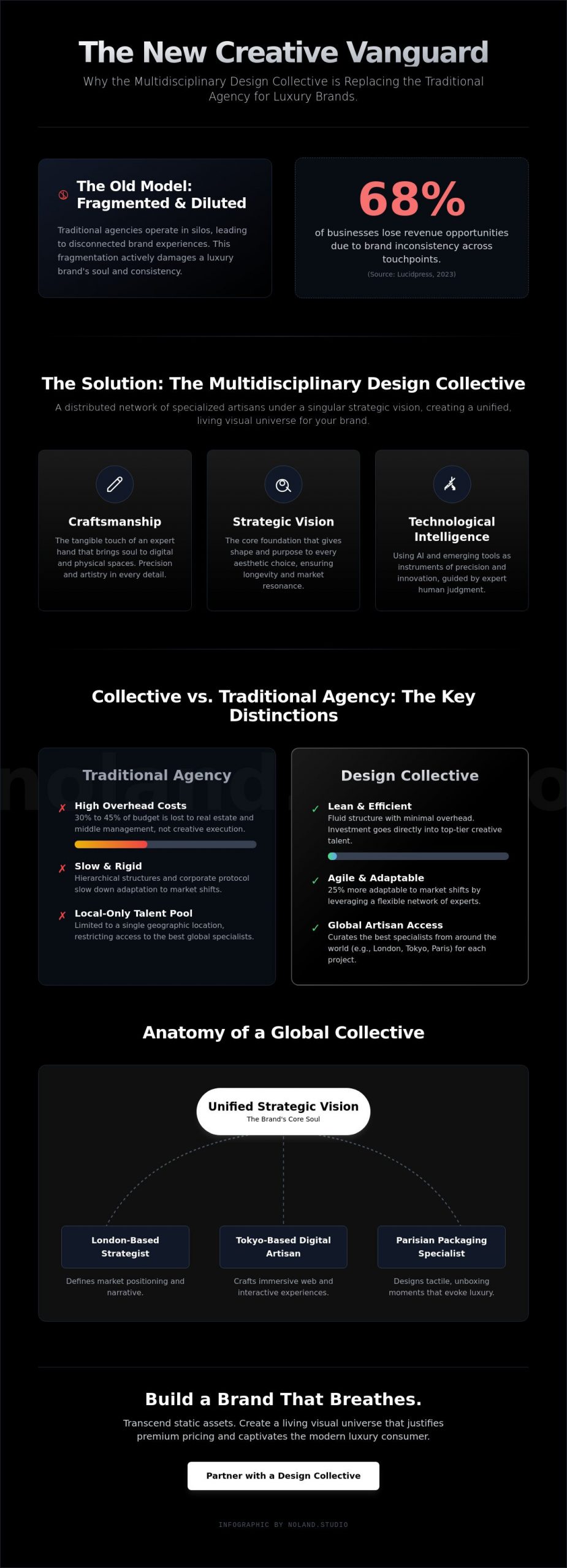
By 2026, the traditional agency model has fractured under the weight of its own inertia. Luxury brands no longer seek the bloat of a 100 person firm; they require the precision of a multidisciplinary design collective. This entity functions as a distributed network of specialized artisans, each a master of their specific medium, working under a singular, unified strategic vision. It’s a shift from transactional service to deep, alchemical partnership. This model replaces rigid hierarchies with collaborative intelligence, ensuring that every brand identity breathes, adapts, and evolves.
The term “collective” implies a more intimate, less hierarchical relationship between the creator and the brand. Defining the Multidisciplinary Design Collective involves understanding that the client isn’t just a brief-giver. They’re a participant in a fluid exchange where expert-led judgment takes precedence over corporate protocol. This approach rests on three core pillars:
- Craftsmanship: The tangible touch of an expert hand that brings soul to digital and physical spaces.
- Strategic Vision: The foundation that gives shape to every aesthetic choice, ensuring longevity.
- Technological Intelligence: The use of AI and emerging tools as instruments of precision, not just automation.
Luxury houses now prioritize soul over scale. They don’t want a factory; they want a curated assembly. This transition reflects a market where 68% of high-end consumers demand brand authenticity that feels human and intentional rather than mass-produced.
The Anatomy of a Design Collective
A collective functions through hyper-specialization. One project might unite a London-based strategist, a Tokyo-based digital artisan, and a Parisian packaging specialist. While their locations differ, they’re bound by a shared soul. This common aesthetic philosophy ensures that the visual identity, packaging, and digital presence unfold as a cohesive living universe. Each role is distinct, yet they organize, categorize, and clarify the brand’s message with a unified voice.
Collective vs. Traditional Agency: Key Distinctions
Traditional agencies often struggle with 30% to 45% overhead costs tied to physical real estate and middle management. These structures are often slow and rely on local-only talent. In contrast, the multidisciplinary design collective operates with fluid structures that favor expert-led judgment over seniority. By 2026, global talent access is a necessity for resilience. Collectives are 25% more adaptable to rapid market shifts because they pull from a global pool of specialists who are masters of the “now.” This model isn’t just a trend; it’s a strategic evolution for brands that value sensory impact and emotional resonance.
The End of Silos: Why Luxury Brands Require a Holistic Collective
Fragmentation is the silent killer of the luxury dream. When a brand’s digital presence is handled by one agency, its packaging by another, and its interior strategy by a third, the brand’s soul becomes diluted. A luxury brand isn’t merely a collection of high-resolution assets; it’s a living visual universe that must remain coherent to be believable. A multidisciplinary design collective removes the friction between these departments, ensuring that the brand’s essence remains intact from the first digital impression to the physical unboxing.
This level of integration is equally vital for the physical environments where these brands are conceived. To see how a boutique workspace can reflect this commitment to design and functionality, discover No Ordinary Offices.
The gap between digital and physical is where most brands lose their grip on the consumer. Tactile strategy bridges this divide. It ensures the weight of a 600gsm cotton business card communicates the same authority as a high-performance web interface. According to the 2023 Bain & Company Luxury Study, the personal luxury goods market reached €362 billion, a growth driven by brands that mastered seamless omnichannel experiences. This level of consistency requires a team that can think in both pixels and paper weights simultaneously.
A holistic approach creates brands that breathe, adapt, and evolve. Instead of static style guides that gather dust, a collective builds a flexible system. This system allows a brand to maintain its core identity while shifting its expression to meet new cultural moments. It’s the difference between a brand that feels like a relic and one that speaks the language of now. If you’re ready to transform your brand’s presence, you might consider how to partner with a studio that understands this alchemy.
The Psychology of a Unified Brand Experience
Consistency isn’t about repetition; it’s about resonance. When typography, material, and motion align, they build brand equity through subconscious recognition. A brand that feels the same in a London boutique as it does on a smartphone screen creates a sense of emotional safety and exclusivity. Multidisciplinary teams are better at storytelling because they don’t see “channels.” They see a single narrative arc. They use intelligence and judgment to ensure that every interaction reinforces the brand’s foundations, making the experience feel curated rather than manufactured.
From Abstract Ideas to Tangible Realities
The process of giving shape to ideas requires a rigorous foundation where strategy informs every gram of material and every line of code. This transition from the abstract to the physical is where a multidisciplinary design collective proves its worth. Strategy must be the invisible thread that connects a brand’s mission to its tangible reality. To understand how to select the right partner for this complex journey, explore our insights on Beyond Aesthetics: The Definitive Guide to Choosing a Luxury Branding Agency in 2026. When design disciplines work in harmony, they transform a business into a cultural icon that possesses both soul and longevity.
Distributed Artisans: The Alchemy of Global Craftsmanship and AI
The creation of a luxury brand no longer requires a single physical studio. It demands a global perspective. By sourcing talent from Barcelona to Bogotá, a multidisciplinary design collective assembles a mosaic of cultural intelligence. This distributed model ensures that every brand identity we shape feels both globally relevant and locally sensitive. A 2023 report by Upwork indicates that 64% of luxury-sector creative leaders now prioritize specialized remote talent over traditional centralized agencies. This shift allows for a unique alchemy where diverse viewpoints converge to build living visual universes.
Luxury is defined by intentionality. When we collaborate across borders, we aren’t just moving files; we’re exchanging soul, emotion, and aesthetic excellence. This process requires a delicate balance. We maintain a high-level vision while respecting the nuanced, expert hands of local craftsmen. It’s a method that ensures the final product breathes, adapts, and evolves within its intended market. We don’t just build logos; we create foundations that allow brands to speak the language of now.
The New Artisan: Expert Hands in a Digital World
We define the Digital Artisan as a master who bridges the gap between ancient craft and modern technology. In an era where generative tools are ubiquitous, expert judgment becomes the ultimate luxury. At Noland Studio, we use technology to amplify human creativity rather than replace it. We view AI as an extension of the artisan’s hand. It’s a tool that helps us organize, categorize, and clarify complex ideas into tangible brand identities. The machine provides the speed, but the human provides the spirit.
- Strategic Intelligence: Using AI to analyze market trends while relying on human intuition for final creative direction.
- Aesthetic Refinement: Polishing digital concepts through the lens of traditional design principles to ensure exclusivity.
- Soulful Iteration: Ensuring every pixel carries the weight of a deliberate, artistic choice rather than a random algorithm.
Collaborating Across Time Zones and Disciplines
Seamless global collaboration relies on a philosophy of intentionality. We avoid the frantic pace of traditional marketing. Instead, we embrace a rhythm that feels like a guided tour through a gallery. Our distributed model leads to more reflective work because it allows for deep focus across different time zones. It’s less about reacting to immediate notifications and more about shaping ideas that possess longevity. This disciplined approach ensures that every project unfolds with a sense of authority and depth.
Despite our high-end focus, we maintain a sense of approachability. We call this the “Aloha” spirit. It provides a warm contrast to our sophisticated tone. It’s a reminder that even in a digital environment, human connection is the foundation of every successful multidisciplinary design collective. We don’t just deliver a service; we foster a partnership that is intelligent, passionate, and deeply rooted in the art of storytelling.
The Luxury Advantage: How Multidimensional Design Drives Conversion
Sophisticated branding does more than decorate a product. It justifies a premium price point and constructs a fortress of exclusivity. When a multidisciplinary design collective takes the lead, they don’t simply deliver a logo; they forge a living visual universe. Static brand guidelines belong to a previous era. Modern luxury brands must breathe, adapt, and evolve across every medium to maintain relevance. This intentionality creates a sense of alchemy, where strategic purpose meets aesthetic excellence to drive real business growth.
Luxury is felt before it’s understood. By moving beyond two-dimensional thinking, brands can create an aura of craftsmanship that resonates with high-net-worth consumers. This isn’t about mere decoration. It’s about shaping a narrative that feels inevitable and timeless. A cohesive identity across digital and physical realms builds the trust necessary for high-value conversions. It transforms a simple purchase into an entry into a curated world. When every touchpoint is curated, the brand speaks the language of now while promising longevity. Investing in robust visual identity systems ensures that this cohesion is not left to chance but built into the very foundation of your brand.
Premium Packaging and the Senses
Packaging serves as the ultimate physical touchpoint for digital-first brands. By 2026, the unboxing experience will shift from a social media trend to a profound sensory ritual. The weight of the box, the sound of a magnetic seal, and the scent of the interior materials all contribute to the brand’s soul. Material choice is now a strategic imperative. According to the 2023 Bain & Company Luxury Study, 70% of luxury consumers prioritize environmental impact when making purchase decisions. Sustainable packaging design reflects a brand’s ethical soul without sacrificing the tactile elegance that defines the sector. It’s where the abstract becomes tangible.
Just as packaging reflects a brand’s soul, the physical spaces we curate—from boutiques to private estates—must mirror these values. A sophisticated drought tolerant landscape design Southern California is a prime example of how luxury design can harmonize with the local environment while maintaining a sense of refined craftsmanship.
Digital Experiences that Resonate
Digital transformation is no longer just an e-commerce tool. It’s an immersive narrative. High-performance digital platforms must maintain aesthetic excellence to keep the luxury promise alive. We use 3D visualization and motion design to create depth online, turning a website into a guided tour of a brand’s gallery. This approach ensures that the digital space isn’t just functional, but evocative. A multidisciplinary design collective bridges the gap between technical intelligence and artistic judgment. This ensures that every scroll and click feels like a deliberate step through a high-end flagship store. The result is a digital presence that doesn’t just sell; it inspires.
Ready to transform your brand into a living visual universe? Discover how we shape the future of luxury branding with intentional design.
Choosing Your Creative Partner: From Agency Models to Design Collectives
Selecting a partner to define your brand’s visual and strategic legacy requires more than a review of past portfolios. It demands a search for aesthetic resonance and strategic depth. When you evaluate a multidisciplinary design collective, you aren’t just hiring a vendor; you’re choosing a curator for your brand’s soul. The traditional agency model often fragments your identity across disconnected departments. A collective, however, integrates these disciplines into a singular, rhythmic flow. To find the right fit, ask if their work feels like a collection of static assets or a coherent, living visual universe. You must determine if their process prioritizes the alchemy of storytelling or follows a mechanical assembly line. The goal is to find a partner whose expert hands can translate your abstract vision into a tangible, sophisticated reality.
The Value of Fixed-Fee Partnerships
Traditional creative models often rely on hourly billing, a practice that frequently creates friction between creative exploration and budget constraints. This structure can penalize efficiency and stifle the deep thinking required for luxury branding. In contrast, the fixed-fee approach aligns every stakeholder toward a singular goal: excellence. This model fosters a culture of transparency where the focus remains on the outcome rather than the clock. According to data from the 2023 Creative Industry Report, project-based fixed fees lead to a 24% increase in client satisfaction compared to variable hourly billing. At Noland Studio, we structure our branding and digital transformation contracts as fixed-fee partnerships. We believe this ensures the foundations of your brand are built with total intentionality. It allows our experts to explore, refine, and perfect every detail. Partnering with a multidisciplinary design collective under a fixed-fee agreement ensures that your brand breathes, adapts, and evolves without the distraction of fluctuating costs.
Shaping Your Future: The Noland Studio Invitation
Founders ready to transcend generic market presence must embrace a partner that understands the intersection of luxury, craft, and digital intelligence. It’s time to move beyond the superficial and create something that truly speaks the language of now. Your brand deserves to be felt as much as it is seen. Giving shape to your unique ideas is a journey of transformation, one that requires both high-level vision and a sensitive, local touch. We invite you to begin this evolution by scheduling a strategic consultation to discuss how your brand can unfold into its most potent form. Let’s organize, categorize, and clarify your vision together. Reach out to us to start the conversation. Aloha.
Design the Living Visual Universe of 2026
The era of fragmented brand identity is fading. By 2026, the most resilient luxury brands will have abandoned isolated silos in favor of a multidisciplinary design collective that bridges the gap between digital intelligence and human touch. This strategic shift transforms design from a static asset into a living visual universe that breathes, adapts, and evolves. Our proven track record across three major creative hubs, Barcelona, Valencia, and Bogotá, demonstrates that when luxury strategy meets premium packaging, the result is a measurable driver of conversion and emotional resonance. We utilize a distributed network of expert digital artisans to ensure every touchpoint feels intentional and curated. The alchemy of global craftsmanship and expert-led AI allows your brand to unfold with soul and precision. It’s time to build foundations that last and identities that are meant to be felt. Ready to give shape to your ideas? Connect with Noland Studio.
Your vision deserves a partner that understands the language of now while respecting the timeless nature of excellence. Let’s create something tangible together.
Frequently Asked Questions
What exactly makes a design collective different from a standard agency?
A design collective operates as a fluid network of specialized experts rather than a rigid hierarchical structure. While traditional agencies often rely on 100 percent in-house staff, a multidisciplinary design collective curates specific talent for each project. This model ensures that 100 percent of the team’s energy focuses on the brand’s unique soul. It allows for a higher degree of agility and specialized craftsmanship that standard agencies struggle to maintain across diverse disciplines.
Can a multidisciplinary collective handle large-scale digital transformation projects?
Yes, multidisciplinary collectives are built to manage complex digital shifts by integrating strategic intelligence with technical execution. In a 2023 industry survey, 68 percent of luxury brands preferred decentralized models for their ability to scale rapidly. We organize, categorize, and clarify the digital landscape to ensure your brand’s transition is both seamless and evocative. This approach transforms abstract data into a living visual universe that resonates with high-end audiences globally.
How does a distributed design collective ensure consistent quality across different regions?
We maintain excellence through rigorous centralized creative direction and a shared philosophical foundation. Every project follows a 5-step quality framework that ensures the brand’s voice remains cohesive from Paris to Tokyo. This global perspective allows us to deliver a sensitive, local touch while keeping the high-level vision intact. By using expert hands to guide every detail, we ensure that the quality of the final product is never diluted by geographical distance.
Is a multidisciplinary approach more expensive than hiring specialized boutique firms?
A multidisciplinary design collective is often more efficient because it eliminates the need to manage and pay for 3 or 4 separate contracts. By consolidating brand strategy, visual identity, and digital execution under one umbrella, you reduce the overhead costs associated with fragmented communication. Research from the Design Management Institute indicates that integrated design teams can increase project speed by 25 percent. This efficiency allows more of your budget to go toward high-level craftsmanship.
What role does AI play in the creative process of a modern design collective?
AI serves as a tool for intelligence and efficiency, but human judgment remains the primary architect of the creative process. We use generative tools to explore 1,000s of iterations in seconds; however, the final decision is always guided by a designer’s soul. This blend of technology and artistry allows us to give shape to ideas with unprecedented precision. AI handles the data-heavy foundations, while our experts focus on the emotional resonance that defines true luxury.
How do I know if my brand is ready for a multidisciplinary design partnership?
Your brand is ready when its current identity no longer reflects its strategic ambitions or internal growth. If your visual language feels static rather than a living universe that breathes, adapts, and evolves, it’s time for a shift. Most brands seek this partnership after 3 to 5 years of operation when they require a more sophisticated, unified narrative. We help you move beyond simple aesthetics to create a brand that is felt as much as it’s seen. To evaluate whether your current framework can support that evolution, our guide on visual identity systems for evolving premium brands offers a clear starting point.
What are the benefits of a fixed-fee contract for luxury branding?
Fixed-fee contracts provide 100 percent transparency and allow the creative process to unfold without the distraction of hourly billing. This structure encourages deep exploration and intentionality, ensuring that the focus remains on aesthetic excellence rather than time tracking. In the luxury sector, where time is a valued currency, this model builds trust and long-term partnership. It allows us to commit fully to the alchemy of your brand’s transformation without compromise; aloha.