If a luxury brand’s heritage cannot be felt through a glass screen, it risks becoming invisible to the modern consumer. You likely feel the frustration of digital touchpoints that appear flat; they fail to capture the weight of a gold foil emboss or the subtle grain of fine leather. Many luxury leaders hesitate because they fear 3d visualization & motion design will look too techy or gaming-inspired for an audience that values timelessness. It’s a valid concern when the soul of a product is at stake.
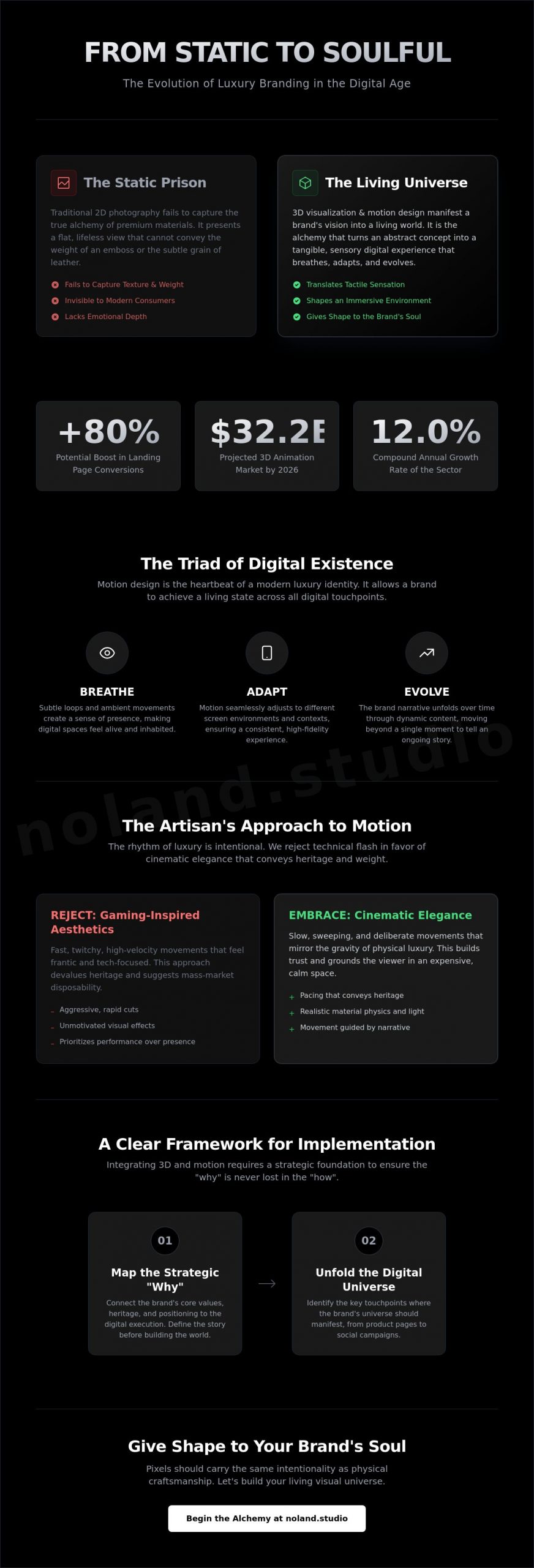
We believe pixels should carry the same intentionality as physical craftsmanship. With the global 3D animation market projected to reach $32.21 billion in 2026, the shift toward hyper-realism is a necessity for brands that want to remain relevant. This article reveals how to use digital alchemy to give shape to your brand’s soul, creating a living visual universe that breathes, adapts, and evolves. You will discover a clear framework for implementing motion design that preserves your heritage while leveraging tools that can boost landing page conversions by over 80%.
Key Takeaways
- Learn how to transcend static imagery by manifesting your brand’s vision into a living visual universe that captures the attention of the modern digital consumer.
- Discover the triad of movement to understand how 3d visualization & motion design allow a brand to breathe, adapt, and evolve across every digital touchpoint.
- Explore techniques for translating the physical weight and intricate textures of premium packaging into sensory digital experiences that feel as tangible as the product itself.
- Understand the role of the digital artisan and how human judgment guides AI tools to ensure your high-end content remains soulful rather than generic.
- Gain a clear, two-step framework for mapping your strategic “why” and identifying exactly where your brand’s digital universe should unfold.
The Evolution of Immersion: Why Luxury Brands Need 3D Visualization
The boundary between the physical and the digital has dissolved. In May 2026, luxury is no longer defined solely by what a customer can hold in their hands; it’s defined by the depth of the world they can enter through a screen. We view 3D visualization not as a technical output, but as the digital manifestation of a brand’s vision. It’s the alchemy that turns an abstract concept into a living visual universe that speaks to a global, borderless audience. When a brand embraces 3d visualization & motion design, it isn’t just creating content. It’s shaping an environment where the brand’s soul can finally unfold without the limitations of physical geography or traditional media.
This evolution is essential for bridging the gap between high-level Brand Strategy & Positioning and tangible reality. Strategy often lives in the realm of the abstract, defined by values and heritage. 3D visualization provides the foundations for these ideas to take shape, allowing a brand to manifest its identity in three dimensions. As the global 3D animation market grows to a projected $32.21 billion in 2026, the brands that thrive are those that use these tools to create consistent, high-fidelity experiences across every digital touchpoint.
From Static to Soulful: The Strategic Shift
Traditional 2D photography often fails to capture the true alchemy of premium materials. It cannot convey the way light dances across hand-blown glass or how a specific texture reacts to movement. This is where the psychology of depth becomes a competitive advantage. By utilizing sophisticated motion design, a brand creates a sense of presence and exclusivity that static images simply cannot match. This shift allows a studio to move beyond the role of a service provider; we become curators of an identity that breathes, adapts, and evolves. It’s about moving from a “flat” digital presence to a multidimensional experience that feels as premium as the product itself.
3D as a Tool for Strategic Vision
Beyond the final aesthetic, 3D serves as a vital instrument for strategic intelligence. Digital prototyping and pre-visualization allow luxury houses to test complex concepts before a single physical resource is spent. This approach directly supports sustainability by reducing the waste associated with physical samples and logistical overhead. With a compound annual growth rate of 12.0% in the 3D animation sector, the industry is moving toward a future where digital and physical development are inseparable. Integrating 3D into the end-to-end branding process ensures that the strategic “why” is never lost, giving shape to ideas with precision, judgment, and expert-led innovation.
Motion Design: Moving Luxury from Static to Dynamic
Motion design isn’t just animation; it’s the heartbeat of a modern luxury identity. If 3D visualization provides the physical foundations of a product, motion design acts as the soul, defining how that body moves, speaks, and exists. We view this as a triad of digital existence: a brand breathes through subtle loops, adapts to different screen environments, and evolves as the narrative unfolds. This living language allows for a form of verbal artisanship where the movement itself tells the story of the brand’s meticulous standards. When executed with precision, 3d visualization & motion design transform a flat interface into a sensory journey.
A common fear among heritage houses is that digital movement feels too gaming-inspired or frantic. This happens when designers prioritize technical flash over cinematic elegance. In our practice, we reject the twitchy, high-velocity aesthetics of mass-market tech. Instead, we embrace a cinematic approach that mirrors the weight and gravity of physical luxury. Research into the potential of 3D in online fashion shows that when motion is used to simulate realistic draping and material physics, consumer trust increases significantly. It’s about precision, not just performance. We use movement to ground the viewer in a space that feels expensive, deliberate, and calm.
The Rhythm of Luxury: Pacing and Flow
The speed of a transition says as much about a brand as its logo. A rapid, aggressive cut suggests fast-fashion innovation, while a slow, sweeping camera movement conveys centuries of heritage. We treat digital content like a guided gallery tour. Each movement is intentional, measured, and graceful. By controlling the communication rhythm, we ensure the viewer feels the exclusivity of the space. This transition from static icons to dynamic narratives is what separates a mere storefront from a curated brand experience that respects the viewer’s time.
Motion Design in Digital Touchpoints
Luxury is found in the details. On a high-performance digital platform, motion design manifests as premium micro-interactions. It’s the way a menu unfolds like a silk scarf or how a product rotates with the weight of real gold. These details guide the reader through a digital brand book, ensuring the journey is as intuitive as it is beautiful. With 91% of businesses using video as a marketing tool in 2023, the challenge isn’t just to move; it’s to move with purpose. If you’re ready to see how your brand can speak this new language, we invite you to explore how we give shape to digital identities that resonate with the modern world.
Translating the Tactile: 3D Visualization & Motion Design Examples
The greatest challenge in the digital sphere is the loss of the sense of touch. When a consumer interacts with a luxury product in person, they feel the temperature of glass, the resistance of a ribbon, and the specific weight of a vessel. Translating these sensations into a digital environment requires more than just high resolution; it requires a deep understanding of physics and light. Through 3d visualization & motion design, we recreate these tactile cues, ensuring the digital experience is as sensory as the physical one. We don’t just show a product; we manifest its presence.
Consider the following manifestations of this digital alchemy:
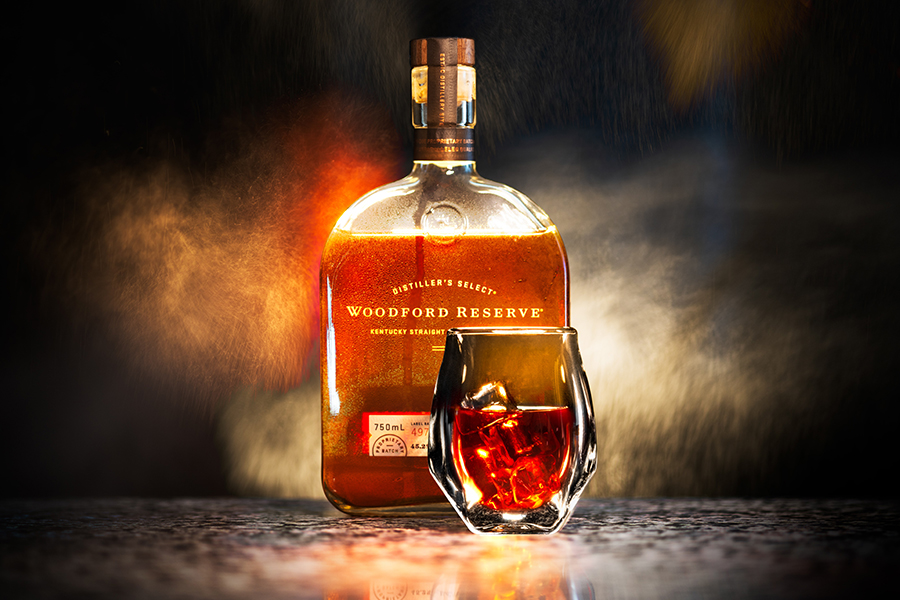
- Fragrance & Spirits: We capture the precise viscosity of liquid and the complex refraction of light through faceted glass. It’s about showing how the liquid catches the light as it moves, creating a “living” bottle.
- Premium Packaging: A 3D unboxing sequence simulates the friction of a sliding drawer or the soft click of a magnetic closure. These micro-moments justify a premium price point by reinforcing the artisan’s touch.
- Fashion & Textiles: We simulate the specific drape of a heavy silk or the rigid structure of embossed leather. This level of detail is vital when 91% of businesses are using video to compete for attention as of 2023.
Material Alchemy: Liquid, Glass, and Silk
Achieving realism requires a delicate balance between technical precision and artistic judgment. We use tools like Cinema 4D, which as of May 2026 costs approximately $839 per year for an annual subscription, to manipulate light and shadow with mathematical accuracy. However, true luxury lies in the “imperfection.” A perfectly smooth surface often feels sterile or tech-inspired. We introduce subtle, soulful irregularities; a slight grain in the leather or a soft blur in the glass makes the digital universe feel human. This visual tactility must align with your Naming & Verbal Identity. When the visual weight of the 3D model matches the evocative language of the brand, the sensory experience is complete.
The Digital Unboxing: Motion as Experience
Motion design transforms a static package into a tactile journey. By visualizing complex packaging structures in motion, we allow the consumer to experience the ritual of the unboxing before the product even arrives. This isn’t a mere demonstration; it’s a performance. We use 3d visualization & motion design to highlight the structural integrity and the deliberate design choices of the packaging. Each fold, slide, and reveal is paced to mirror a physical launch. This creates a sense of anticipation that reinforces the product’s premium positioning in a crowded digital marketplace.
The Artisan’s Edge: AI-Enhanced Tools and Human Judgment
True luxury isn’t found in the click of a button. It resides in the intelligence and judgment of the creator. While the global 3D animation software market is estimated at $30.47 billion in 2026, the value doesn’t lie in the tools themselves; it lies in the expert hands that guide them. We view 3d visualization & motion design as a form of modern craftsmanship where AI acts as a sophisticated collaborator rather than a replacement. This partnership allows us to explore the foundations of a visual universe with speed, but the final shaping of an idea requires a human soul to ensure it feels exclusive and intentional.
Our approach favors a distributed network of global experts over the rigid, corporate structure of traditional agencies. This model allows for a multicultural perspective that is both visionary and sensitive to local nuances. By moving away from a clinical service-provider mindset, we position ourselves as curators of brand identities. We believe that technological savvy must always be balanced by artistic weight. It’s the difference between a brand that looks “tech-inspired” and one that speaks the timeless language of luxury.
AI as a Strategic Tool for 3D
AI-enhanced workflows accelerate the iteration process without sacrificing aesthetic excellence. We use these tools to simulate complex lighting scenarios or environmental textures in seconds, allowing more time for creative exploration. This isn’t mere automation; it’s a strategic advantage. For instance, an artist can use AI to organize, categorize, and clarify visual data before a final render in a tool like Maya 2026. This allows us to test how a luxury concept might unfold across different digital touchpoints before committing to a final manifestation. The goal is always to use intelligence to heighten the sensory impact of the work. A disciplined approach to creative art direction ensures that these AI-assisted explorations remain anchored to the brand’s soul rather than drifting toward generic outputs.
The Human Element in Motion
Emotion cannot be programmed. A machine can calculate the physics of a liquid, but it cannot understand the specific weight of a brand’s heritage or the nuanced rhythm of a “Gallery Tour” experience. Our multidisciplinary collective brings a human touch to every frame, ensuring that the motion design feels as premium as the physical product. We craft living brand identities that aren’t just seen, but felt. This requires a level of storytelling that only a seasoned artisan can provide. If you’re ready to transcend generic digital content, you can collaborate with our global collective of artisans to give your brand a soulful digital presence.
Implementing 3D & Motion: A Guide for Premium Brands
The transition from an abstract strategy to a tangible digital presence requires a disciplined, intelligent framework. To give shape to a living visual universe, a brand must move beyond transactional design and toward a philosophy of digital alchemy. This process ensures that every pixel serves the broader narrative, allowing the brand’s soul to unfold with precision across a borderless digital landscape. Successfully integrating 3d visualization & motion design is not a matter of technical implementation alone; it is an act of strategic curation.
- Step 1: Define the strategic ‘why’: Before the first render, we identify the specific emotion we are giving shape to. Is it the quiet weight of heritage or the fluid energy of innovation?
- Step 2: Map the digital touchpoints: We determine exactly where this living universe will unfold. Whether it is a high-performance e-commerce platform or an immersive AR experience, the movement must be tailored to the medium.
- Step 3: Collaborate with digital artisans: Bridging the abstract and the tangible requires expert hands. We bring together a multidisciplinary collective to translate brand values into sensory digital realities.
- Step 4: Integrate and evolve: Motion design is not a static asset. It is a dynamic system that must align with long-term brand strategy, evolving as the brand grows and speaks to new audiences.
Avoiding Common Pitfalls
One of the most frequent errors in premium branding is the tendency to “over-animate.” When movement is frantic or lacks gravity, it dilutes the brand’s authority and risks looking tech-inspired rather than luxury-led. Precision matters. Every transition should feel like a guided tour through a gallery, where the pace is intentional and the rhythm is calm. Technical performance must also be balanced with aesthetic excellence. In May 2026, a high-fidelity visual that takes too long to load is a failure of judgment. We ensure that the visual system is unified, maintaining a consistent soul across every platform without compromising the user experience. This is precisely where creative art direction for premium brands becomes indispensable, providing the overarching human judgment that keeps every motion asset coherent and intentional.
Next Steps for Visionary Brands
The journey from static assets to a dynamic content library begins with a clear vision. With the motion graphics market expected to reach $129.1 billion by 2028, the shift toward movement is an essential evolution for any brand that values longevity. We recommend starting with a fixed-fee approach for initial 3D visualization projects, allowing for a focused exploration of the brand’s digital manifestation. This foundation enables you to build a library of living assets that can be reused, adapted, and evolved over time. Aloha: Connect with Noland Studio to shape your brand’s digital future.
Shaping the Future of Digital Luxury
Digital luxury is no longer a static representation; it is a living environment that breathes, adapts, and evolves. By 2028, the motion graphics market is projected to reach $129.1 billion, signaling a permanent shift in how premium brands communicate with a borderless audience. You now have the framework to transcend the flat screen by using 3d visualization & motion design to manifest tactile, soulful experiences. Success requires a curator’s expert hand. Technology is merely a collaborator for human judgment and strategic intentionality.
Our multidisciplinary collective of global digital artisans specializes in luxury strategy and aesthetic excellence. We offer fixed-fee branding and 3D visualization contracts that provide clarity and focus for your most ambitious projects. Together, we can build a visual universe that is as disciplined as it is evocative, ensuring your brand speaks the language of now while honoring its heritage.
Give shape to your brand’s digital soul with Noland Studio.
The digital future is yours to define. Aloha.
Common Inquiries on Digital Alchemy
What is the difference between 3D visualization and motion design for a brand?
3D visualization is the manifestation of a product’s physical form, while motion design acts as the living language that defines how that form exists in a digital universe. When a brand integrates 3d visualization & motion design, it bridges the gap between a static object and a dynamic narrative. Think of visualization as the architecture of the object and motion as the way it breathes, adapts, and interacts with the viewer.
How much does high-end 3D visualization cost for a luxury product?
High-end 3D visualization for premium brands typically ranges from $1,500 to $3,000 per image, according to industry data from April 2026. This investment reflects the artisan’s touch required to capture hyper-realistic textures and complex lighting. While mid-tier projects might cost $500 to $800, luxury houses prioritize the strategic judgment and technical precision needed to maintain an exclusive positioning in a competitive digital market.
Can 3D motion design be used for sustainable packaging development?
3D motion design is a powerful tool for sustainable development because it allows brands to test complex packaging structures without physical production. By creating digital prototypes, luxury houses reduce material waste and logistical overhead associated with physical samples. This eco-sensitive approach ensures that the strategic foundations of a design are perfected in a virtual space before any resources are committed to the physical world.
How long does it take to create a photorealistic 3D render of a product?
Creating a photorealistic 3D render usually takes between three to ten days, depending on the complexity of the materials and lighting. This timeline includes the initial shaping of foundations, refining textures, and the final rendering process. For high-end work, the artisan spends a significant portion of this time on subtle imperfections that give the product its soul, ensuring the final manifestation feels human rather than clinical.
Do I need a 3D model of my product before starting a motion design project?
You do need a 3D model as the foundation for any motion project, but it doesn’t have to exist before you begin. Our approach to 3d visualization & motion design often starts with creating the digital product from scratch based on your physical blueprints or strategy documents. Once the tangible form is shaped, we then introduce the motion that allows the brand to unfold across various digital touchpoints.
Will 3D visualization make my brand look too ‘tech-focused’?
3D visualization only looks tech-focused when it lacks artistic weight and human judgment. We avoid the frantic, high-velocity aesthetics of gaming by employing a cinematic rhythm that mirrors the calm of a gallery tour. By focusing on light, shadow, and the subtle alchemy of materials, we ensure your digital assets feel as premium and timeless as the physical products they represent.
How can motion design improve the conversion rate of a premium e-commerce site?
Including a video or interactive 3D element on a landing page can boost conversion rates by over 80%, according to 2023 marketing statistics. Motion design improves the user journey by providing micro-interactions that feel intuitive and premium. By guiding the consumer through a tactile digital journey, you provide the sensory reassurance needed to justify a luxury purchase in a borderless e-commerce environment.
What software do digital artisans use for luxury 3D visualization?
Digital artisans rely on industry-standard tools such as Autodesk Maya 2026, which costs approximately $1,680 annually, or Cinema 4D, priced at $839 per year. These platforms are often paired with GPU-accelerated renderers like Redshift or V-Ray to achieve hyper-realism. These tools allow us to organize, categorize, and clarify complex visual data, ensuring that every frame reflects the high-level craftsmanship expected by a luxury audience.