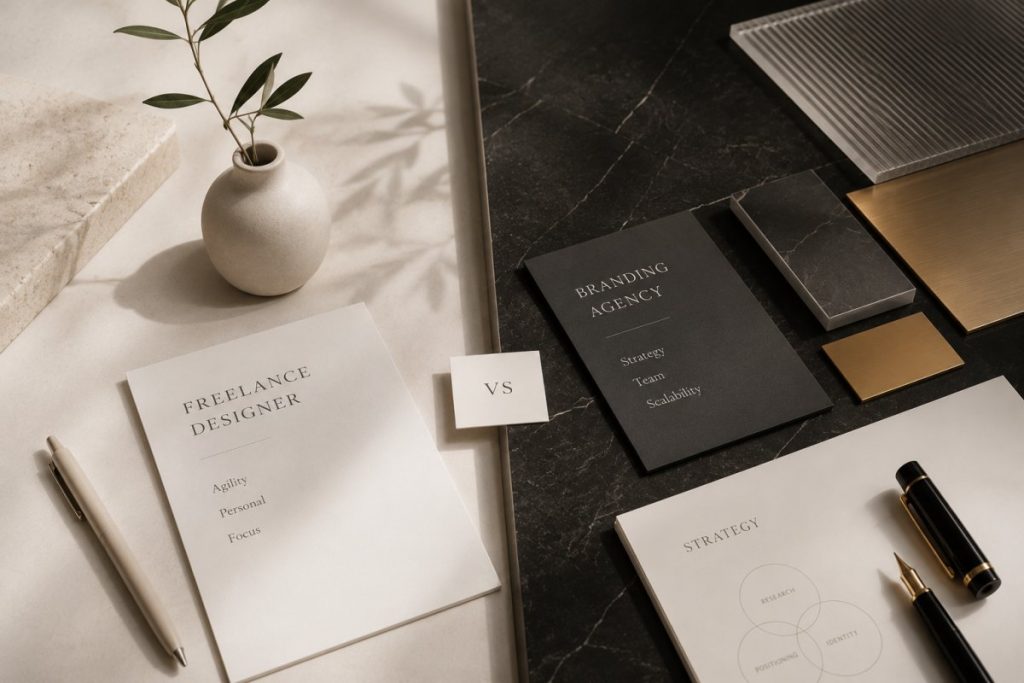
Choosing between a freelance designer vs branding agency for startups is rarely a matter of budget, though your spreadsheet might suggest otherwise. It’s a decision between hiring a hand to execute a task or a mind to architect a legacy. You’ve likely felt the frustration of inconsistent visuals that fail to capture your vision, or perhaps you’ve hesitated at the thought of paying for an agency’s sprawling overhead. You’re looking for something that feels both premium and agile; a partner who understands that a startup’s identity must be felt, seen, and remembered.
This guide helps you navigate this critical choice by dissecting the structural differences between individual talent and collective expertise. We’ll explore how to ensure your design spend translates into a cohesive identity that attracts investors and commands premium attention. You’ll learn to identify the exact moment your venture outgrows a solo creative and requires the holistic, multi-dimensional approach of a strategic studio to build, refine, and sustain a brand that truly resonates. By the end, you’ll have a clear path to choosing a partner who can give physical form to your most abstract, visionary thoughts.
Key Takeaways
- Contrast the agility and cost of a freelance designer vs branding agency for startups to identify which structure aligns with your current stage of growth and strategic needs.
- Move beyond the concept of design as a simple commodity by investing in a brand ecosystem that evolves alongside your venture and attracts premium clientele.
- Identify the risks of the silo effect, where fragmented visual identities fail to communicate a cohesive, visionary story to sophisticated investors and partners.
- Uncover the benefits of the design collective model, which offers the strategic depth of a full studio paired with the intimate, expert-led touch of a specialized artisan.
- Establish a foundation for longevity by choosing a partner capable of manifesting your abstract intentions into tangible, sensory brand experiences that endure.
The Startup Dilemma: Execution vs. Strategic Vision
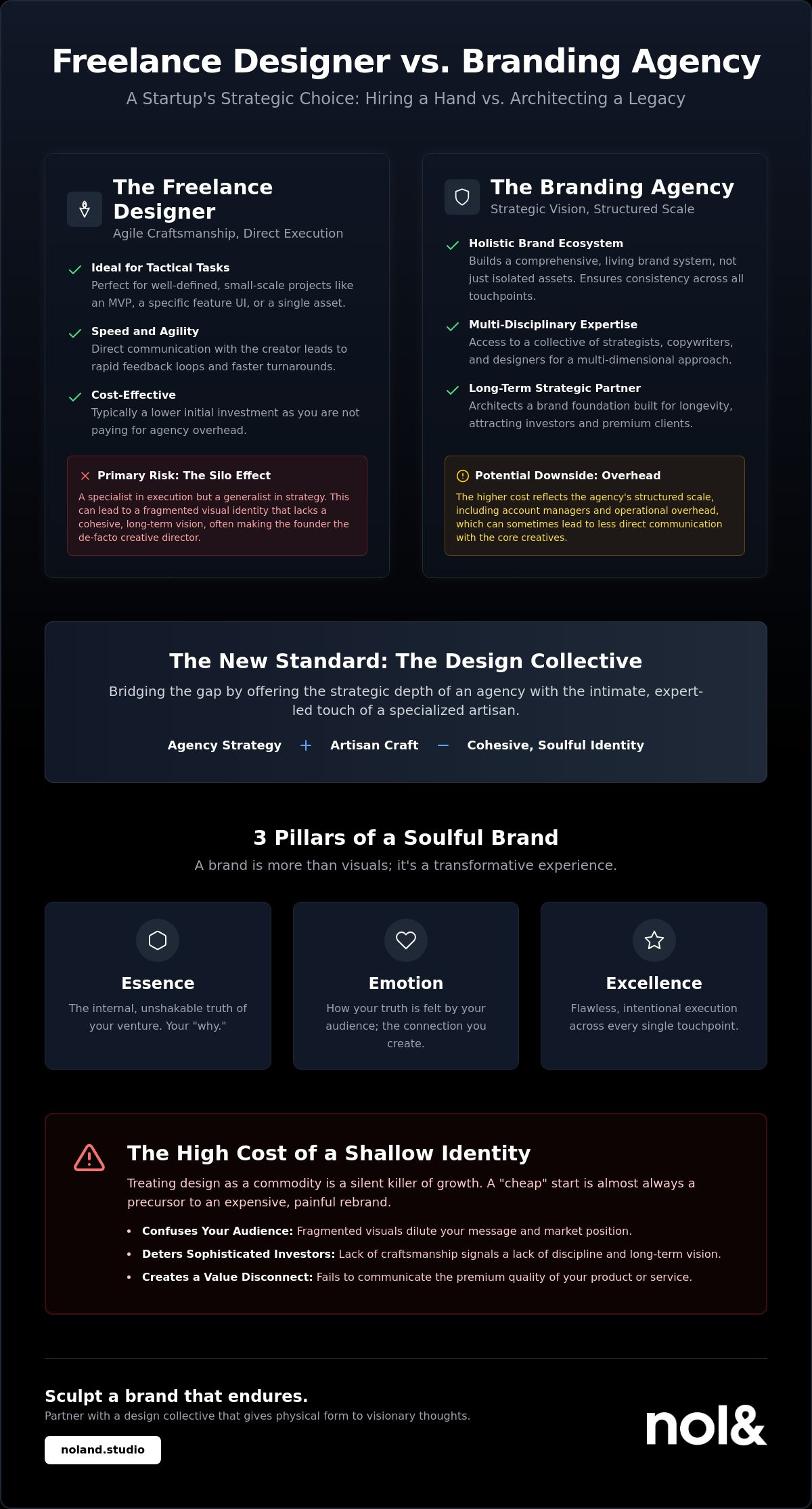
The initial friction founders face when choosing between a freelance designer vs branding agency for startups often stems from a fundamental misunderstanding of what they’re purchasing. Many view design as a commodity; a series of isolated graphic assets like a logo or a pitch deck. In reality, a brand is a living ecosystem. It’s the structural base upon which every future interaction is built. When you treat identity as a transactional task, you risk creating a fragmented presence that lacks the weight of true craftsmanship. This approach might save capital in the short term, but it fails to manifest the internal truth of your venture.
A soulful brand is anchored by three essential pillars: Essence, Emotion, and Excellence. Essence provides the internal truth of the venture. Emotion dictates how that truth is felt by the audience. Excellence ensures the execution is flawless across every touchpoint. Without these pillars, a startup remains a collection of features rather than a transformative experience that resonates with its audience.
The Cost of Shallow Identity
Choosing the path of least resistance often results in a visual disconnect that dilutes your market position. Fragmented identities don’t just look unprofessional; they actively confuse your target audience. This confusion is a silent killer of growth. For startups targeting premium sectors, shallow execution is particularly dangerous. Investors look for discernment, maturity, and vision. High-level craftsmanship signals that a founder possesses the discipline to build something of lasting value. Understanding what corporate identity entails is the first step in moving beyond mere aesthetics toward a strategic asset that inspires confidence. A “cheap” start is almost always a precursor to an expensive, painful rebrand once the market notices the lack of depth.
Defining the Scope of Your Ambition
Before committing to a partner, you must assess the horizon of your vision. Are you building for a single season, or are you architecting a decade of influence? If your ambition is to disrupt a luxury market or lead a new category, a simple logo is insufficient. You require comprehensive Brand Strategy & Positioning to give physical form to your abstract ideas. This strategic architecture serves as a bridge between your internal essence and the external world. It ensures that every digital and physical touchpoint resonates with intentionality. The choice between a freelance designer vs branding agency for startups is ultimately a question of scale. It’s about deciding whether you need someone to follow instructions or a mentor to help you define the very rules of your brand’s existence.
Hiring a Freelance Designer: Agile Craftsmanship at a Price
The allure of the individual artisan is undeniable. For many founders, the choice of a freelance designer vs branding agency for startups begins with a desire for directness, speed, and agility. You’re speaking directly to the creator. There are no account managers or layers of bureaucracy to navigate. This proximity allows for a rapid translation of ideas into visuals, often at a fraction of the cost associated with larger firms. It’s a relationship built on intimacy and immediate feedback loops.
However, this efficiency often comes with a hidden tax: the Silo Effect. A solo designer is frequently a specialist in execution but a generalist in strategy. They can craft a beautiful mark, yet they may lack the multidisciplinary oversight required to build an enduring brand ecosystem. In this scenario, the founder often becomes the de facto creative director, responsible for bridging the gap between business objectives and aesthetic output. It’s a heavy burden that requires significant discernment, organization, and time; resources that are often scarce in the early stages of a venture.
When a Freelancer is the Right Move
Solo hires excel in tactical, well-defined environments. If your objective is a low-budget MVP or a specific, small-scale task, an independent expert provides the necessary focus. To succeed here, you must vet for “digital artisans” who demonstrate a high level of craftsmanship rather than those who rely on generic templates. Success depends on your ability to set clear boundaries and provide a rigid brief. There are several key considerations for startups to weigh before making this hire, particularly regarding the complexity of the project and the internal resources available to manage the creative process.
The Risk of Fragmented Brand Evolution
The primary challenge of the solo hire is scaling. A single individual rarely possesses the expertise to master packaging, web development, and strategic positioning simultaneously. This often leads to fragmented brand evolution. While the logo may look exceptional, the Naming & Verbal Identity might feel disconnected, or the digital experience might lack the same level of refinement as the physical touchpoints. This fragmentation creates “Brand Debt,” a cumulative burden of aesthetic and technical inconsistencies that must eventually be fixed at a higher cost. For those seeking to avoid these pitfalls, exploring a more holistic design approach ensures that every element of your identity is woven into a single, seamless narrative. When the weight of managing multiple freelancers begins to overshadow the creative output, it’s a clear signal that your vision has outgrown the solo model.
The Traditional Branding Agency: Structured Scale and Its Overhead
If the freelance model is an intimate dialogue, the traditional agency is a grand symphony. It offers a structured scale that solo artisans simply cannot replicate. For founders weighing the choice of a freelance designer vs branding agency for startups, the primary draw is the multidisciplinary engine. You aren’t just hiring a designer; you’re gaining access to a collective of strategists, copywriters, and production experts who work in concert to ensure every facet of your identity is aligned. This centralized approach eliminates the “silo effect” mentioned previously, ensuring that your naming, visual system, and digital presence are born from the same strategic core.
Yet, this structured scale introduces its own complexities. Legacy agencies are often built on foundations of bureaucracy and high overhead. Startups, with their need for speed and agility, can easily feel like a small fish in a large pond when placed alongside enterprise-level accounts. The transparency gap is a common frustration; it’s often difficult to discern how much of a fixed-fee budget is fueling the creative process versus maintaining the agency’s physical office or middle management layers. Deciding on hiring an agency vs. freelancers for your startup requires a candid look at whether you value the security of a large institution over the nimble evolution of a modern studio.
The Strategic Weight of Traditional Structures
The true value of a legacy agency lies in its rigorous frameworks and market research capabilities. They provide a sense of stability when managing complex production cycles, particularly for Premium Packaging Design where technical precision is as vital as aesthetic beauty. A dedicated account management layer offers peace of mind, acting as a buffer that allows founders to step away from the daily creative grind. It’s a model designed for endurance, helping brands transition from early-stage ventures to established market leaders with a cohesive, well-documented identity.
Navigating the Overhead of Legacy Models
Efficiency can be the first casualty of traditional structures. Proposals often include “bloat” in the form of unused software licenses, expansive office space costs, and layers of supervision that don’t directly improve the work. Perhaps more concerning is the “Junior Hand-off.” While a senior visionary might pitch the project, the actual execution is frequently delegated to junior staff who lack the deep expertise promised in the initial meeting. When evaluating a freelance designer vs branding agency for startups, it’s essential to confirm that the hands doing the work possess the same level of discernment as the minds selling the vision.
The Design Collective: The New Standard for Premium Startups
The historical binary between a freelance designer vs branding agency for startups is becoming obsolete. A third path has emerged to meet the demands of the modern, visionary founder: the design collective. This model functions as a distributed network of expert digital artisans, each a master of their specific craft, working under a unified strategic lead. Unlike the fragmented nature of hiring multiple freelancers or the rigid bureaucracy of a traditional firm, a collective provides a cohesive vision directed by expert hands. It’s an evolution that prioritizes discernment, craftsmanship, and strategic depth over corporate structure.
By operating without the weight of legacy overhead, collectives reallocate resources toward senior-level talent. This allows for a unique flexibility; teams scale up or down based on the specific demands of a project’s evolution. It’s an environment where Art Direction & Content Creation thrives because the artisans aren’t confined by a single office or a narrow corporate culture. Instead, they draw inspiration from a global, multicultural network, offering a nuanced perspective that is vital for startups with international ambitions. This model ensures that the creative output is as diverse and multidimensional as the markets you aim to capture.
The Rise of Distributed Expertise
Modern collectives are at the forefront of technological integration, utilizing AI-enhanced tools not to automate creativity, but to accelerate the manifestation of complex brand identities. These tools allow for rapid 3D visualization and motion design, giving physical presence to abstract thoughts in a fraction of the time required by traditional methods. This acceleration doesn’t sacrifice excellence; it enhances the ability of the expert to refine and perfect the sensory impact of the brand. You get the strategic weight of a large firm paired with the nimble, expert-led execution of a specialized studio.
Why Premium Startups Choose Collectives
For a premium startup, the goal is to build a soulful identity that resonates on a deep, emotional level. Collectives bridge the gap between Digital Design & Web Development and tactile, physical touchpoints with seamless intentionality. You aren’t handed off to a junior team; you maintain direct access to the creative directors who are actually shaping your vision. This model ensures that the essence of your brand is preserved from the first strategic session to the final digital launch. If you’re ready to build an identity that is meant to be felt as much as it is seen, explore how our design collective can transform your vision into an enduring legacy.
Noland Studio: Sculpting Soulful Identities for Global Startups
The journey to define a brand’s essence often feels like a choice between two compromises. Founders frequently find themselves navigating the tension of a freelance designer vs branding agency for startups, searching for a partner who possesses both the intimate touch of an artisan and the strategic weight of a studio. At Noland Studio, we eliminate this friction. We operate as a design collective that practices what we call Digital Alchemy; the process of transforming abstract, visionary thoughts into tangible, multidimensional brand experiences. We don’t just create assets. We build, refine, and manifest identities that are meant to be felt as much as they are seen.
Our studio is rooted in the rich artistic heritage of Barcelona, yet our network is global and multicultural. This unique positioning serves as a bridge between timeless craftsmanship and modern innovation. We understand that a startup’s identity must be agile enough to evolve but disciplined enough to endure. By integrating high-level strategy with sensitive, expert-led execution, we help founders organize their thoughts, elevate their aesthetics, and manifest their market presence. This approach ensures that your brand carries a sense of exclusivity and intentionality from its very first interaction.
Beyond Aesthetics: Our Multidimensional Approach
We believe that a soulful brand is born from an internal truth. Our process begins with philosophical foundations, moving beyond mere visuals to uncover the core essence of your venture. We give physical form to this essence through expert-led craft, prioritizing sensory impact and aesthetic excellence at every turn. Whether we are architecting a visual system or directing a 3D visualization, our focus remains on emotional resonance. This multidimensional approach ensures that your brand doesn’t just exist in the market; it commands it. We act as a thoughtful mentor for founders who demand more than a template, providing the discernment required to build a premium legacy.
Fixed-Fee Clarity for Scaling Startups
Growth requires predictability, especially when managing the complexities of a luxury launch. We remove the friction of hourly billing by offering fixed-fee engagements that focus entirely on transformative results. This model allows us to solve the freelance designer vs branding agency for startups conflict by providing agency-level depth without the hidden costs of legacy overhead. Our comprehensive packages include everything from strategic positioning and naming to visual identity systems and premium packaging. We provide the structural base your startup needs to attract investors and resonate with premium customers. Discover how Noland Studio gives shape to visionary brands.
Architecting an Enduring Legacy
The choice between a freelance designer vs branding agency for startups isn’t merely a logistical calculation; it’s a defining moment for your venture’s soul. You’ve seen how solo artisans provide agility but often lack the strategic depth to build a cohesive ecosystem. Conversely, traditional agencies offer scale but frequently introduce bureaucratic bloat and fragmented execution. The path forward lies in choosing a partner that bridges these worlds, offering the expert-led craft of a specialist with the multidisciplinary vision of a studio. By prioritizing essence, emotion, and excellence, you ensure your identity transcends fleeting trends to become a permanent market fixture.
Noland Studio operates as a multidisciplinary design collective with global reach, specializing in luxury strategy and premium packaging. We remove the friction of traditional models through a fixed-fee approach, ensuring end-to-end brand transformation without the hidden costs of legacy overhead. Our mission is to give physical form to your most ambitious thoughts, turning abstract visions into tangible, sensory realities that attract investors and resonate with premium customers. Partner with a collective of digital artisans to manifest your brand vision.
Your vision deserves a foundation as sophisticated as the future you’re building. Trust your discernment, embrace the transformative power of high-level craftsmanship, and watch as your startup evolves into a brand that is truly felt.
Frequently Asked Questions
Is a freelance designer or a branding agency better for a seed-stage startup?
The ideal choice between a freelance designer vs branding agency for startups depends entirely on the scale of your ambition. Solo artisans are excellent for tactical, low-budget MVPs where speed is the primary driver. If your venture seeks to disrupt a premium sector or secure significant funding, a studio provides the strategic architecture required to manifest a vision that resonates with sophisticated investors and command a higher market position.
What is the average cost difference between a freelancer and a design collective?
The cost difference is fundamentally a matter of structure and long-term value. Freelancers typically bill by the hour or per task, which can lead to unpredictable expenses as the scope of your brand evolves. A design collective offers fixed-fee clarity for end-to-end luxury branding. This model provides a comprehensive structural base that prevents the long-term financial burden of fixing a fragmented or inconsistent identity later.
How do I know if my startup needs a full brand strategy or just a logo?
You require a full strategy if your venture aims to be felt as much as it is seen. A logo is a singular graphic asset; a strategy is the living ecosystem that defines your market position and emotional impact. If you’re building for longevity and seeking to attract premium customers, a strategic foundation is an essential investment that ensures your visual assets have a purposeful, internal truth.
Can a freelance designer handle high-end packaging production?
Managing high-end packaging production is a complex task that typically exceeds the capacity of a single individual. It involves technical discernment, 3D visualization, and deep material expertise. While a freelancer might design a beautiful label, a multidisciplinary team ensures the tactile experience and structural base reflect the brand’s internal essence while meeting rigorous global manufacturing and luxury standards.
What are the risks of hiring a traditional agency as a fast-moving startup?
The primary risks of traditional agencies include legacy overhead and slower communication rhythms. Startups often find themselves as smaller accounts in a large agency’s ecosystem, which can lead to delays and a lack of direct access to senior talent. This mismatch often results in a brand identity that feels corporate and clinical rather than agile, soulful, and visionary.
How does a design collective manage consistency across digital and physical touchpoints?
Consistency is maintained through a unified strategic lead who guides a network of expert digital artisans. This model ensures that every digital touchpoint and physical product is an extension of the same philosophical foundation. By centralizing the vision while decentralizing the execution, collectives achieve a level of sensory impact and aesthetic excellence that fragmented solo hires simply cannot replicate.
What should be included in a premium branding project for a startup?
A premium branding project should encompass naming, verbal identity, a visual system, and strategic positioning. For ventures in high-end sectors, it’s vital to also include art direction and premium packaging design. This holistic approach ensures every interaction is curated with intentionality, manifesting a brand that is both structurally sound and emotionally evocative to your target audience.
How does AI impact the branding process for luxury startups in 2026?
In 2026, AI acts as a catalyst for human-led craftsmanship, particularly in rapid 3D visualization and motion design. It allows experts to give physical presence to abstract thoughts with greater speed, freeing them to focus on the nuances of storytelling and aesthetic excellence. For luxury startups, this means a faster journey from initial vision to a sophisticated, market-ready identity without sacrificing quality.