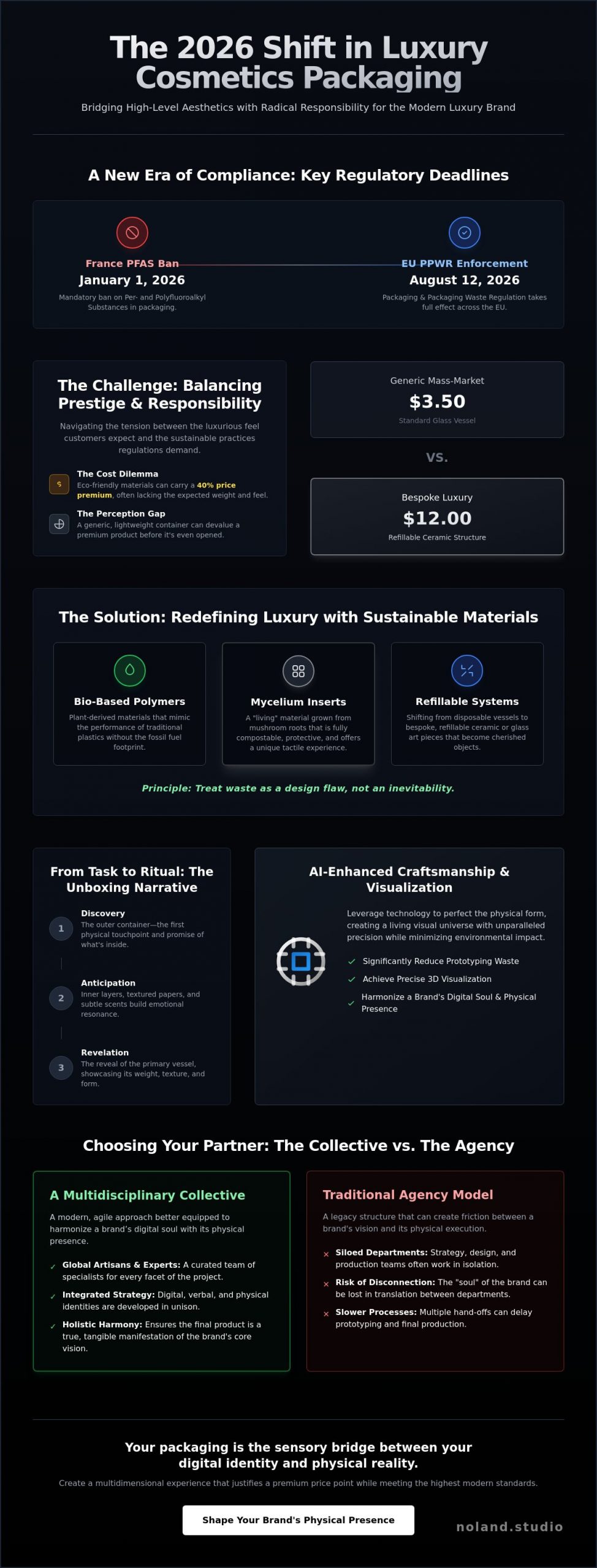
Can a brand truly claim luxury if its physical presence fails to honor the earth? With the EU’s Packaging and Packaging Waste Regulation (PPWR) taking full effect on August 12, 2026, the industry faces a pivotal shift where sustainability is no longer a choice but a legal mandate. You likely feel the tension of this transition. It’s frustrating when a $3.50 glass vessel feels generic or when eco-friendly materials carry a 40% price premium yet lack that essential, prestigious weight. You want a design that breathes, adapts, and evolves without compromising the sensory excellence your customers expect.
This article reveals how strategic luxury cosmetics packaging design bridges the gap between high-level aesthetics and radical responsibility. We’ll show you how to transform simple containers into a living visual universe that captures the heart of your brand identity. You’ll gain a clear roadmap for production that navigates the January 1, 2026 PFAS bans in France and masters the alchemy of sustainable craftsmanship. By the end, you’ll understand how to create a multidimensional experience that justifies a premium price point while meeting the highest modern standards of intelligence and judgment.
Key Takeaways
- Master the art of the unboxing ritual to transform your product’s first tangible touchpoint into a soulful narrative that resonates with exclusivity.
- Use luxury cosmetics packaging design as a strategic foundation to validate premium price points through intentionality and high-level brand positioning.
- Transition toward sustainable prestige by adopting bio-based polymers and mycelium-based inserts that treat waste as a design flaw rather than an inevitability.
- Leverage the alchemy of AI-enhanced craftsmanship and 3D visualization to create precise, living visual universes while significantly reducing prototyping waste.
- Recognize why a multidisciplinary collective of global artisans is better equipped than traditional agencies to harmonize your brand’s digital soul with its physical presence.
The Alchemy of Luxury Cosmetics Packaging Design in 2026
A brand’s vision is a silent whisper until it finally touches the customer’s hand. In the 2026 landscape, luxury packaging serves as the first tangible manifestation of that soul. It’s the precise moment where abstract strategy becomes a physical reality. The alchemy of luxury cosmetics packaging design isn’t about mere containment; it’s about shaping an experience that breathes, adapts, and evolves. We no longer view these objects as static boxes. Instead, they’re multidimensional brand universes that invite exploration through every sense. Luxury packaging is a sensory bridge between digital identity and physical reality.
This transition from task to ritual is what defines the modern unboxing experience. It’s an unfolding narrative. Every layer removed should feel like a discovery, moving the consumer deeper into the brand’s story. For a broader context on industry standards, this Cosmetic Packaging Overview highlights how materials have evolved from basic utility to high-end storytelling. By treating the unboxing as a ceremony, brands build a lasting emotional resonance that justifies their position in the premium sector. It’s a curated sequence of events designed to inspire awe and build loyalty before the product ever touches the skin.
The Psychology of Tactility
Weight and texture are the silent languages of trust. When a customer feels the substantial heft of a $3.50 glass vessel or the cool touch of a $12 ceramic limited edition, their brain registers value before the product is even applied. Haptic feedback creates an immediate sense of desire. The precise, satisfying click of a magnetic closure isn’t an accident. It’s a calculated piece of engineering that signals quality and security. These sensory cues build a foundation of prestige that visual design alone can’t achieve. They turn a simple interaction into a moment of high-level craftsmanship.
Visual Archetypes in Modern Beauty
Choosing a visual language requires deep intelligence and judgment. In 2026, we see a fascinating tension between quiet minimalism and expressive maximalism. Minimalism focuses on the clarity of form, using negative space to highlight sophisticated foundations. Maximalism uses rich textures and complex narratives to speak to the soul. Color palettes have evolved toward earth-derived jewel tones and iridescent finishes that suggest a living, breathing product. Typography acts as a silent ambassador, where every serif and stroke communicates the brand’s heritage or its visionary future. It’s through these choices that ideas take shape and brands speak the language of now.
Strategic Foundations: Packaging as a Brand Positioning Tool
Packaging is where the abstract world of ideas meets the cold reality of the shelf. It’s the ultimate test of Brand Strategy & Positioning. If the strategy says “exclusivity” but the box feels hollow or lightweight, the brand’s soul is lost in translation. In 2026, creating a cohesive luxury cosmetics packaging design requires an intentionality that flows from the core vision to the final varnish. This isn’t just graphic design; it’s the architecture of prestige. Every decision, from the choice of a $3.50 glass vessel to the specific weight of the cardstock, must validate the premium price point through physical presence.
The intersection of label design and verbal identity is where many brands falter. Every word on a bottle must earn its place, balancing poetic storytelling with strict legal compliance. While we use Naming & Verbal Identity to craft an invisible architecture of desire, we must also adhere to the FDA Cosmetics Labeling Requirements to ensure transparency and safety. This balance of the evocative and the regulatory is a form of strategic alchemy. It ensures the brand speaks with authority while maintaining the mystery that luxury demands.
Consider the case of a European heritage fragrance house that faced declining relevance in early 2025. By shifting their packaging from generic mass-market glass to bespoke, refillable ceramic structures costing approximately $12 per unit, they reclaimed their niche status. They didn’t just change a box; they reshaped their entire market position. This shift drove a 22% increase in brand sentiment within six months, proving that intentional design is a powerful tool for business evolution.
Aligning Visual Identity with Physical Form
The “living visual universe” of a brand shouldn’t stop at the screen. Consistency across touchpoints is vital. The same intelligence found in your digital presence must manifest in the grain of the paper on your vanity table. When these elements align, the brand breathes. If you’re looking to bridge this gap, our team can help you give shape to your brand’s physical soul through expert craftsmanship.
Market Positioning through Material Choice
Materials signal status with immediate clarity. In high-growth markets like the U.S., projected to reach $3.44 billion by 2035, material choice dictates whether a product is perceived as niche exclusivity or mass-prestige. Regional nuances also play a role. A brand in Barcelona might lean into minimalist, sustainable glass to meet the EU’s August 12, 2026 recycling mandates. Conversely, a brand in Bogotá might utilize vibrant, tactile foils to capture local energy and warmth. Limited editions further maintain brand heat, acting as rare artifacts in an increasingly crowded market.
Sustainable Luxury Packaging: The New Standard of Prestige
The conscious elite of 2026 no longer views opulence through the lens of excess. Instead, they seek a narrative of responsibility. In this evolving landscape, we must redefine waste as a design flaw rather than an inevitability. When a brand treats sustainability as an afterthought, it signals a lack of vision. True luxury cosmetics packaging design now integrates ethical craftsmanship into its very soul. It’s a shift from the disposable to the eternal. Circular luxury is the ultimate expression of brand longevity.
This movement is driven by both cultural desire and regulatory necessity. With the EU’s Packaging and Packaging Waste Regulation (PPWR) taking effect on August 12, 2026, the industry is rapidly moving toward mandatory recyclability. High-end brands are leading this charge by adopting bio-based polymers and mycelium-based inserts. While sustainable materials often carry a 25-40% price premium over traditional options, this investment serves as a powerful differentiator. It transforms the package from a temporary container into a statement of values that the modern consumer can feel and trust.
The Traditional vs. Sustainable Luxury Comparison
The transition to green prestige requires a sophisticated understanding of materials. We’re seeing a decisive move away from virgin plastics toward ocean-bound recycled resins that maintain a high-clarity finish. Traditional foil stamping, once the hallmark of the premium sector, is being replaced by eco-friendly metallic inks that don’t compromise recyclability. Even the concept of luxury weight is changing. Instead of heavy, multi-material components that are impossible to sort, we use lightweighting innovation and mono-materials to create a sense of presence that remains ecologically intelligent.
Innovative Sourcing and Certifications
Foundational to this new standard is the use of FSC-certified papers and plastic-free coatings that ensure every layer of the unboxing ritual is guilt-free. Refillable systems have moved from niche experiments to the “forever” bottle, where the primary vessel is a piece of art meant to be kept for decades. Transparency in the supply chain has become a luxury in itself. Approximately 20% of beauty packaging designers now utilize generative AI to optimize these sustainable structures, ensuring that every curve and closure is as efficient as it is beautiful. By prioritizing these certifications and systems, brands demonstrate a level of judgment and care that resonates far beyond the initial purchase.
The Artisan Process: AI-Enhanced Craftsmanship
True luxury is born at the intersection of human intuition and digital precision. At Noland Studio, we don’t view technology as a replacement for the artisan’s hand. Instead, we treat it as a sophisticated extension of expert judgment. In the high-stakes world of luxury cosmetics packaging design, the goal is to give shape to ideas that feel both timeless and technologically advanced. By combining our high-level vision with AI intelligence, we ensure every curve, closure, and texture is executed with surgical accuracy. This synergy allows us to move beyond standard templates, creating living visual universes that speak the language of now.
The integration of AI into our creative workflow is a strategic choice for sustainability. Approximately 20% of beauty packaging designers now utilize generative AI to explore sustainable material options, and we’ve refined this process to minimize physical waste. Through advanced 3D visualization, we perfect the interplay of light and shadow on a digital surface before a single physical prototype is ever cast. This reduces the carbon footprint of the development cycle and allows for a more disciplined, intentional approach to prototyping. It’s a form of digital alchemy where ideas take shape with minimal environmental friction.
From Abstract Idea to Tangible Reality
Our methodology unfolds in three distinct stages designed to organize, categorize, and clarify the brand’s physical manifestation:
- Step 1: Strategic Discovery. We begin by mood-boarding the ‘soul’ of the product, ensuring the foundations of the brand strategy are deeply embedded in the aesthetic direction.
- Step 2: AI-Assisted Iteration. We use digital intelligence to rapidly test structural innovations, exploring complex geometries that would be impossible to visualize through traditional sketching alone.
- Step 3: High-Fidelity Rendering. We create hyper-realistic 3D models to perfect the sensory impact of the design, ensuring the final product evokes the exact emotional response intended.
Production Management and Technical Excellence
Moving from a digital model to a physical shelf requires rigorous technical development. We coordinate with a distributed network of high-end manufacturing partners to navigate the complexities of premium finishes. Whether it’s the 15% cost addition for standard embossing or the nuances of UV coatings, we manage the technical hurdles that often dilute a brand’s vision. We ensure absolute color accuracy across different substrates, from the grain of the paper to the smooth surface of the glass. This meticulous process is further enhanced by our expertise in Art Direction & Content Creation, which ensures that the physical package performs flawlessly under the lens for launch campaigns. If you’re ready to bridge the gap between abstract vision and physical excellence, you can partner with our multidisciplinary studio to shape your brand’s future.
Choosing a Multidisciplinary Collective for Your Cosmetics Line
Traditional agencies often struggle to bridge the gap between a brand’s digital soul and its physical touchpoints. They frequently treat the screen and the shelf as separate kingdoms, which leads to a fragmented identity. This disconnect is where the emotional resonance of a premium product often dissolves into generic cardboard. A multidisciplinary collective operates differently. By integrating digital artisans with physical craftsmen, we ensure that your luxury cosmetics packaging design is a seamless extension of your brand’s core strategy. This collaborative alchemy allows ideas to take shape in a way that is both technologically savvy and guided by expert hands.
At Noland Studio, we build brands that breathe, adapt, and evolve. We don’t just design boxes; we curate identities meant to be felt as much as they are seen. This approach is vital in a global luxury packaging market projected to reach USD 18.27 billion by late 2026. As the definition of luxury moves from mere aesthetics to deep-rooted values, your packaging must serve as a living visual universe that speaks to the conscious consumer. It’s about creating a multidimensional experience that justifies a premium position through every layer of the unboxing ritual.
The Global Perspective, Locally Delivered
Our creative hubs in Barcelona and Valencia provide a unique vantage point that blends European heritage with a visionary, global outlook. This multicultural sensibility is essential for brands planning international launches in 2026. We understand that a luxury aesthetic in one region may require a sensitive, local touch in another. To provide clarity and discipline, we utilize customized fixed-fee contracts for end-to-end projects. This ensures that the roadmap from concept to shelf is transparent, allowing you to focus on the evolution of your brand while we handle the technical foundations and artisan coordination.
Building a Living Visual Universe
Packaging is the foundation for future digital experiences. It’s no longer just a static object. By 2030, the global AI in beauty market is expected to reach $13.34 billion, and packaging is the primary gateway for this intelligence. We integrate smart features like NFC tags, which currently range from $0.80 to $2.50 per unit, to offer interactive rituals and verify authenticity. These elements ensure your brand story remains soulful at every scale, from the smallest vial to the largest display. The physical package becomes a portal into your brand’s wider universe.
The time has come to move beyond the ordinary. Transform your vision into a tangible luxury reality that resonates with the language of now. We invite you to partner with us to shape a brand identity that is as enduring as it is evocative. Let’s give shape to your ideas together. Aloha.
Shaping the Future of Sensory Excellence
The journey from an abstract vision to a physical artifact requires more than just design skill; it demands a form of alchemy that honors both the planet and the senses. We’ve explored how luxury cosmetics packaging design has evolved into a strategic foundation that validates premium positioning through intentionality. By embracing circular luxury and treating waste as a design flaw, brands ensure their longevity in a market where the cosmetics and fragrance segment now accounts for 51% of the luxury packaging share. This evolution thrives on the synergy of AI-enhanced precision and the sensitive touch of expert hands.
Noland Studio stands at this intersection as a multidisciplinary collective of global artisans. We provide the fixed-fee transparency needed for complex branding projects, ensuring your roadmap from concept to shelf is disciplined and clear. Our expertise in sustainable prestige allows your brand to breathe, adapt, and evolve within a living visual universe that captures the heart of your audience. It’s time to move beyond the static and embrace a multidimensional brand experience.
Give shape to your luxury vision with Noland Studio and transform your soulful ideas into a tangible reality. Your brand’s most evocative chapter is waiting to unfold. Aloha.
Frequently Asked Questions
What defines luxury cosmetics packaging design in 2026?
Luxury cosmetics packaging design in 2026 is defined by the intersection of legal compliance and sensory ritual. It isn’t just about aesthetics. It’s about a brand’s commitment to the August 12, 2026 EU packaging regulations while maintaining a soulful unboxing experience. This multidimensional approach ensures that every physical touchpoint justifies the premium price through intentionality and high-level craftsmanship.
How can I make my luxury packaging sustainable without losing the premium feel?
You achieve sustainability through sustainable luxury by redefining waste as a design flaw. Use bio-based polymers or mono-materials that offer the same weight and clarity as virgin plastics. Since sustainable materials often carry a 25-40% premium, the value is reclaimed through brand loyalty and compliance with 2030 recyclability mandates. It’s about choosing materials that breathe and evolve with the brand’s vision.
What are the most popular materials for high-end beauty packaging right now?
Current favorites include high-end ceramics for limited editions and ultra-clear glass vessels. With the global luxury packaging market expected to reach USD 25.71 billion by 2033, brands are investing in materials that provide a substantial sensory experience. We also see a rise in mycelium-based inserts and ocean-bound recycled resins that maintain a prestigious finish without the environmental cost of traditional plastics.
How does the unboxing experience affect brand loyalty in cosmetics?
The unboxing experience acts as a ritual that bridges the gap between digital identity and physical reality. It’s a critical moment of transformation where the customer first feels the brand’s soul. By creating a narrative of unfolding, you build an emotional resonance that standard packaging cannot match. This sensory impact directly influences repeat purchases and long-term brand advocacy in a crowded market.
What is the difference between primary and secondary packaging in luxury design?
Primary packaging is the vessel that holds the product, such as a glass jar or a ceramic bottle. Secondary packaging refers to the outer box or sleeve that protects the primary container and provides the canvas for the unboxing narrative. In luxury design, both must work in harmony to organize and clarify the brand’s visual universe while meeting strict labeling requirements for the 2026 market.
How long does the design and production process for custom packaging usually take?
A comprehensive design and production cycle typically spans 6 to 12 months. This timeline accounts for strategic discovery, AI-assisted iterative design, and the technical development required for high-end finishes. It also allows time to ensure compliance with the July 31, 2026 fragrance allergen declaration rules. These regulations require precise updates to ingredient lists and labels to maintain transparency and consumer safety.
Can AI really help in the design of luxury physical goods?
AI serves as a powerful mentor and creative partner for human artisans. Approximately 20% of beauty packaging designers use generative AI to create sustainable options and detect defects with 99% accuracy. We use it to perfect 3D visualizations and motion design. This ensures that every idea takes shape with minimal physical waste during the early prototyping stages while maintaining surgical precision.
Why is material tactility so important for premium skincare brands?
Tactility is the silent language of trust for premium skincare. The weight of a jar or the cool touch of ceramic provides immediate haptic feedback that signals quality to the brain. For high-end brands, these sensory cues are essential foundations that build desire. They turn a simple interaction into a moment of high-level craftsmanship that the customer can feel and trust.