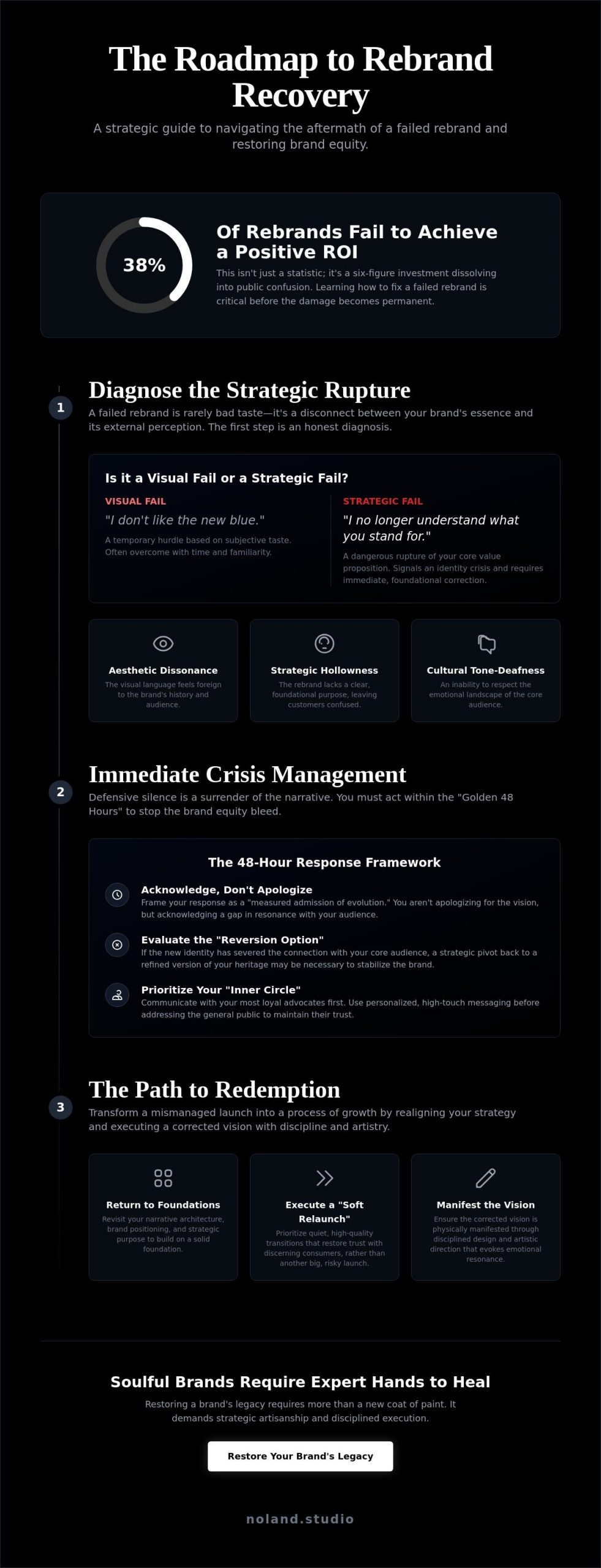
A study tracking 614 rebranding campaigns through 2025 found that 38% of rebrands fail to achieve a positive return on investment. This statistic often masks a deeper pain, the sound of a six-figure investment dissolving into public ridicule and internal confusion. If you’re watching your brand equity erode after a launch, you’re likely searching for how to fix a failed rebrand before the damage becomes permanent. It’s a heavy burden to carry, especially when the visual identity you’ve built no longer resonates with the discernment of your audience.
We understand the sting of social media backlash and the quiet frustration of a team that’s lost its sense of direction. You don’t have to let a strategic rupture define your future. You’ll learn how to diagnose the disconnect, stabilize your reputation, and realign your brand identity through strategic artisanship and disciplined execution. This guide provides a clear roadmap to restore trust among your core luxury consumers. We’ll explore how to transform a mismanaged launch into a process of growth, organization, and refinement that secures your legacy for 2026.
Key Takeaways
- Identify the specific dissonance between your internal essence and external perception to move beyond superficial aesthetic fixes.
- Navigate the “Golden 48 Hours” of brand recovery by choosing a measured admission of evolution over the risks of defensive silence.
- Master the strategic steps of how to fix a failed rebrand by returning to your foundational narrative architecture, refined positioning, and strategic purpose.
- Execute a “Soft Relaunch” that prioritizes quiet, high-quality transitions to restore trust among your most discerning luxury consumers.
- Ensure your corrected vision is physically manifested through disciplined digital design and artistic direction that evokes emotional resonance.
The Anatomy of a Failed Rebrand: Diagnosing the Strategic Rupture
A failed rebrand is rarely a matter of bad taste. It’s a strategic rupture where the physical manifestation of the brand no longer mirrors its soulful essence. To understand what is rebranding at its most fundamental level, one must see it as a process of evolution, organization, and refinement. When these pillars crumble, the brand enters a state of crisis. Learning how to fix a failed rebrand begins with an honest diagnosis of the misalignment between your internal truth and external perception.
Most failures fall into three distinct modes. Aesthetic dissonance occurs when the visual language feels foreign to the brand’s history. Strategic hollow-ness happens when a change lacks a foundational purpose. Cultural tone-deafness is the inability to respect the emotional landscape of your audience. These errors often lead to Brand Dysmorphia, a condition where a brand attempts to wear a skin that doesn’t fit its heritage. It’s a painful disconnect that leaves long-term clients feeling abandoned and new ones feeling confused.
Luxury brands face a prestige tax that makes these errors ten times more costly. In the high-end sector, consistency is the currency of trust. When a legacy house adopts a generic identity, it sacrifices the very exclusivity that fuels its value. It’s not just a loss of sales; it’s a loss of soul. Recovery in this space requires more than a new coat of paint. It requires a return to the expert hands that understand the weight of storytelling and sensory impact.
Is it a Visual Fail or a Strategic Fail?
Subjective dislike of a logo is often a temporary hurdle. A strategic fail is far more dangerous. It’s the difference between a client saying “I don’t like the new blue” and “I no longer understand what you stand for.” Take the Gap’s 2010 refresh. By trading its iconic visual heritage for generic modernity, the brand signaled it had lost its way. It wasn’t just an ugly logo; it was an identity crisis. You must determine if your failure is purely communicative or if the underlying value proposition has been compromised.
The 2026 Brand Audit: Measuring the Damage
Quantifying the rupture requires a modern approach to sentiment analysis. Look beyond the vocal minority on social media to identify Brand Equity Leakage in your most profitable segments. Is the backlash coming from your core luxury consumers or casual observers? More importantly, assess internal stakeholder alignment. If your team has stopped believing in the vision, the brand cannot heal. A successful recovery requires a disciplined audit of your narrative, your visuals, and your internal culture. This is the first step in understanding how to fix a failed rebrand at scale.
Immediate Crisis Management: Stopping the Brand Equity Bleed
When a rebrand falters, the initial impulse is often defensive silence. This is a mistake. In the high-stakes world of luxury, a void is quickly filled by the loudest, most critical voices. Silence isn’t golden; it’s a surrender of the narrative. To master how to fix a failed rebrand, you must act within the “Golden 48 Hours.” This window isn’t for a full retreat, but for a measured, sophisticated admission of evolution. You aren’t apologizing for your vision; you’re acknowledging a gap in resonance.
One of the most critical decisions is evaluating the “Reversion Option.” Should you go back to the old identity or stay the course? As seen in the classic Tropicana rebranding case study, the failure to respect a consumer’s emotional bond can lead to immediate revenue loss. If the new identity has fundamentally severed the connection with your core audience, a strategic pivot back to a refined version of your heritage may be the only way to stabilize the foundation. Radical transparency is your greatest asset here. Admitting the process was flawed without devaluing the brand’s worth preserves your integrity among high-net-worth customers who value discernment over perfection.
Communication must prioritize your “Inner Circle” first. These are your most loyal advocates, the ones who feel the brand’s essence most deeply. Reach out with personalized, high-touch messaging before addressing the general public. If you find your brand in this precarious position, a refined Brand Strategy & Positioning audit can provide the necessary clarity to move forward with intention.
The 48-Hour Response Framework
A successful recovery relies on a triad of actions: Acknowledge, Contextualize, and Invite. First, validate the customer’s emotional connection to the previous identity. It shows you’re listening. Second, explain the intent behind the change. Why did you choose to evolve? Avoid excuses; focus on the vision. Finally, invite your audience to be co-curators. Create a feedback loop where their expertise is valued. This transforms critics into stakeholders in the brand’s future.
Stabilizing Internal Morale
Internal misalignment is a silent killer of brand recovery. You must keep your digital artisans and creative teams focused while the public storm rages. Re-affirm the core mission to the internal collective to prevent talent churn. Your team needs to know that the failure was a strategic rupture, not a lack of craftsmanship. Brief your customer-facing teams with clear, sophisticated scripts. They are the frontline curators of your reputation, and they must handle premium client inquiries with confidence, intelligence, and grace.
Strategic Realignment: Moving Beyond Cosmetic Fixes
Correcting a misstep in the luxury sector requires a return to the brand’s foundational narrative architecture. A failed rebrand isn’t a surface wound; it’s a structural failure where the brand’s physical manifestation has lost its soulful essence. When exploring how to fix a failed rebrand, the solution rarely lies in another loud announcement. Instead, it’s about re-evaluating your Brand Strategy & Positioning to identify exactly where the strategic rupture occurred. In 2026, sophisticated brands don’t guess. They use AI-enhanced sentiment tools to quantify the lost essence the audience is mourning, allowing for a recovery built on data rather than intuition.
The recovery process relies on a synchronized triad: Vision, Voice, and Visuals. If these elements aren’t aligned, the brand will continue to feel disjointed. Research shows that 38% of rebranding campaigns between 2022 and 2025 failed to achieve a positive ROI, primarily due to misaligned strategy and insufficient consumer testing. To reverse this, you must look beyond the aesthetic. You’re not just changing a logo; you’re rebuilding a structural base that supports your long-term legacy. This requires a disciplined, intelligent approach that prioritizes human-centric discernment over automated trends.
Refining the Verbal Identity
Often, the visual system takes the blame when the true culprit is the Naming & Verbal Identity. If your brand’s voice feels too corporate or detached, it will fail to resonate with a soulful audience. Auditing your tone of voice is essential. You must craft a “Correction Narrative” that feels like a natural evolution rather than a retreat. This narrative shouldn’t apologize for the brand’s existence, but rather clarify its purpose, ensuring the language you use carries the artistic weight your premium clients expect.
Visual Recalibration
You don’t always need a total “re-rebrand” to find success. Often, the bridge between the old and new lies in subtle Art Direction & Content Creation. By adjusting the visual system through expert art direction, you can soften the blow of a harsh redesign. For luxury goods, the importance of tactility and sensory impact cannot be overstated. Whether it’s the weight of physical packaging or the rhythm of a digital interface, every touchpoint must reflect a corrected strategy that feels intentional, exclusive, and deeply rooted in excellence.
The Path to Redemption: Executing the Corrected Vision
Executing a recovery requires a fundamental shift from the performative to the substantive. If the initial failure was a loud, misaligned explosion, the solution is a quiet, precise restoration. A “Soft Relaunch” strategy allows the brand to heal in real-time, replacing friction with flow. This approach prioritizes high-quality rollouts over second chances at a “big bang” announcement. Understanding how to fix a failed rebrand in 2026 means recognizing that your audience values consistency and depth over grand gestures.
Your digital presence acts as the living visual universe of your brand. It’s essential that your Digital Design & Web Development reflects the corrected strategy across every touchpoint. A well-executed rebrand can lead to a 10% to 20% increase in revenue by attracting higher-paying customers and improving retention, according to research published in May 2026. To reach these figures after a setback, you must implement rigorous “Brand Guardianship.” This involves setting up systems, protocols, and internal benchmarks that prevent future strategic drift, ensuring your identity remains a faithful manifestation of your essence.
The Distributed Expert Advantage
Traditional agencies often struggle to fix their own mistakes because they remain tethered to the original, flawed logic. Bringing in a multidisciplinary design collective offers a fresh, objective perspective. These global artisans provide the localized nuance needed to prevent tone-deafness in international markets. By moving away from rigid corporate structures, you gain access to a sensitive, expert-led craft that prioritizes human-centric discernment over mere automation.
Building for Longevity
Longevity is built through growth, organization, and refinement. You must create a “living” brand book that allows for evolution without future ruptures. This isn’t a static document but a dynamic guide that grows with the company. Training your internal teams on the refined brand essence ensures that the identity is felt as much as it is seen. Consider establishing a “Luxury Advisory Board” composed of your most loyal customers. Their insight acts as a bridge between your abstract ideas and the physical world of your products, securing your place in the premium market for years to come.
If you’re ready to realign your vision with an identity that resonates, explore our Visual Identity Systems to begin your recovery.
Why Soulful Brands Require Expert Hands to Heal
A brand is a living entity, an intricate tapestry woven from history, emotion, and strategic intent. When this tapestry is torn by a mismanaged identity shift, the repair cannot be found in a generic template. Knowing how to fix a failed rebrand requires a return to the intersection of luxury and strategic purpose. It’s a process that demands the sensitivity of an artist and the discipline of a strategist. Learning how to fix a failed rebrand is not about erasing the past, but about demonstrating the strength to evolve with grace. At Noland Studio, we act as curators of identities that are meant to be felt as much as they are seen, positioning ourselves as the bridge between a fractured present and a visionary future.
The antidote to a generic, uninspired rebrand is the integration of high-level craftsmanship with a profound strategic vision. In an era where automation often replaces artistry, we prioritize human-centric discernment. Our distributed network of global digital artisans provides the localized touch and multicultural expertise necessary to navigate complex brand recoveries. We don’t just offer services; we offer a transformative process where abstract concepts take on a physical presence. This expert-led craft ensures that your brand’s evolution feels intentional, exclusive, and deeply rooted in excellence.
Restoring a reputation in the luxury sector is a multidimensional challenge. It involves more than just visual corrections; it requires a deep alignment of internal essence and external perception. By focusing on longevity and emotional resonance, we help brands move beyond fleeting trends to achieve an enduring impact. This measured pace is vital for high-end sectors where time and consideration are valued over quick, transactional interactions. Ultimately, a rebrand is a promise made to your audience, but a successful recovery is a demonstration of character and commitment to your core values.
The Noland Method of Brand Transformation
Our approach is centered on giving physical form to abstract thoughts with absolute intentionality. We move beyond the superficial, focusing on premium sustainable packaging and immersive digital experiences that resonate through every sense. Whether we’re refining your visual system or correcting your verbal identity, every action is a step toward building a structural base that supports your legacy. We invite you to give shape to your brand vision with Noland Studio and transform your strategic rupture into a narrative of growth, organization, and refinement.
Restoring Your Legacy with Strategic Intent
A strategic rupture in your brand identity doesn’t have to be a permanent failure. By diagnosing the disconnect between your internal essence and external perception, you can begin the disciplined process of recovery. We’ve explored the necessity of the Golden 48 Hours, the refinement of verbal identity, and the quiet power of a soft relaunch. Understanding how to fix a failed rebrand is ultimately a journey of returning to your brand’s soulful essence through expert-led craft and visionary alignment.
Success in the luxury and premium sectors requires more than just a visual refresh; it demands a demonstration of character. Our multidisciplinary collective provides an objective strategic vision that traditional agencies often miss. With a global perspective and a sensitive, localized touch, our expert digital artisans give physical form to your most abstract ideas. It’s time to transform your brand’s current friction into a steady, intentional flow that resonates with your core audience. You don’t have to navigate this transition alone. Partner with Noland Studio to realign your brand strategy and secure your place in the future of luxury. Your brand’s greatest evolution is still within reach.
Frequently Asked Questions
Should we immediately go back to our old logo if the rebrand fails?
Reversion is a strategic choice, not a panic response. If the new identity has fundamentally severed the emotional bond with your core luxury consumers, returning to a refined version of your heritage may be necessary. However, a total retreat can signal a lack of vision. You must evaluate if the failure is purely visual or deeply strategic before deciding to revert or stay the course.
How much does it typically cost to fix a failed rebrand in 2026?
The cost of recovery depends on the scale of the strategic rupture and the complexity of the assets involved. Fixing a large-scale brand requires auditing current systems, realigning internal teams, and carefully transitioning customers, which is a resource-intensive process. While foundational strategy and visual identity systems require significant investment, the true price is found in the time and consideration needed to restore trust.
How do we know if the backlash is just “resistance to change” or a genuine failure?
Resistance to change is often vocal but fleeting; a genuine failure is marked by a loss of clarity among your most discerning clients. Use sentiment analysis to quantify the backlash beyond the vocal minority. If the critique targets your brand’s core values or its internal essence, you’re likely facing a strategic rupture that requires a disciplined roadmap for correction rather than a cosmetic fix.
Can a failed rebrand actually be turned into a positive PR opportunity?
Radical transparency can transform a crisis into a demonstration of character and commitment. By acknowledging the disconnect and inviting your audience to be co-curators of the recovery, you build a deeper level of trust. This transparency shows that the brand is guided by expert hands and remains sensitive to the emotional landscape of its community, turning a misstep into a story of evolution.
What are the first three steps to take when we realize a rebrand is failing?
First, initiate a measured admission of evolution within the Golden 48 Hours to control the narrative. Second, conduct a deep brand audit to identify where the internal essence and external perception diverged. Third, prioritize your inner circle of loyal clients with personalized communication. These steps stabilize your reputation while you determine how to fix a failed rebrand through strategic realignment and execution.
How do we prevent internal team burnout during a brand crisis?
Re-affirming the core mission is vital for maintaining morale among your digital artisans and creative teams. Provide clear, sophisticated scripts for customer-facing teams so they can handle premium client inquiries with confidence and grace. When the internal collective understands that the failure is a strategic challenge to be solved through refinement rather than a lack of talent, they remain focused on the transformation.
Is it possible to fix a rebrand without hiring a new agency?
It’s possible, but the original agency may be too close to the failure to offer an objective vision. A multidisciplinary design collective brings a fresh, global perspective and a sensitive, localized touch. These experts act as curators who can identify the specific failure modes, such as aesthetic dissonance or strategic hollow-ness, that the original team might overlook during the high-pressure recovery process.
How does AI help in diagnosing a failed brand strategy?
In 2026, AI-enhanced sentiment tools provide the data needed to quantify the lost essence your audience is mourning. These systems analyze complex emotional landscapes across global markets to find exactly where the narrative architecture failed. This allows for a recovery built on discernment and expertise, ensuring that the corrected strategy resonates through emotion and aesthetic excellence rather than mere automated trends.