The most valuable asset in your fleet isn’t the aircraft; it’s the invisible architecture of trust that justifies its flight. Many founders recognize that branding for a private aviation company has devolved into a predictable sea of navy blue and gold foil clichés. You’ve likely felt the disconnect when a sophisticated digital booking platform leads to a physical cabin experience that lacks the same intentionality. It’s difficult to command premium pricing when your visual identity doesn’t mirror the high-level craftsmanship of your service.
We understand that your clients don’t just buy a seat; they invest in the curation of time, safety, and status. This article shows you how to transcend the corporate jet stereotype by building a multidimensional brand that resonates with the world’s most discerning travellers. We’ll explore how to refine your positioning, organize your visual systems, and manifest a cohesive identity across every touchpoint. By the end, you’ll have a clear blueprint for a brand that attracts ultra-high-net-worth individuals through expert-led craft and emotional resonance.
Key Takeaways
- Learn to transcend industry clichés by shifting your focus from the physical aircraft to the internal essence of the passenger’s journey and trust.
- Discover how to utilize strategic archetypes and the “Quiet Luxury” movement to command authority and resonance with the world’s most discerning travellers.
- Explore how comprehensive branding for a private aviation company ensures a fluid transition between high-performance digital platforms and the tactile reality of the cabin.
- Master the creation of a visual identity system that maintains its structural integrity and aesthetic weight across both global digital interfaces and physical touchpoints.
- Identify the strategic value of naming and verbal identity in shaping expectations and manifesting a sense of exclusivity before the flight even begins.
Beyond the Tail Fin: The Multi-Dimensional Nature of Aviation Branding
Effective branding for a private aviation company transcends the application of a logo on a tail fin. It’s the intentional orchestration of a total sensory experience. Think of it as the architecture of a journey. It begins long before the engines start. It lives in the weight of a physical invitation, the responsiveness of a digital interface, and the curated atmosphere of the cabin. We don’t just design symbols; we build structural bases for trust. This process transforms abstract concepts like safety and speed into a physical manifestation of excellence that passengers can feel. When done correctly, branding becomes the invisible thread that connects strategy, emotion, and aesthetic precision.
The Currency of Trust in the Skies
In high-altitude luxury, trust is the primary currency. It’s the foundation upon which every interaction is built. While safety credentials are non-negotiable, they must be wrapped in aesthetic excellence to truly build confidence. A brand that appears neglected or uninspired suggests a similar lack of discernment in its operations. Modern aviation identities must balance the weight of heritage with the energy of innovation. Branding acts as a surrogate for the physical experience. It’s a promise of the care, organization, and refinement that await. The evolution of the business jet has moved from a purely corporate tool into a sanctuary of high-level craftsmanship where the brand serves as a guardian of the passenger’s peace of mind.
From Utility to Lifestyle: The New Narrative
The industry is witnessing a profound shift. We’re moving away from utility-based travel toward lifestyle-oriented narratives. It’s no longer just about getting from one point to another. It’s about arriving in a better state than when you departed. This transformation requires a deep understanding of the ultra-high-net-worth individual’s desire for “Invisible Service.” This is a branding element that passengers feel rather than see. It’s the silent anticipation of their needs, the seamless flow of their itinerary, and the emotional resonance of the environment. Branding for a private aviation company must now speak to the soul, not just the schedule. Aviation branding is the intersection of engineering, hospitality, and art. It requires a disciplined, intelligent approach to storytelling that prioritizes sensory impact over fleeting trends.
Strategic Positioning: Defining Your Territory in the Skies
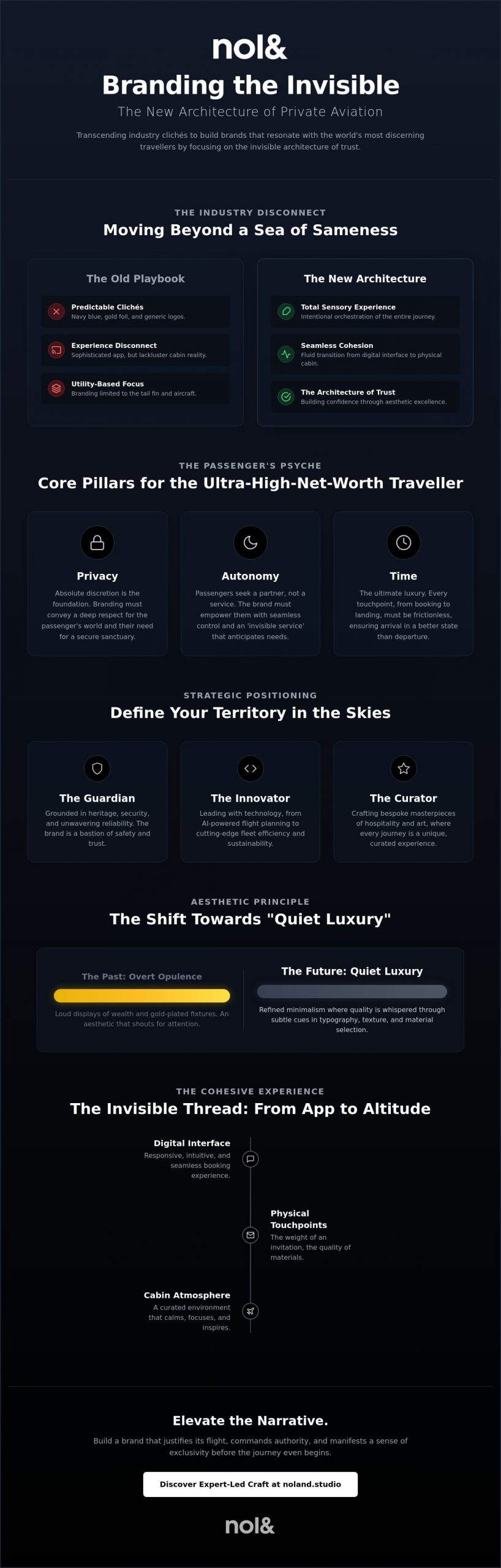
Branding for a private aviation company requires a departure from the generic. To command authority, you must decide which strategic territory you occupy. Most companies fail because they attempt to be everything to everyone, resulting in a diluted identity that fails to resonate. Instead, we look to core archetypes to ground the brand. Are you The Guardian, focusing on the pillars of heritage, security, and unwavering reliability? Perhaps you are The Innovator, leading the charge with AI-powered flight planning and modern fleet efficiency. Or you might be The Curator, where every journey is a bespoke masterpiece of hospitality and art. Establishing this archetype allows your identity to transcend mere logistics and become a strategic vessel for your vision.
The Psychology of the Ultra-High-Net-Worth Passenger
Discerning travellers value three core pillars: privacy, autonomy, and time. They don’t seek a service; they seek a partner that understands their internal essence. Effective Brand Strategy & Positioning is about giving shape to these soulful luxury visions, ensuring every touchpoint respects the passenger’s desire for absolute discretion. Designing for the ‘segment of one’ means your brand must feel as if it were built specifically for their world. This level of personalization is not a feature; it’s a brand pillar that justifies premium positioning and fosters long-term loyalty.
Quiet Luxury vs. Overt Opulence
The era of gold-plated fixtures and loud displays of wealth is fading. Modern private jet travel trends suggest a pivot toward “Quiet Luxury.” This is an aesthetic of refined minimalism, where quality is whispered through subtle cues in typography, texture, and material selection. Sustainability has also become a cornerstone of premium branding. As European hubs mandate a 10% Sustainable Aviation Fuel (SAF) blend in 2026, brands that integrate these environmental standards into their narrative signal a higher level of global discernment. It’s about a commitment to longevity and responsibility that resonates with the modern UHNWI’s values.
Finding ‘blue ocean’ space in the clouds requires a rigorous competitive audit. Most competitors linger in the safe, saturated territory of corporate blue and navy. To stand out, you must align your internal culture with your external promises. Your ground crew, your digital platform, and your flight operations must all breathe the same brand spirit. When the internal essence matches the external manifestation, you create an unbreakable bond of trust. If you’re ready to explore how your identity can command greater authority in this evolving market, discovering our approach to Visual Identity Systems can provide the necessary structural base for your transformation.
Visual and Verbal Artisanship: Crafting the Sensory Experience
Branding for a private aviation company is a multidimensional process of giving physical form to abstract luxury. It isn’t enough to possess a fleet of high-performance aircraft; those assets must be housed within a sensory framework that communicates expertise and intentionality. We view this as a form of craftsmanship where every touchpoint, from the digital interface to the cabin interior, acts as a building block for an enduring legacy. True differentiation lies in the intersection of visual precision and verbal resonance, creating an atmosphere that is felt as much as it is seen.
Naming and Verbal Identity: The Language of the Elite
Words are the invisible architecture of your brand. They define the passenger’s expectations before they ever set foot in the terminal. Utilizing a sophisticated Naming & Verbal Identity allows a company to move beyond clinical corporate-speak. Instead, the voice should adopt the persona of a curated mentor: knowledgeable, disciplined, and deeply attentive. When naming a fleet or a service tier, avoid transactional language. Terms should evoke a sense of journey, transformation, and refinement. This verbal strategy ensures that your brand speaks the language of discernment, positioning your services as a bespoke experience rather than a mere commodity.
Visual Systems: Consistency Across Altitudes
The challenge of modern aviation branding is maintaining structural integrity across vastly different scales. Your visual system must command authority on the side of a large-cabin jet and remain legible on a six-inch smartphone screen. This requires typography that balances modern performance with timeless elegance, avoiding fleeting trends in favor of longevity. Color psychology plays a vital role here. While navy and silver are industry standards, we explore palettes that evoke deep calm and exclusivity, such as muted earth tones or charcoal metallics. In attracting the next generation of private flyers, visual storytelling must be both technologically savvy and guided by expert hands. We use 3D visualization to preview these brand environments, ensuring that every texture and light source aligns with the overarching strategy.
Tactile prestige serves as the final, physical manifestation of the brand journey. It’s the weight of the cardstock used for boarding passes, the grain of the leather in the cabin, and the curated layout of the in-flight menu. These elements shouldn’t be secondary thoughts. They are essential components of a cohesive identity that reinforces premium pricing. By organizing these sensory details into a unified system, a private aviation brand becomes a sanctuary of high-level craftsmanship, standing apart in a saturated market.
The Digital Hangar: Seamless Experiences from App to Altitude
For the modern traveller, the journey doesn’t begin on the tarmac. It starts on a screen. Branding for a private aviation company must extend its structural integrity into the digital realm, treating the app or website as the first ‘cabin’ the passenger enters. If the interface feels clunky or utilitarian, the promise of a refined physical experience is immediately undermined. High-performance booking platforms shouldn’t sacrifice aesthetic excellence for functionality. Instead, they should manifest the same expert-led craft found in the aircraft’s interior. This digital hangar is where you build the structural base for the entire flight journey, ensuring that the transition from a smartphone screen to a 30,000-foot altitude is entirely seamless.
Immersive Digital Platforms
Digital presence is no longer a static brochure; it’s a living visual universe. Effective Digital Design & Web Development is critical for charter brokers who need to balance complex logistics with sensory delight. In 2026, as AI-powered flight planning becomes the industry standard, these tools must remain human-centric. They prioritize discernment and expertise over mere automation. Speed and security are the foundations, but the emotional resonance comes from an interface that adapts to the user’s needs in real-time. Every click and transition should feel like a guided tour through a curated space, reflecting a brand that is both technologically savvy and deeply disciplined.
The Post-Booking Journey
The space between booking and boarding is a strategic opportunity to deepen trust. You can use digital tools to provide ‘anticipatory service,’ managing expectations through intentional storytelling and real-time updates. Motion design plays a vital role here. A simple status update can be elevated into a brand moment through fluid, descriptive transitions that mirror the grace of flight. This isn’t just about transmitting information; it’s about maintaining the narrative of exclusivity. By connecting the app experience directly to in-flight entertainment and service preferences, you ensure that the brand’s internal essence is felt long before the passenger reaches the airfield.
Consistency across these touchpoints distinguishes a global expert from a standard operator. When your digital design reflects the same level of craftsmanship as your physical fleet, you command a level of authority that justifies premium positioning. It’s about creating a cohesive identity that feels intentional at every altitude. If you’re ready to evolve your digital presence into a transformative brand asset, explore our Digital Design & Web Development services to begin your transformation.
Elevating the Narrative: Why Noland Studio for Private Aviation
Branding for a private aviation company requires more than a visual facelift; it demands a partner that understands the weight of a legacy. Noland Studio operates as a multidisciplinary collective, bridging the gap between abstract strategic thought and the physical reality of luxury products. We don’t believe in fleeting trends. Instead, we focus on building structural bases for soulful brands that resonate through emotional depth and aesthetic excellence. Our role is that of a thoughtful mentor and a sophisticated creator, guiding your identity from its internal essence to its global manifestation. In a sector defined by precision, branding for a private aviation company is the invisible thread that connects engineering, hospitality, and art.
Traditional agency models often struggle with the agility required in the high-altitude luxury sector. By utilizing a distributed network of digital artisans, we provide a level of expertise that remains guided by expert hands while staying technologically savvy. This model ensures that every aspect of your brand, from the digital interface to the physical cabin touchpoints, receives the attention of a dedicated specialist. We act as curators of identities that are meant to be felt as much as they are seen, ensuring your vision takes on a physical presence that commands authority.
The Expert Artisan Advantage
Our approach to Art Direction & Content Creation is rooted in the belief that a brand should be a living visual universe. We don’t just produce assets; we shape narratives that endure. In an industry that demands endurance, our commitment to longevity ensures your brand remains relevant as fleet technologies and passenger preferences evolve. This distributed expert network allows us to maintain a high-level vision while providing the sensitive, localized touch that global aviation brands require.
Transforming Vision into Reality
The Noland Studio process is a journey from philosophical foundations to strategic implementation. We begin by identifying the internal essence of your service, organizing its core values, and refining its visual expression. This disciplined approach transforms abstract visions into tangible realities that command trust. We invite visionary leaders in the aviation sector to move beyond saturated clichés and build a multidimensional identity that truly reflects their craftsmanship. Connect with Noland Studio to define your brand’s competitive altitude.
Manifesting Your Future in the Skies
Transcending the corporate jet cliché requires a disciplined approach to both strategy and sensory impact. We’ve explored how a cohesive identity must bridge the gap between the digital hangar and the physical cabin, ensuring every touchpoint resonates with the world’s most discerning travellers. Successful branding for a private aviation company isn’t about following trends; it’s about building a structural base for trust, authority, and emotional resonance. By aligning your internal essence with a visionary visual system, you transform a transactional service into an enduring legacy.
Noland Studio stands as a multidisciplinary collective of global artisans dedicated to this transformative process. We bring deep expertise in luxury strategy and premium positioning to every partnership, offering fixed-fee transparency for even the most complex branding projects. We don’t just design symbols; we curate experiences that are felt at every altitude. It’s time to give physical form to your highest aspirations. Partner with Noland Studio to craft your aviation legacy and redefine what it means to travel with distinction.
Frequently Asked Questions
What is the most important element of branding for a private aviation company?
The most important element is the cultivation of trust through uncompromising consistency across every touchpoint. For ultra-high-net-worth individuals, branding for a private aviation company acts as a silent guarantee of safety, discretion, and high-level craftsmanship. Every interaction must reflect this internal essence, ensuring that the promise made on a digital platform is perfectly mirrored in the tactile reality of the cabin environment.
How does luxury branding for aviation differ from commercial airlines?
Luxury aviation branding differs from commercial airlines by shifting the focus from mass utility to individual curation. Commercial entities prioritize volume and standard efficiency, whereas private brands emphasize the “segment of one.” This requires an identity that values the passenger’s time, privacy, and autonomy, transforming a flight into a bespoke masterpiece of hospitality rather than a transactional commute.
Why is naming so critical in the private jet industry?
Naming serves as the invisible architecture that defines a passenger’s expectations before they ever reach the airfield. In the private jet industry, a name isn’t just a label; it’s a signal of status and service philosophy. A well-crafted nomenclature for fleet tiers or membership programs differentiates a brand from clinical corporate competitors, positioning the service as a curated experience led by expert hands.
How can a private aviation brand incorporate sustainability without losing prestige?
Incorporating sustainability involves framing environmental responsibility as a hallmark of modern discernment and global leadership. With 2026 mandates requiring Sustainable Aviation Fuel (SAF) blends at many European hubs, brands can position these practices as a commitment to longevity and “Quiet Luxury.” Highlighting the use of advanced, lightweight materials and carbon-offsetting programs demonstrates a high-level vision that respects both the planet and the passenger’s values.
What digital touchpoints are essential for a modern charter brand?
Essential digital touchpoints include high-performance booking platforms, personalized concierge apps, and anticipatory post-booking communications. These interfaces act as the first “cabin” the passenger enters. They must utilize sophisticated digital design to provide a seamless transition to the physical journey, ensuring that speed and security are balanced with an evocative, sensory-rich aesthetic that reflects the brand’s premium positioning.
How long does a comprehensive rebranding process take for an aviation firm?
A comprehensive rebranding process typically spans four to eight months, depending on the complexity of the fleet and digital requirements. This timeline allows for a deep exploration of philosophical foundations, the development of a visual identity system, and the strategic implementation across physical and digital assets. It ensures every detail is refined with the expert-led craft necessary to command authority in a saturated market.
Should a private aviation brand focus on the aircraft or the service?
A brand should prioritize the service experience while using the aircraft as its physical manifestation. While a modern fleet is a baseline requirement, the soul of the brand lies in the curation of the journey and the “Invisible Service” provided. Effective branding for a private aviation company positions the aircraft as a sanctuary where the passenger’s needs are anticipated, making the service the primary differentiator in the clouds.
How can 3D visualization help in the branding process?
3D visualization allows stakeholders to preview the brand experience before it takes physical form, bridging the gap between abstract ideas and physical products. This tool is invaluable for designing cabin interiors, livery, and terminal spaces, ensuring that every texture and light source aligns with the strategic vision. It provides a structural base for decision-making and ensures a cohesive identity across all sensory touchpoints.