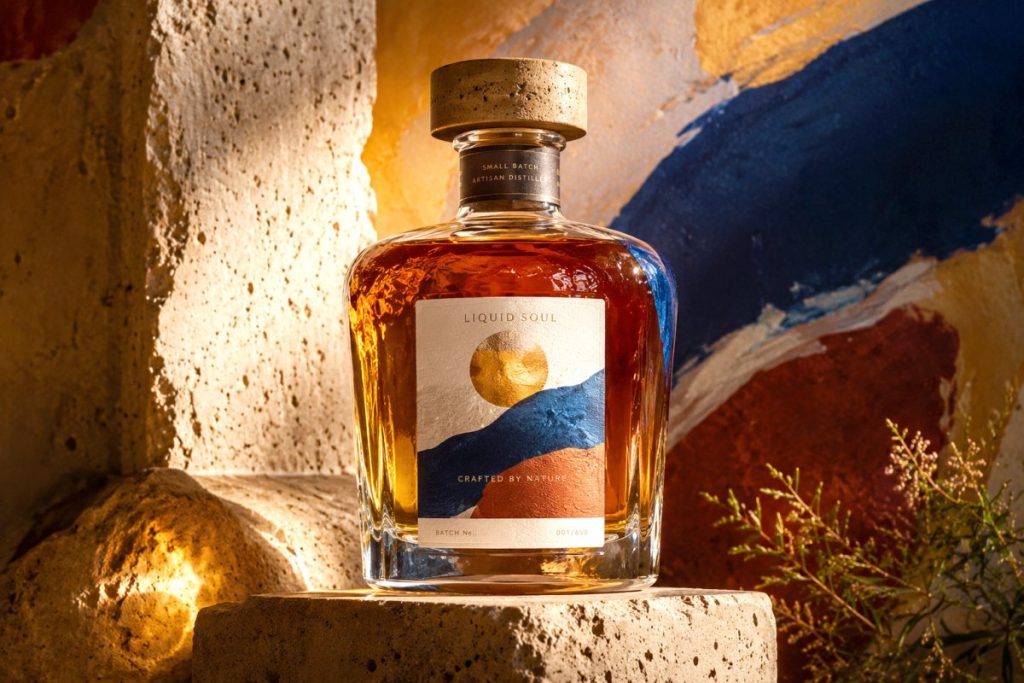
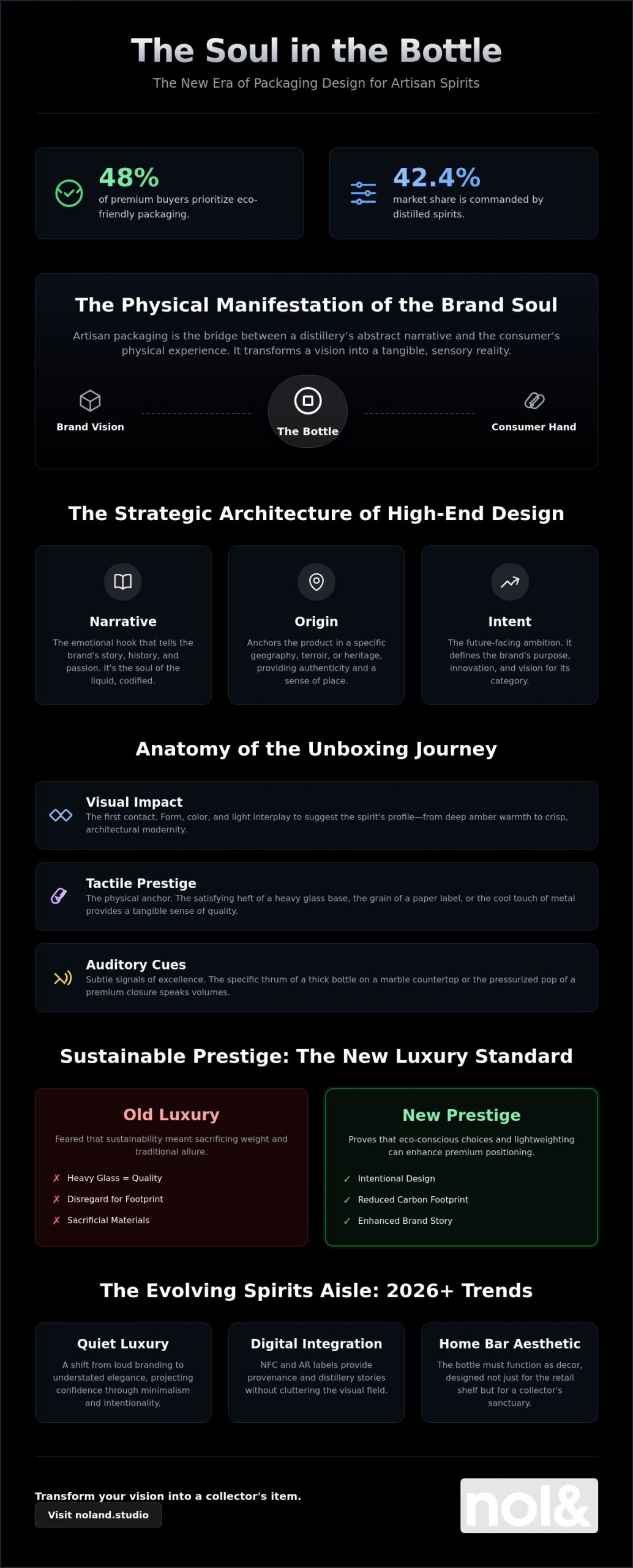
Nearly 48% of premium spirits buyers now prioritize eco-friendly packaging, yet many producers still fear that sustainability requires sacrificing the weight and allure of luxury. In a competitive market where distilled spirits command a 42.4% share, the strategic packaging design for artisan spirits must do more than simply hold liquid. It must act as a physical manifestation of a brand’s internal essence, bridging the gap between an abstract vision and a tangible, sensory experience.
You know that your craft is more than just a product; it’s a labor of heritage, precision, and passion. It’s frustrating when that soul is obscured by commoditized designs that fail to communicate your worth at a glance. This article explores how to transform your bottle into a collector’s item through a synthesis of strategy, tactility, and intentionality. We will examine the path toward increased shelf velocity, the integration of new TTB labeling standards, and the methods for building a brand narrative that feels as refined as the spirit within.
Conclusiones clave
- Understand why your packaging must serve as a bridge between the distillery’s abstract narrative and the consumer’s physical hand.
- Learn to define your brand’s internal essence through a strategic triad of narrative, origin, and intent before selecting materials or molds.
- Resolve the sustainable luxury paradox by discovering how eco-conscious choices and glass lightweighting can actually enhance premium prestige.
- Master the anatomy of the unboxing journey to ensure every touchpoint of your packaging design for artisan spirits builds anticipation and tactile value.
- Explore how a distributed network of specialized experts provides the discerning craftsmanship needed to evolve complex identities into tangible realities.
The Physical Manifestation of the Liquid Soul: Defining Artisan Spirits Packaging
Packaging design for artisan spirits is the bridge between the abstract narrative of the distillery and the physical hand of the consumer. It exists to serve three distinct masters: the protection of the liquid, the rigid regulations of the industry, and the internal soul of the brand. While mass-market containers focus on utility, artisan packaging is the tangible reality of a brand’s visionary essence. It’s a transformative process where a distiller’s history, geography, and craft take on a structural base that can be felt, held, and admired.
In the high-end sector, the bottle acts as a totem. It is an object of desire that must justify a premium price point long before the first pour reaches the glass. This positioning relies on Luxury Packaging principles that prioritize emotional resonance over mere shelf visibility. By moving beyond the functional, we create an artifact that reflects the liquid’s complexity. A well-executed design doesn’t just house a spirit; it curates an identity that the consumer wants to invite into their private world.
Beyond the Bottle: The Multidimensional Experience
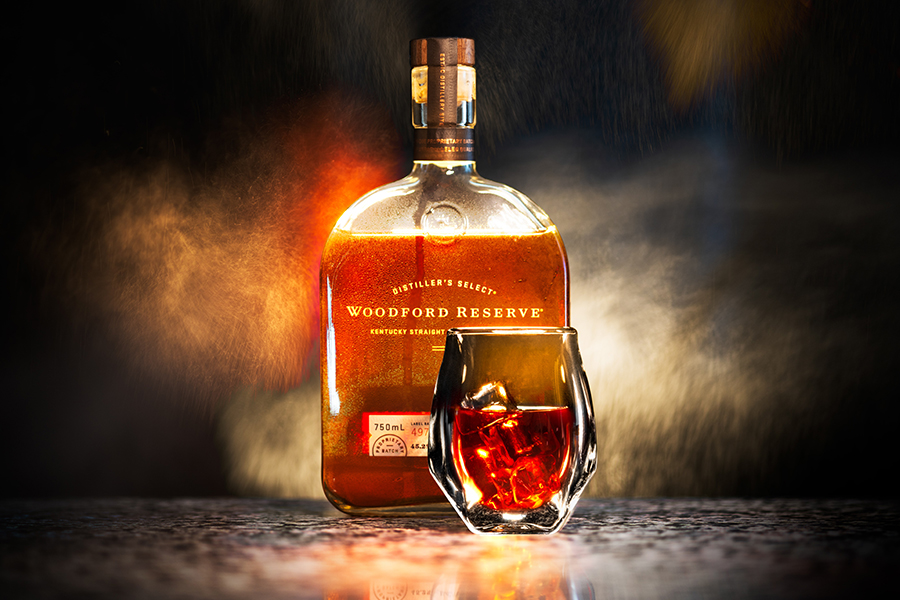
True sophistication in packaging design for artisan spirits requires a mastery of sensory details. Visual impact is the first point of contact, where the interplay of color, light, and form communicates the age and intensity of the spirit. A deep amber liquid requires a glass clarity that enhances its warmth, while sharp, architectural bottle shapes suggest a modern, crisp profile. Tactile prestige follows, defined by the role of weight, texture, and temperature. The cool touch of a heavy glass base or the grain of a high-quality paper label provides a physical anchor for the brand’s story. Even auditory cues play a part. The specific thrum of a thick-walled bottle meeting a marble countertop or the pressurized pop of a premium closure signals quality with a clarity that words cannot match.
The Evolution of the Spirits Aisle in 2026
The landscape of 2026 has shifted away from loud, aggressive branding toward a philosophy of quiet luxury and understated elegance. Discerning consumers now seek brands that project confidence through minimalism and intentionality. Digital integration has also become a standard for authenticity. NFC tags and AR-enabled labels allow producers to prove provenance and share the distillery’s story without cluttering the visual field. This technological layer supports the rising importance of the home bar aesthetic. As the primary site of consumption moves from the crowded lounge to the curated home space, the bottle must function as a piece of decor. It’s no longer just about standing out on a retail shelf; it’s about belonging in a collector’s sanctuary.
The Strategic Architecture of High-End Spirits Design
Before a single drop is bottled or a glass mold is commissioned, the internal essence of the spirit must be codified. Packaging design for artisan spirits is not a decorative afterthought but a strategic manifestation of a brand’s core. By utilizing Estrategia y posicionamiento de marca, we identify the soul of the liquid, ensuring that every curve and texture serves a higher purpose. Strategic vision transforms a simple container into a brand beacon. This approach ensures that Consumer Perceptions of Packaging align perfectly with the liquid’s actual quality, fostering immediate trust and exclusivity.
Every successful design choice rests upon a triad of storytelling: Narrative, Origin, and Intent. The narrative provides the emotional hook, while origin anchors the product in a specific geography or heritage. Intent describes the brand’s future-facing ambition. Without this foundation, a bottle is merely a commodity in a crowded market. When these elements are aligned, the packaging becomes a vessel for transformation, moving the consumer from a casual observer to an active participant in the brand’s history.
Visual Identity Systems for Distillers
A cohesive visual system acts as the face of the distillery. Typography choices speak volumes; serif fonts might whisper of centuries-old heritage, while bespoke, minimalist sans-serifs signal future-forward innovation. Color palettes should never be arbitrary. They are often derived from the spirit’s natural ingredients or the raw, atmospheric tones of the distillation environment. Finally, sophisticated iconography creates a secret language, rewarding the brand’s inner circle with subtle details that reflect the maker’s discernment.
Verbal Artisanship: Naming the Liquid
Words are the invisible architecture of luxury. Through Denominación e identidad verbal, we create a structural base that supports every visual flourish. In the world of artisan spirits, evocative nouns are far more powerful than literal descriptions. A name should suggest a flavor profile, an emotion, or a memory without being overly explicit. This verbal architecture allows for a seamless evolution, scaling effortlessly from core ranges to exclusive limited editions. If you’re ready to refine your brand’s voice, exploring a partner who understands this expert-led craft is the first step toward enduring impact.
Sustainable Prestige: The New Standard for Luxury Spirits
The long-held assumption that sustainability and luxury are mutually exclusive is a relic of a less sophisticated era. For the modern connoisseur, discernment is no longer measured solely by excess, but by the intelligence and ethics behind the craft. In the context of packaging design for artisan spirits, this shift has birthed a new philosophy. Sustainable Prestige is the intentional refinement of materials for longevity and impact. It’s a movement that proves eco-conscious choices can actually enhance, rather than diminish, the prestige of a bottle. When a brand chooses to innovate with its footprint in mind, it signals a level of confidence and long-term vision that resonates deeply with high-end consumers.
Lightweighting glass is perhaps the most technical challenge within this new standard. It requires a precision exercise in structural integrity, where we remove unnecessary mass while maintaining the ‘heft’ and ‘thrum’ that signifies a premium product. Beyond the glass itself, we embrace circular design as a core principle. A bottle should never be destined for a recycling bin after the final pour. Instead, we design vessels with the intent that they become permanent fixtures in a home, serving as decanters, vases, or decorative objects that continue to tell the brand’s story for years to come.
Material Innovation in Spirits Packaging
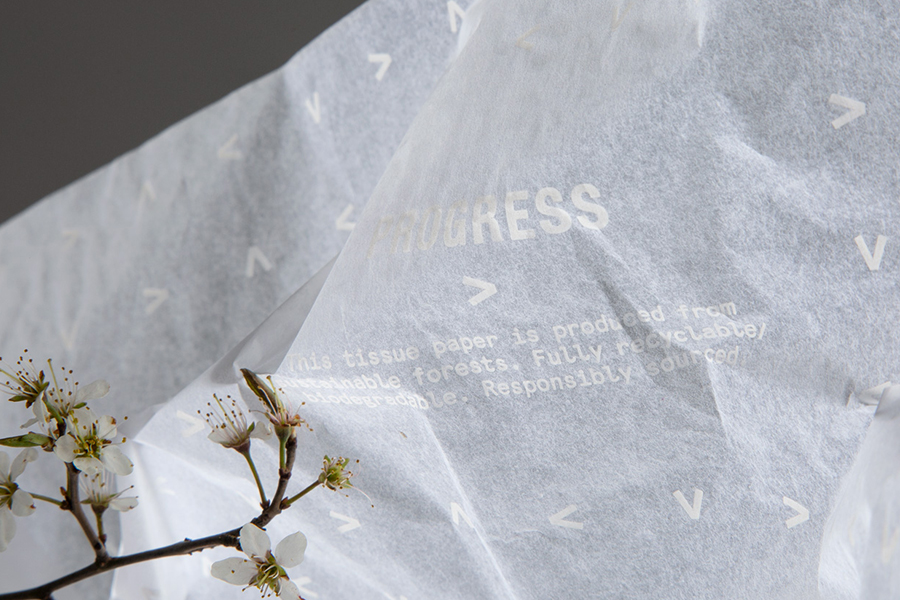
True luxury often lies in the unique grain of the organic world. We’ve moved away from sterile, mass-produced perfection toward materials that carry a sense of provenance. Recycled glass, for instance, often features beautiful imperfections, such as subtle ripples or tiny trapped bubbles, that signal artisan authenticity. These are not flaws; they are signatures of a human-centric process. This tactile honesty extends to biodegradable labels and organic inks that provide deep, vibrant hues without environmental compromise. To ground the product in nature, we prioritize plastic-free closures using cork, hand-carved wood, or polished stone, ensuring every touchpoint feels anchored in the earth.
Production Management and Global Sourcing
Executing a vision of sustainable luxury requires a sophisticated approach to production management. We coordinate with a distributed network of high-end manufacturing partners who possess the specialized knowledge to handle eco-materials without losing aesthetic excellence. Navigating the complexities of the production line, from the viscosity of organic inks to the cooling rates of recycled glass, demands constant discernment. By sourcing local, sustainable artisans through our expert network, we ensure that the packaging design for artisan spirits remains as refined as the liquid it protects. This expert-led craft turns abstract environmental goals into tangible realities that command a premium position in the global market.
The Anatomy of a High-End Unboxing Journey
The unboxing ritual is where the abstract promise of a brand finally meets the physical reality of the consumer’s world. In the specific context of packaging design for artisan spirits, this journey is a choreographed sequence of discovery. It begins with anticipation, fueled by the secondary packaging that shields the liquid soul. Whether it’s a rigid box, a textured tube, or a bespoke wooden crate, this outer layer builds the reveal by delaying gratification and heightening the sense of exclusivity. It’s an invitation to pause, consider, and admire.
First contact is a critical moment of tactile prestige. When the consumer first touches the outer shell, their brain immediately categorizes the product’s value based on texture, temperature, and resistance. A high-end experience demands a material that feels intentional. It shouldn’t just be a container; it should be a structural base for the story that follows. This initial interaction sets the stage for the internal reveal, where the bottle is presented not merely as a product, but as a central work of art within its own curated gallery.
The reveal itself must be seamless and evocative. Once the bottle is removed, the afterglow begins. This is where sensory details create lasting emotional resonance, ensuring the brand remains in the consumer’s memory long after the seal is broken. By focusing on the weight, the sound, and the visual framing of the spirit, we transform a simple transaction into a transformative experience. If you’re ready to evolve your product into a tactile masterpiece, our team is ready to curate your brand’s physical presence.
Sensory Details that Define Luxury
Luxury is often found in the details that aren’t immediately visible. The scent of natural wood or heavy paper can reinforce a brand’s origin, grounding the spirit in its native environment through olfactory memory. We use heavy-bottomed glass to suggest the weight of history, providing a sense of stability and longevity that mass-market bottles lack. Hidden details, such as subtle embossing or micro-text on the underside of a label, reward the consumer for closer inspection. These small gestures of discernment foster a deep, personal connection between the maker and the connoisseur, proving that every element has been guided by expert hands.
Digital Integration in Physical Space
Modern technology allows us to extend this physical journey into a living visual universe. Before the bottle even arrives, 3D visualization and motion design can preview the unboxing experience online, building desire through high-level digital craft. Smart labels now allow a simple smartphone tap to unlock provenance data, cocktail recipes, or exclusive distiller’s notes. By connecting the physical bottle to a Diseño digital y desarrollo web ecosystem, we ensure the brand narrative remains cohesive across every touchpoint. This synthesis of the physical and digital worlds creates a multidimensional identity that is meant to be felt as much as it is seen.
Noland Studio: A Distributed Collective for Visionary Spirits
The traditional agency model often operates within rigid walls, limiting the scope of creativity to the hands available within the room. At Noland Studio, we replace this localized constraint with a distributed expert network. This model allows us to assemble a bespoke triad of strategists, designers, and artisans specifically chosen for your brand’s unique soul. When executing packaging design for artisan spirits, we believe that specialized mastery produces a depth of work that generalist teams simply cannot reach. By sourcing the finest talent across the globe, we ensure that every project is guided by expert hands who understand the specific physics of luxury materials and the psychology of high-end consumers.
Our process is a journey of transformation. We begin by listening to the abstract whispers of a distiller’s vision and then codify those thoughts into a structural base. This isn’t a transactional exchange; it’s a collaborative evolution. We synthesize AI-enhanced tools with human discernment to push the boundaries of what is possible in the physical world. While technology allows us to iterate with unprecedented speed, it’s the human eye that provides the final refinement, ensuring that every bottle is as much a collector’s item as it is a commercial product. Choosing the right partner is the most critical step in this journey, and you can learn more about finding the perfect fit in our guide to Beyond Aesthetics: Choosing a Luxury Branding Agency.
Craftsmanship in the Digital Age
Modern luxury requires a mastery of both the physical and the virtual. Our digital artisans use advanced 3D modeling to perfect light refraction within glass long before the first physical mold is cast. This precision allows us to visualize how the spirit’s color will interact with the bottle’s geometry, ensuring aesthetic excellence from every angle. This high-level craft is balanced by a localized touch. Because our network is global, we possess a sensitive understanding of regional luxury cues, allowing us to design packaging that resonates in specific multicultural markets while maintaining a cohesive global identity. We don’t just build bottles; we build icons.
Transforming Your Vision into a Soulful Brand
We are committed to longevity and emotional resonance. A spirit should not just sit on a shelf; it should tell a story that grows richer with time. To achieve this, we integrate Dirección de arte y creación de contenido into the core of the packaging journey. This ensures that the visual identity, the digital presence, and the physical bottle all speak the same language of excellence. Our goal is to create a living visual universe where your brand can thrive and evolve. If you’re ready to give physical form to your liquid soul, it’s time to Inicia la transformación de tu marca con Noland Studio. and see your visionary ideas manifest into tangible reality.
Manifesting the Future of Your Spirit
The transition from an abstract distillation process to a tangible luxury object requires more than just aesthetic flair. It demands a rigorous synthesis of strategic positioning, material innovation, and sensory storytelling. As we’ve explored, the most successful packaging design for artisan spirits serves as a permanent vessel for a brand’s internal essence. By prioritizing sustainable prestige and orchestrating a high-end unboxing journey, you ensure your product isn’t just consumed, but cherished. This physical manifestation is what ultimately justifies a premium position in a crowded global market.
Noland Studio operates as a multidisciplinary collective, uniting global artisans who possess a sensitive touch for luxury strategy and the technical expertise to handle complex production challenges. We focus on creating soulful, multidimensional brand experiences that resonate across every touchpoint. If you’re ready to evolve your vision into a physical reality that commands attention, it’s time to transform your spirit into a tactile luxury experience with Noland Studio. Your craft deserves a bottle that reflects the depth of its soul. Let’s build something enduring together.
Preguntas frecuentes
What makes packaging design for artisan spirits ‘luxury’?
High end packaging design for artisan spirits is defined by its ability to act as a physical totem for the brand’s internal essence. It moves beyond mere utility by integrating specialized materials, unique bottle geometries, and a strategic narrative that justifies premium positioning. This level of luxury is felt through the intentionality of every curve, texture, and weight, transforming a simple purchase into a sensory experience.
How does sustainable packaging impact the perception of premium spirits?
Sustainable choices now serve as a primary indicator of brand discernment and ethical intelligence. Since nearly 48% of premium spirits buyers prioritize eco-friendly packaging, using recycled glass or biodegradable materials enhances a brand’s prestige. This shift proves that sustainable luxury is not a paradox but a refined standard that signals a distillery’s commitment to longevity and thoughtful craft.
Why is brand strategy important before starting a packaging design?
Strategy provides the structural base for every visual and tactile choice. By defining the brand’s narrative, origin, and intent before production begins, you ensure the final bottle acts as a cohesive beacon for your identity. This prevents the commoditization of your spirit. It allows the design to reflect the specific soul of the liquid and resonate with a more discerning audience.
Can packaging design help a new artisan spirit compete with established brands?
Exceptional design allows emerging producers to bypass traditional marketing barriers by creating an immediate sense of authority. A bottle that feels like a collector’s item can disrupt the shelf velocity of established brands by offering a fresh, soulful narrative. When packaging design for artisan spirits is executed with strategic precision, it bridges the gap between a new distillery and a sophisticated consumer.
What are the most important tactile elements in spirits packaging?
The most critical elements are the glass weight, label grain, and closure resistance. A heavy glass base suggests stability and heritage, while textured labels provide a physical connection to the ingredients or environment. Even the auditory pop of a premium closure functions as a tactile cue. It signals quality and craftsmanship the moment the consumer touches the product.
How do digital tools like AI and 3D modeling help in packaging design?
These tools allow digital artisans to perfect light refraction and material integrity within a virtual space. By using 3D modeling, we can visualize how the liquid’s color interacts with glass geometry before a physical mold is cast. This synthesis of technology and human discernment ensures aesthetic excellence while allowing for more ambitious, innovative designs that push the boundaries of traditional glassmaking.
What is the benefit of a distributed design collective for spirits branding?
A distributed collective offers a multidisciplinary expert network that isn’t limited by geography. This model allows you to work with specialized artisans who possess a localized touch for regional luxury cues and a global vision for brand evolution. It ensures that your project is guided by the most qualified hands for every specific stage, from naming and strategy to 3D visualization.
How does spirits packaging design differ from other luxury goods?
Spirits packaging must simultaneously navigate rigid TTB labeling regulations and the complex physics of liquid interaction. Unlike other luxury goods, the container must protect the spirit’s proof while showcasing its clarity and color through the glass. It requires a unique understanding of how light, volume, and industrial standards intersect to create a vessel that is both legally compliant and artistically visionary.