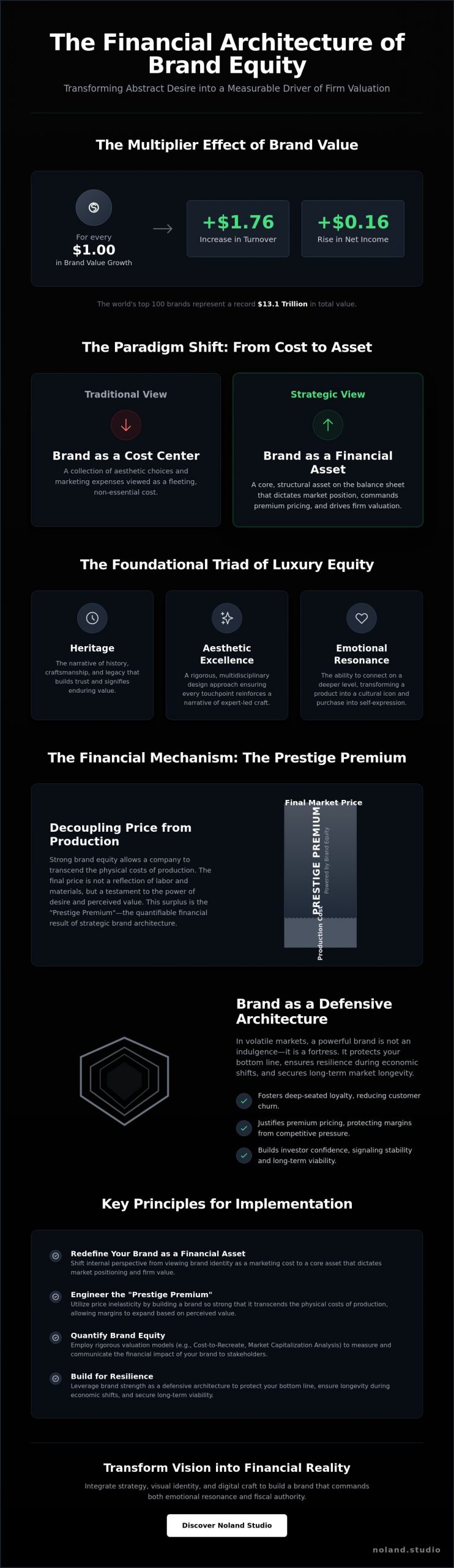
A single dollar of growth in brand value generates a $1.76 increase in turnover and a $0.16 rise in net income. In a marketplace where the world’s top 100 brands have reached a record $13.1 trillion in value, the financial impact of strong brand equity is no longer a nebulous concept; it’s a rigorous, structural architecture. You’ve likely felt the pressure of a saturated market where sustaining premium pricing feels like an uphill battle against skepticism from the boardroom. It’s a common struggle to justify visionary design when it’s viewed as a fleeting cost rather than a foundational asset.
We believe that for a luxury brand to endure, its identity must be felt, seen, and measured. This article reveals how strategic brand equity transforms abstract desire into a measurable driver of premium pricing, market resilience, and firm valuation. We’ll explore the frameworks that justify your positioning, the data behind the 2026 global brand leaders like Apple and NVIDIA, and the methodology of architecting an identity that commands both emotional resonance and fiscal authority.
Conclusiones clave
- Redefine your brand identity not as a collection of aesthetic choices, but as a core financial asset that dictates market positioning.
- Explore the mechanics of price elasticity and learn how a “Prestige Premium” allows your margins to transcend the physical costs of production.
- Quantify the financial impact of strong brand equity using rigorous valuation models like the Cost-to-Recreate method and market capitalization analysis.
- Protect your bottom line by leveraging brand strength as a defensive architecture that ensures resilience and longevity during economic shifts.
- Discover how integrating strategy, visual identity, and digital craft creates a foundation for long-term firm valuation and successful exit strategies.
What is Brand Equity in the Context of Luxury Strategy?
In the rarefied world of luxury, a brand is far more than a trademark or a visual marker. It represents a value premium; an intangible yet potent force that allows a company to generate superior returns from a recognizable, trusted, and evocative identity. To understand What is Brand Equity in this specific context, one must look past the surface. It’s the shift from viewing a brand as a mere logo to recognizing it as a strategic financial asset. When we analyze the financial impact of strong brand equity, we see it manifest as the difference between a product that is purchased for its utility and an object that is desired for its essence.
The architecture of luxury equity rests upon a foundational triad: heritage, aesthetic excellence, and emotional resonance. These three pillars work in concert to build, organize, and refine the brand’s presence in the mind of the consumer. Positive equity enables the command of premium pricing and fosters deep-seated loyalty. Conversely, negative equity leads to the commodity trap, where a brand loses its perceived exclusivity and is forced to compete on price alone. In luxury, the goal is never to be the most accessible, but to be the most significant.
The Internal Essence: Beyond Awareness
For mass-market entities, awareness is the primary metric of success. In luxury, we prioritize discernment. It’s not about how many people know the name, but how the right people perceive the soul of the work. High-level craftsmanship serves as the base of this equity; it’s the physical manifestation of the brand’s internal standards. Through a multidisciplinary design approach encompassing brand strategy, visual identity systems, and 3D visualization, we give physical form to abstract brand values. This process ensures that every touchpoint, from premium packaging to digital design, reinforces a narrative of expert-led craft rather than mass-produced utility.
Intangible Assets and Firm Valuation
Financial analysts and CFOs increasingly categorize brand equity within the “intangible assets” portion of the balance sheet. A strong visual identity system does more than attract customers; it builds investor confidence by signaling stability, vision, and long-term viability. The financial impact of strong brand equity is clearly visible during firm valuations for exit or expansion, where the brand premium often accounts for a significant portion of the total market capitalization. Luxury brand equity is the intersection of strategic purpose and sensory impact. By treating brand development as a rigorous financial investment, leaders can ensure their creative vision translates into enduring market value and structural resilience.
The Financial Mechanism: Price Elasticity and Premium Margins
In the architecture of a high-end enterprise, price is rarely a reflection of labor. It’s a testament to the power of desire. Strong brand equity decouples the final price from the raw cost of production, creating a financial surplus we define as the “Prestige Premium.” This surplus isn’t accidental. It’s the result of a deliberate process where aesthetic excellence, strategic vision, and emotional resonance converge. When we quantify the financial impact of strong brand equity, we see it most clearly in price inelasticity. These brands don’t just survive price increases; they use them to reinforce their exclusivity. They don’t compete on cost; they command through value.
Much of this perceived value is anchored by the invisible architecture of Denominación e identidad verbal. A name acts as a vessel for meaning, giving physical form to the abstract essence of a vision. It’s the difference between a commodity and a legacy. When a brand’s verbal identity aligns with its visual presence, it creates a cohesive narrative that justifies a higher entry point in the mind of the consumer.
The Psychology of Premium Pricing
Evocative storytelling is the catalyst that transforms a mere product into a cultural icon. It moves the conversation away from utility toward identity. By focusing on scarcity, intentionality, and craftsmanship, a brand justifies its transition into a high-performance asset. Academic insights on how to build and measure brand equity suggest that this psychological shift is what enables a firm to command margins that competitors cannot touch. It’s about building a world that the audience feels compelled to inhabit, where the act of purchase is an act of self-expression.
Lowering Customer Acquisition Costs (CAC)
Established equity creates a natural “pull” effect. Instead of chasing leads through frantic marketing, the brand acts as a beacon, attracting those who seek discernment. This organic attraction significantly lowers customer acquisition costs while simultaneously boosting the compounding effect of loyalty on Customer Lifetime Value (CLV). By utilizing sophisticated Estrategia y posicionamiento de marca, a studio can align its resources with the most discerning audiences. This ensures that marketing spend isn’t a cost center, but a precise instrument of growth. If you’re ready to architect a brand that commands this level of authority, explore how the multidisciplinary experts at Estudio Noland can refine your vision.
Resilience and Market Longevity: Protecting the Bottom Line
Economic volatility is the ultimate stress test for any luxury enterprise. While many view branding as a tool for growth, its most critical role is often defensive. In times of market contraction, the financial impact of strong brand equity reveals itself as a structural shield. It acts as an insurance policy. When consumer confidence wavers, the market doesn’t stop spending entirely; it becomes more selective. Discerning clients gravitate toward names that represent enduring value, emotional safety, and cultural permanence. These brands don’t just survive downturns. They use their established trust to maintain market share while competitors without a clear “soul” are forced into silence.
Maintaining this resilience requires a constant state of refinement. Through sophisticated Dirección de arte y creación de contenido, a brand can shape its living visual universe to remain relevant without chasing fleeting trends. This consistency ensures that the brand’s narrative remains vibrant and persuasive, even when the external environment is uncertain. History shows us that brands with deep equity are the first to recover because their identity is woven into the lifestyle of their audience, not just their shopping habits.
Mitigating Commodity Risk
Without equity, a business is trapped in a “race to the bottom.” When products are seen as interchangeable, price becomes the only lever left to pull. This is a commodity trap that erodes margins and destroys long-term viability. Luxury brands avoid this fate by cultivating a unique, multidisciplinary design signature. This signature creates a barrier to entry that competitors can’t easily replicate. By building an enduring impact, you ensure your offerings are viewed as high-performance assets rather than disposable goods. This structural advantage protects your bottom line from the pricing wars that decimate mass-market sectors.
The Halo Effect in Product Expansion
Strong equity is a portable asset. It creates a “halo effect” that allows a brand to move seamlessly between categories. When a house known for exquisite fragrance launches a line of digital experiences, the established trust of the former fuels the success of the latter. This significantly reduces the financial risk of new product launches. By leveraging expert Digital Design & Web Development, you can create immersive entry points for new customers that feel just as premium as your physical products. This interconnected ecosystem ensures that the financial impact of strong brand equity compounds over time, turning a single vision into a multidimensional legacy.
How to Measure the Financial Value of Your Brand
Quantifying the “intangible” has long been the primary challenge for luxury leaders facing skeptical boardrooms. Yet, as global brand valuations reach record heights, the tools for measurement have evolved into a rigorous discipline. Measuring the financial impact of strong brand equity requires a shift from viewing design as an expense to analyzing it as a structural asset. We move beyond surface-level awareness to evaluate how identity, strategy, and craft manifest as tangible line items on a balance sheet. By employing specific valuation models, a firm can move from abstract vision to a documented brand premium.
One of the most grounding approaches is the “Cost-to-Recreate” method. This evaluates the total investment required to build a similar market presence from scratch, accounting for years of strategic positioning and visual refinement. Another vital metric is the “Brand Premium,” calculated by subtracting a firm’s tangible assets from its total market capitalization. This surplus represents the financial weight of the brand’s reputation and its power to command the market. For a more granular view, Revenue Premium Analysis compares your specific margins against a generic or mid-market competitor, highlighting exactly how much extra profit each sale generates due to your name alone.
Quantitative Valuation Frameworks
To arrive at a definitive figure, we often utilize a three-step quantitative framework. First, we isolate the brand-induced portion of earnings, stripping away the value derived from logistics or physical infrastructure. Second, we apply a brand strength multiplier based on your market position, loyalty rates, and competitive advantage. Finally, we discount these projected earnings to their net present value. This process provides a final brand valuation figure that serves as a cornerstone for exit strategies or expansion capital. If you need to translate your creative vision into a documented financial asset, the experts at Estudio Noland can help you architect a brand designed for high-level valuation.
Qualitative Indicators of Equity Growth
Numbers tell the story of the past; qualitative indicators predict the future. We track the shift from transactional interactions to emotional advocacy, where clients become curators of your narrative. In the physical world, we measure “Tactile Prestige.” This involves analyzing how physical touchpoints, such as premium packaging, impact the unboxing experience and drive organic social sharing. In the digital space, AI-enhanced tools now allow us to track brand sentiment across global distributed networks. This ensures that the brand’s essence remains consistent, evocative, and influential, regardless of the platform or territory. By balancing these data points, leaders can ensure their brand is not just seen, but valued as a high-performance financial engine.
Noland Studio: Transforming Vision into Financial Reality
At Noland Studio, we don’t just design; we architect value. We recognize that the financial impact of strong brand equity is the ultimate measure of a vision’s success. Our multidisciplinary collective is built to bridge the gap between abstract emotion and tangible performance. By merging Brand Strategy & Positioning with high-end Visual Identity Systems and 3D Visualization & Motion Design, we create identities that are felt as much as they are seen. We move beyond the superficial, ensuring every aesthetic choice serves a strategic purpose in your firm’s valuation.
Our process is one of intentional manifestation. We take the internal essence of your business and give it a physical presence that commands market respect. Whether we’re developing Premium Packaging Design or crafting immersive Digital Design & Web Development, our goal remains the same: to build a structural base for your brand’s longevity. This intersection of craftsmanship and strategic vision allows our clients to transcend market saturation and maintain the premium margins that define true luxury.
The Artisan Approach to Strategic Branding
We operate as a distributed network of global experts, offering a level of discernment and localized touch that traditional agencies struggle to replicate. This structure allows us to pull from a diverse pool of talent to solve complex brand challenges. We prioritize:
- Expert-Led Craft: Every project is guided by sensitive, experienced hands rather than automated processes.
- Innovación estratégica: We integrate sustainability and modern technology as core value drivers for the next generation of luxury.
- Soulful ROI: Our commitment is to creating brands with an internal soul that deliver a measurable return on investment.
Next Steps: Defining Your Brand’s Economic Future
Building a brand that resonates through emotion and aesthetic excellence requires a disciplined approach to storytelling. We collaborate with global clients to build multidimensional experiences that act as a bridge between ideas and products. This collaborative journey ensures your brand is not just a fleeting trend, but an enduring impact in your industry. We invite you to consult with Noland Studio to evolve your brand’s financial architecture and secure its position in the luxury market.
Architecting an Enduring Legacy
The journey from abstract desire to measurable fiscal value requires a disciplined fusion of craft and strategy. The evidence shows how a recognizable identity decouples price from production costs, creates resilience against market volatility, and establishes a clear brand premium on the balance sheet. Understanding the financial impact of strong brand equity is the first step toward transforming your creative vision into a high-performance asset that commands market authority.
At Noland Studio, we specialize in giving physical form to these abstract values. As a multidisciplinary design collective with global expertise, we act as specialists in luxury strategy and digital transformation, guiding you through the complexities of modern identity. We offer fixed-fee transparency for our projects, ensuring our partnership remains as disciplined and intentional as the brands we curate. Partner with Noland Studio to architect your brand’s financial future and build a legacy that is both felt and measured.
Your vision deserves a foundation that endures. Let’s create something extraordinary together.
Preguntas frecuentes
How does brand equity specifically affect the stock price of luxury companies?
Brand equity acts as a multiplier for market capitalization by signaling long-term stability and pricing power to investors. Companies with high equity often trade at higher price-to-earnings multiples because their revenue is perceived as more resilient. This surplus accounts for a significant portion of the firm’s total value; it often exceeds the value of its physical assets.
Can a small premium brand build significant equity without a massive marketing budget?
A smaller brand builds equity through discernment, exclusivity, and expert-led craft rather than broad awareness. By focusing on a precise Visual Identity System and a targeted Brand Strategy & Positioning, a boutique label can command the same level of authority as a global house. It’s about being deeply significant to a specific audience instead of being vaguely known by the masses.
What is the difference between brand value and brand equity in financial reporting?
Brand equity represents the consumer’s perception and loyalty, while brand value is the specific dollar amount that perception adds to the balance sheet. The financial impact of strong brand equity is the surplus generated when customers pay more for your name than for the product’s utility. Equity is the psychological foundation; value is the financial manifestation of that foundation in firm valuation.
How long does it typically take to see a financial return on a rebranding project?
Qualitative returns, such as improved sentiment and internal alignment, are often immediate. Quantifiable financial returns, including increased margins and lower customer acquisition costs, typically manifest within 12 to 24 months. This timeline allows the new visual and verbal identity to settle into the market and influence long-term consumer behavior.
Does digital transformation improve or dilute the brand equity of heritage luxury brands?
Digital transformation improves equity when it acts as a bridge between tradition and modern immersive experiences. Utilizing high-end Digital Design & Web Development ensures that the heritage narrative remains vibrant and accessible to new generations. Dilution only occurs if the brand compromises its exclusivity for the sake of mass digital reach or automated interactions.
What are the most common mistakes that lead to negative brand equity?
The most damaging mistakes include over-distribution, inconsistent visual identity systems, and chasing fleeting trends that contradict the brand’s soul. When a luxury brand becomes too accessible, it loses the scarcity that fuels desire. This erosion of exclusivity creates a commodity trap where the brand is forced to compete on price rather than its internal essence.
How do you measure the ROI of premium packaging design on brand equity?
The ROI of Premium Packaging Design is measured through “Tactile Prestige” and its ability to drive organic, high-value advocacy. Exceptional packaging increases the perceived value of the product, justifying premium price points and reducing the need for paid media spend. We track this through unboxing engagement, social sharing metrics, and the compounding effect on customer lifetime value.