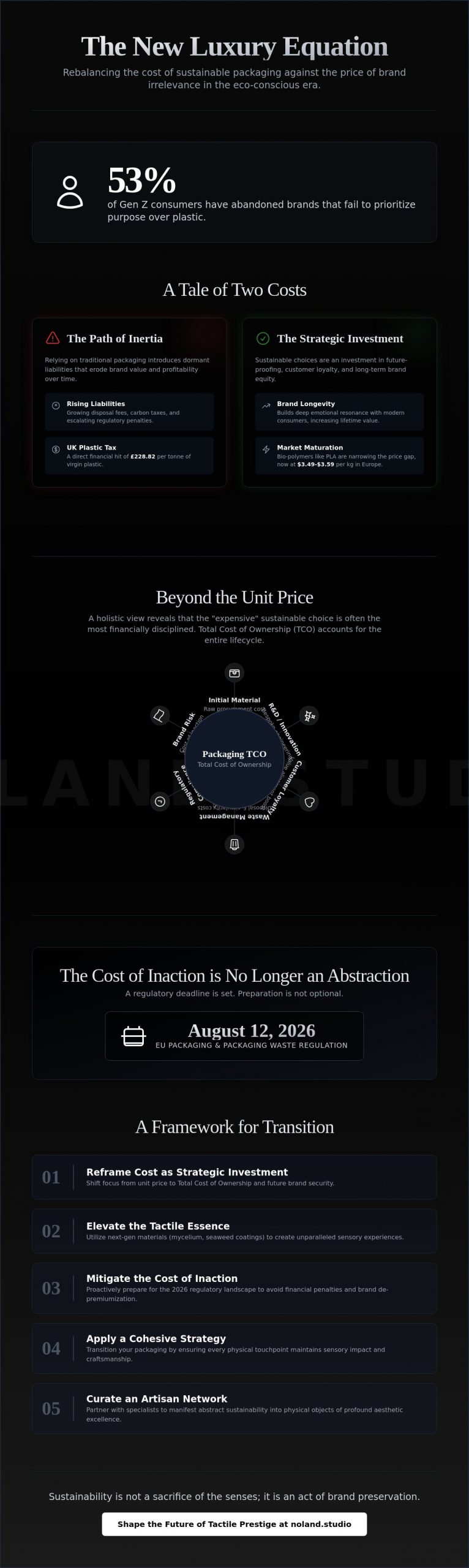
Fifty-three percent of Gen Z consumers have already walked away from brands that prioritize plastic over purpose. In the high-end sector, the friction between procurement budgets and creative vision often centers on the perceived cost of sustainable packaging vs traditional materials. You likely feel the weight of this tension; the fear that eco-conscious choices might look “recycled” or “cheap” in a world where tactile excellence is the only currency that matters. It’s a delicate dance between maintaining a heritage of prestige and navigating the cold reality of the August 12, 2026 EU Packaging and Packaging Waste Regulation.
Choosing sustainability isn’t a sacrifice of the senses; it’s an act of brand preservation. This article explores why the price gap is narrowing as technologies like PLA and PBAT mature and why the UK’s £228.82 per tonne plastic tax makes traditional options a growing liability. You’ll discover a framework to justify these investments to stakeholders by reframing them as a bridge to longevity. We’ll examine the ROI of prestige materials that feel intentional, the impact of upcoming 2026 environmental mandates, and the strategies for selecting textures that manifest a sense of discernment while honoring the earth.
Conclusiones clave
- Reframe the initial cost of sustainable packaging vs traditional materials as a strategic investment in future brand security and emotional resonance.
- Identify how next-gen materials, such as mycelium and seaweed-based coatings, can elevate the tactile essence of luxury products beyond the limitations of virgin plastics.
- Mitigate the “cost of inaction” by preparing for the 2026 regulatory landscape to avoid the de-premiumization of your visual identity.
- Apply a five-step framework to transition your packaging strategy, ensuring every physical touchpoint maintains its sensory impact and high-level craftsmanship.
- Discover how to curate a distributed network of artisans who manifest abstract sustainability into physical objects of profound aesthetic excellence.
The Financial Paradox: Why Sustainable Packaging Costs More (and Less) Than Traditional
Luxury has always been a language of discernment, where every detail serves as a testament to a brand’s essence. When analyzing the cost of sustainable packaging vs traditional methods, many leaders focus solely on the “Green Premium.” This is the initial surcharge that bio-based alternatives carry over virgin plastics, often perceived as a tax on conscience. However, viewing this through a narrow lens ignores the evolution of the market. Sustainability is no longer a peripheral “extra” for the elite; it’s the baseline for entry into the modern high-end sector. To understand what is sustainable packaging in a financial context, one must look past the bill of materials and toward the horizon of brand longevity.
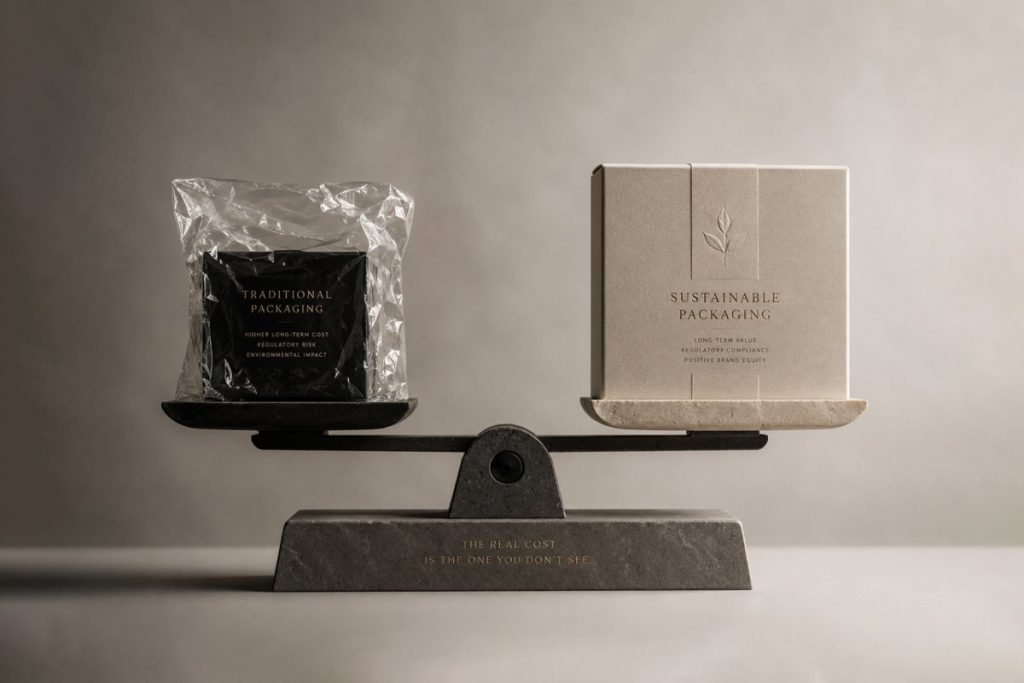
Traditional packaging often hides its true weight in the shadows of the balance sheet. While the unit price of a plastic-lined box might seem attractive, it carries dormant liabilities. These include rising disposal fees, carbon taxes, and the looming threat of the UK’s £228.82 per tonne plastic packaging tax. In contrast, sustainable choices are a strategic investment in customer lifetime value. A brand that mirrors the values of its audience through high-level craftsmanship and ecological integrity builds a bond that transcends a single transaction. It’s a shift from viewing packaging as a disposable vessel to seeing it as a lasting artifact of brand identity.
The Unit Price Myth
Virgin plastics remain artificially cheap because they benefit from decades of established global supply chains. These systems are designed for mass-market speed, not for the sensitive, localized touch required in luxury. However, as we move through 2026, the scaling of bio-polymers like PLA and PBAT is rapidly narrowing the price gap. In Europe, PLA prices currently sit between $3.49 and $3.59 per kilogram, reflecting a market that is maturing and becoming more accessible. While initial R&D costs for bespoke eco-materials can be higher, they represent a one-time investment in a proprietary tactile experience that competitors using off-the-shelf plastics simply can’t replicate.
Total Cost of Ownership (TCO) in Packaging
A sophisticated procurement strategy looks at the Total Cost of Ownership rather than just the invoice from the factory floor. Total Cost of Ownership represents the holistic financial burden of a package from its molecular origin to its ultimate rebirth or disposal within a circular economy. By factoring in waste management and regulatory compliance, the “expensive” sustainable option often emerges as the more disciplined choice. Modular design further refines this process; by creating interchangeable components that can be reused or easily recycled, brands reduce long-term production costs while maintaining a sense of exclusivity and intentionality.
Decoding the Price Gap: Materials, Innovation, and the Luxury Premium
The soul of a luxury product is often first felt through its exterior. When comparing the cost of sustainable packaging vs traditional options, the conversation frequently stalls at the expense of raw materials. Traditional gloss-laminated card relies on a thin layer of plastic to achieve its sheen, a process that is inexpensive but fundamentally lacks depth. In contrast, uncoated FSC papers and bio-based alternatives offer a profound, organic texture that invites touch. This sensory depth is a hallmark of modern prestige; it transforms a simple box into a vessel of intention, storytelling, and craftsmanship. While the innovation costs for next-gen materials like mycelium or seaweed-based coatings remain higher due to intensive R&D, they provide a proprietary aesthetic that mass-market plastics cannot mirror.
A significant portion of the price gap stems from bespoke structural engineering. Luxury packaging isn’t merely a container; it’s a choreographed sequence of reveals. Moving away from traditional glues and non-recyclable foils requires creative problem-solving to ensure structural integrity. This investment in design is what builds the business case for sustainable packaging. Consumers in the high-end sector increasingly expect an ethical “Prestige Markup,” where the price reflects a commitment to planetary health. A 2026 survey revealed that 77% of consumers trust brands more when their packaging appears eco-friendly, suggesting that the “extra” cost is actually a purchase of consumer confidence.
The Sensory Value of Sustainable Substrates
Weight and texture dictate the perceived value of an object. The cool, heavy presence of recycled glass or the unique, matte grip of stone paper enhances the unboxing ritual far more than a standard plastic insert. These choices should never be made in isolation; they must align with your Denominación e identidad verbal to ensure the physical manifestation of the brand speaks the same language as its voice. Even the “natural” imperfections found in recycled fibers can be framed as a mark of authenticity, moving the brand away from sterile perfection toward a more human-centric narrative of expert-led craft.
Economies of Scale and the Artisan Network
Traditional manufacturing thrives on massive, rigid production runs. However, a colectivo de diseño multidisciplinario can leverage a distributed network of artisans to execute smaller, more agile runs of sustainable packaging. This approach reduces the cost of sustainable packaging vs traditional mass production by eliminating the need for excessive inventory and storage. By using AI-enhanced tools to optimize material layouts and reduce waste, we can now achieve a level of precision that makes rare, eco-conscious materials financially viable. To see how these elements converge into a cohesive visual identity, you might explore our approach to Diseño de empaque premium.
Beyond the Bill of Materials: The “Cost of Inaction” for Premium Brands
The true financial paradox of luxury packaging isn’t found in the material invoice; it’s hidden in the cost of silence. As we approach the August 12, 2026 deadline for the EU Packaging and Packaging Waste Regulation (PPWR), the cost of sustainable packaging vs traditional methods must be weighed against the price of total obsolescence. Brands that cling to non-recyclable polymers aren’t just saving pennies; they’re incurring a massive “inaction tax.” This includes the risk of being excluded from high-end retail platforms that increasingly demand strict environmental credentials as a prerequisite for shelf space. In the modern market, a brand’s refusal to evolve is a loud declaration of irrelevance.
There is a profound risk of “de-premiumization” when a brand’s physical presence fails to mirror its elevated promises. To a modern consumer, a plastic-heavy unboxing feels dated, clumsy, and disconnected from the world. This is especially true for Gen-Z and the emerging Gen-Alpha, who view the tactile world through a lens of ethical discernment. While some reports highlight barriers to adopting sustainable packaging such as supply constraints or performance concerns, these hurdles are minor compared to the total erosion of trust. When your packaging fails the planet, it fails the customer.
Regulatory Risk and Financial Penalties
The 2026 landscape introduces harmonized rules for recyclability and labeling that make non-compliance a direct hit to the bottom line. Extended Producer Responsibility (EPR) requirements, such as those expanding in France on July 1, 2026, will force brands to pay more for the “privilege” of using industrial waste. Under the 2026 EU PPWR, packaging that fails to meet strict recyclability performance grades will be progressively phased out or subjected to higher economic levies, effectively penalizing the use of traditional multi-material luxury boxes that prioritize aesthetics over end-of-life recovery. Future-proofing your brand today is a disciplined financial move; it’s far cheaper to innovate now than to execute a frantic, forced pivot when the law finally knocks.
The Erosion of Brand Equity
A single unboxed item can either validate or violate your entire Estrategia y posicionamiento de marca. When a customer pays a premium for a product, they aren’t just buying an object; they’re buying an identity. If that identity is wrapped in unsustainable traditional materials, the resulting “Trust Tax” can be devastating. Rebuilding loyalty after accusations of greenwashing or environmental apathy is an expense that no creative department can easily justify. Sustainable packaging acts as a form of non-verbal storytelling, proving that your brand’s essence is as enduring as the materials it chooses to inhabit. It’s a process of growth, organization, and refinement that gives physical form to your most abstract values.
Strategic Implementation: Balancing Ecological Integrity with Aesthetic Excellence
Transitioning toward a circular model requires a disciplined framework that transcends mere material substitution. To harmonize the cost of sustainable packaging vs traditional methods, brands must move beyond transactional thinking and toward structural evolution. This process isn’t about stripping away luxury; it’s about refining it. By employing a Life Cycle Assessment (LCA) during the initial design phase, creators can quantify the environmental footprint of every fiber, coating, and closure. This data-driven discernment allows for a strategic “Touchpoints of Impact” strategy: investing heavily in the elements consumers touch and keep, while simplifying the hidden components that are destined for the recycling stream.
Execution relies on a five-step sequence of growth and refinement. First, conduct a holistic audit of current waste. Second, prioritize tactile touchpoints that define the unboxing ritual. Third, decouple complex multi-layer laminates in favor of high-performance mono-materials. Fourth, utilize virtual prototyping to eliminate physical sampling waste. Finally, collaborate with manufacturing partners who treat sustainable finishes as a high-level craft rather than a technical hurdle. This methodical approach ensures that every aesthetic choice is both beautiful and biologically responsible.
The Design-First Approach to Cost Control
A sophisticated visual identity doesn’t require excess. By leveraging expert Dirección de arte y creación de contenido, brands can make “less” feel like an intentional, curated choice. Simplifying structural design reduces assembly time on the factory floor and minimizes material offcuts. Mono-material packaging, which uses a single type of fiber or polymer for the entire vessel, significantly reduces production complexity. It’s a manifestation of the “quiet luxury” ethos, where the absence of loud, non-recyclable foils creates a sense of confident, understated prestige.
Sourcing and Production Management
Managing the cost of sustainable packaging vs traditional supply chains requires a shift toward fixed-fee management to control budget creep. Rather than chasing the lowest unit price, elite brands evaluate suppliers based on transparency and ethical labor practices. We utilize advanced 3D visualization to prototype these sustainable structures in a digital space before a single sheet of paper is cut. This precision minimizes the need for costly physical iterations and ensures the final object meets the studio’s standards for aesthetic excellence. If you are ready to evolve your brand’s physical presence, explore our approach to Diseño de empaque premium.
Noland Studio: Shaping the Future of Tactile Prestige
Noland Studio exists at the precise intersection where strategic purpose meets physical manifestation. We understand that for a luxury founder, the cost of sustainable packaging vs traditional materials isn’t just a spreadsheet calculation; it’s a question of how to preserve the brand’s internal essence while honoring the world it inhabits. We bridge the gap between the abstract philosophy of ecology and the tangible reality of prestige. By curating identities that are meant to be felt as much as they are seen, we transform the perceived surcharge into a lasting legacy of craftsmanship. Our work is a process of growth, organization, and refinement that elevates a simple container into a vessel of profound sensory impact.
Our process relies on a distributed network of global artisans who specialize in rare, eco-conscious materials that traditional mass-production facilities often overlook. These creators bring a sensitive, localized touch to every project, ensuring that the final object possesses an artistic weight that resonates with the discerning consumer. Whether it’s a bio-based polymer that mimics the cool touch of marble or a recycled fiber with a unique, rhythmic texture, our materials are selected for their ability to tell a story of exclusivity. We navigate the complexities of the cost of sustainable packaging vs traditional manufacturing by finding specialized efficiencies within this artisan collective, allowing for high-level craft that remains strategically viable.
Modern innovation requires a synergy between technological discernment and the human hand. We use AI-enhanced tools not to replace the artist, but to provide the structural base for expert-led craft to flourish. This technology allows us to visualize complex geometries and optimize material usage with a level of precision that was previously impossible. However, the final soul of the package is always guided by expert hands. This balance ensures that every fold, every texture, and every closure feels intentional. We don’t just design boxes; we build structural bases for brands that are meant to endure far beyond the initial unboxing ritual.
A Collective Vision for Sustainable Luxury
Complexity requires a multidisciplinary approach that looks beyond the physical object. Our studio acts as a mentor and a creator, guiding brands through the intricate maze of 2026 regulations while maintaining an unyielding focus on aesthetic excellence. The physical unboxing is only one chapter of a much larger narrative. We leverage Diseño digital y desarrollo web to weave a cohesive sustainability story across every screen and surface. This ensures that the digital world reflects the tactile integrity of the physical product, creating a unified sensory experience that builds deep emotional resonance with your audience.
We invite founders to view their packaging not as a mere line-item expense, but as the very soul of the product journey. It’s the shell that protects the essence, the first whisper of the brand’s promise, and the final artifact that remains in the customer’s home. When you partner with Noland Studio, you’re choosing to manifest a vision that is disciplined, intelligent, and deeply passionate about its enduring impact. Let’s transform your brand through intentional, tactile design that honors both your heritage and our collective future.
Manifesting the Future of Circular Prestige
The path toward circular luxury is a journey of discernment, where the perceived cost of sustainable packaging vs traditional materials evolves from a financial friction point into a profound strategic asset. We’ve explored how the initial investment is offset by long-term customer loyalty and how the 2026 regulatory landscape makes inaction the most expensive choice of all. True prestige now lies in the ability to harmonize high-level craftsmanship with ecological integrity, ensuring your brand’s physical presence is as enduring as its vision.
Noland Studio stands ready to guide this evolution. As a global collective of digital artisans and specialists in luxury strategy and premium packaging, we ensure that AI-enhanced precision meets traditional craftsmanship in every fold and texture. We don’t just design vessels; we give physical form to your most abstract values. It’s time to move beyond the transactional and embrace a future where beauty and responsibility are inseparable. Begin your brand’s tactile transformation with Noland Studio and redefine the essence of your unboxing ritual. The legacy of your brand depends on the choices you manifest today.
Preguntas frecuentes
Is sustainable packaging always more expensive than traditional options?
No, the perceived price gap is rapidly closing as supply chains for bio-polymers and recycled fibers mature. While the initial unit price for certain next-gen materials remains higher, the cost of sustainable packaging vs traditional methods often balances out when you factor in the UK plastic packaging tax of £228.82 per tonne. Traditional options carry hidden liabilities like disposal fees and carbon levies that sustainable alternatives simply don’t incur.
How much more do consumers typically pay for products with eco-friendly packaging?
A 2026 study indicates that 32% of Americans are now willing to pay between 6% and 10% more for products housed in sustainable vessels. In the luxury sector, this willingness is a testament to the consumer’s desire for ethical craftsmanship and high-level purpose. These shoppers don’t see a price increase; they see an investment in a brand that mirrors their own values of discernment and planetary care.
What are the most cost-effective sustainable materials for luxury brands in 2026?
Polylactic Acid (PLA) and FSC-certified uncoated papers offer the most competitive entry points for prestige brands today. In Northeast Asia, PLA prices currently range from $2.49/kg to $2.56/kg, making it a viable alternative to virgin plastics. These materials provide a sophisticated tactile base that can be further refined through expert art direction to ensure the final object feels intentionally exclusive.
Can sustainable packaging actually reduce my shipping and logistics costs?
Yes, by employing a design-first approach that prioritizes structural efficiency and volumetric weight reduction. Moving away from heavy, traditional multi-material boxes toward lightweight mono-materials or bio-composites directly lowers fuel consumption and shipping fees. It’s a disciplined process of growth, organization, and refinement that streamlines your entire logistics chain without sacrificing the sensory impact of the unboxing ritual.
How does the “Cost of Inaction” affect a brand’s valuation?
Inaction creates a landscape of regulatory risk and brand de-premiumization that can erode investor confidence. Failure to align with the August 12, 2026 EU PPWR mandates can lead to severe financial penalties and potential exclusion from high-end retail platforms. This lack of vision signals to the market that a brand is tethered to the past rather than shaping the future of tactile prestige.
What is the price difference between biodegradable vs. recyclable packaging?
Recyclable materials like PCR plastic generally remain more cost-effective due to established recovery systems and global supply chains. Biodegradable options, such as PBAT which costs approximately $1.80/kg in the USA, carry a slightly higher innovation premium but offer a more evocative narrative for brands focused on circularity. The choice depends on your specific brand strategy and the end-of-life infrastructure available to your global audience.
How can I justify the higher cost of sustainable materials to my board of directors?
Reframe the expenditure as a strategic purchase of future brand security and customer loyalty. Present a framework that includes the Total Cost of Ownership, highlighting how 77% of consumers trust brands more when their packaging appears eco-friendly. By securing regulatory compliance today, you avoid the frantic and expensive pivots that will be forced upon competitors when 2026 mandates take full effect.
Does switching to sustainable packaging require a complete brand redesign?
No, it’s often an evolution of material essence rather than a total visual overhaul. You can maintain your established visual identity while manifesting it through more intentional, earth-centric substrates. This transition serves as a catalyst to refine your storytelling and enhance your brand’s physical presence, ensuring that every touchpoint is guided by expert hands and a sensitive, localized touch.