A rebrand is not a cost to be managed; it is a strategic realignment of your brand’s internal essence with its external manifestation. You likely feel the friction when your visual identity lags behind your vision, yet the challenge remains in how to justify a rebrand to stakeholders who view design as a luxury rather than a lever. It’s natural to worry about accusations of “design for design’s sake” or to feel fatigued by past initiatives that lacked depth, direction, and soul.
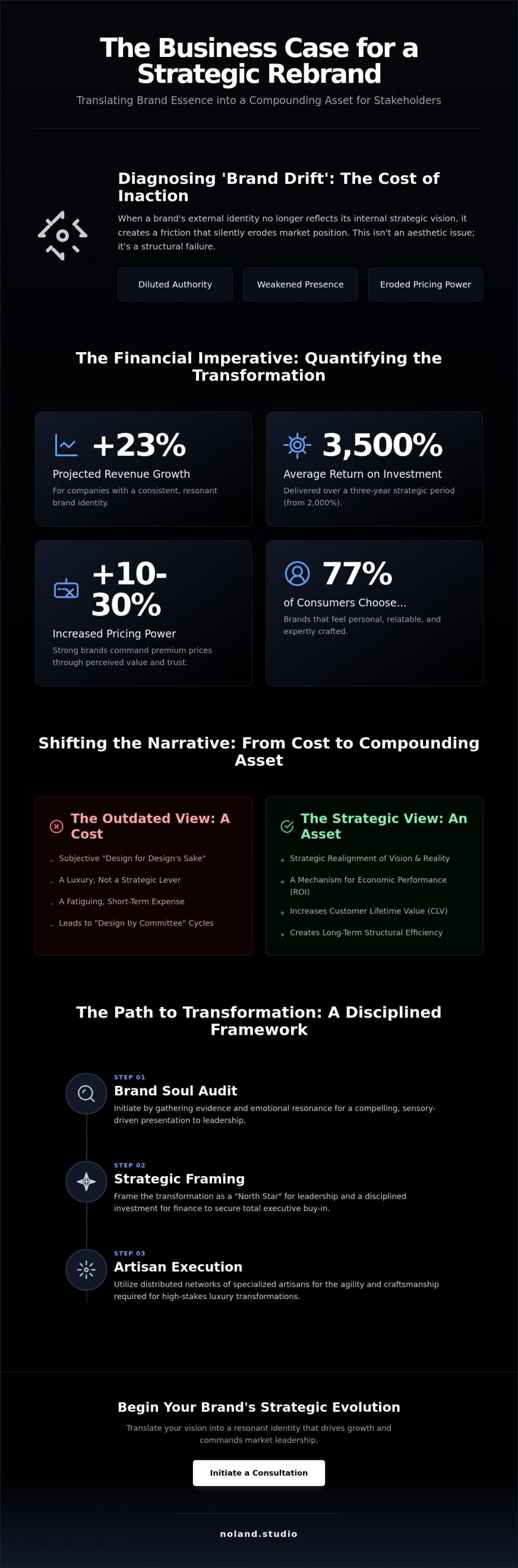
This guide will give you the confidence to lead a high-stakes transformation by translating aesthetic excellence into rigorous business strategy. You’ll master a roadmap that moves beyond subjective taste to highlight how a cohesive identity can drive a 23% increase in revenue and deliver an average ROI of 2,000% to 3,500% over three years. We’ll examine the financial logic, the sensory impact, and the strategic framework needed to prove that evolution is the only path to enduring impact, resonance, and growth.
Key Takeaways
- Identify when your visual presence no longer mirrors your strategic trajectory to prevent brand drift and maintain market relevance.
- Learn how to justify a rebrand to stakeholders by connecting abstract visual systems to concrete metrics like customer lifetime value and premium pricing power.
- Frame the transformation as a “North Star” for leadership and a disciplined investment for financial officers to secure total executive buy-in.
- Discover why distributed networks of specialized artisans offer the agility and craftsmanship required for high-stakes luxury transformations in 2026.
- Initiate the process with a “Brand Soul Audit” to gather the evidence and emotional resonance needed for a compelling, sensory-driven presentation.
Identifying the Strategic Mismatch: Why Rebranding is a Business Necessity
A brand is a living entity, a physical manifestation of an internal philosophy. When the external form no longer mirrors the internal growth, you encounter “Brand Drift.” This misalignment occurs when your visual identity lags behind your strategic trajectory, creating a friction that customers feel even if they cannot name it. A sophisticated Rebranding marketing strategy is not merely an aesthetic choice; it is a vital response to this strategic mismatch. Understanding how to justify a rebrand to stakeholders begins with quantifying this drift. You aren’t just changing a logo. You’re correcting a structural failure that dilutes your authority, weakens your presence, and erodes your pricing power.
The cost of inaction is often invisible until it becomes catastrophic. By 2026, companies with consistent, resonant branding see projected revenue growth of around 23%. Conversely, those clinging to a “soulful” brand that has lost its voice suffer a silent exodus of loyalists. You lose market share not because your product failed, but because your identity stopped communicating your value. When your brand feels dated, your innovation feels suspect. When your visuals feel cheap, your premium positioning vanishes. Recognizing these symptoms is the first step toward reclaiming your place at the intersection of luxury and purpose.
The Gap Between Vision and Manifestation
Luxury thrives on the harmony between what is promised and what is perceived. To identify the gap, you must conduct a rigorous internal audit across every digital and physical touchpoint. Look for “heritage drag,” where outdated design elements anchor you to a past that no longer exists. This is distinct from “heritage value,” which uses history as a springboard for evolution. Inconsistencies in your visual system create a sense of amateurism that high-end clients find repulsive. Brand essence is the foundation of all Brand Strategy & Positioning. If the foundation is cracked, the entire structure of your market presence is at risk.
Market Realities in the Digital-First Era
By 2026, the “aesthetic bar” for premium brands has been raised by rapid digital transformation and the integration of sophisticated AI tools. The “conscious connoisseur” now demands more than just a product; they seek transparency, sustainability, and deep emotional resonance. Static identities fail in a market that is increasingly multi-dimensional and 3D-driven. To succeed, your brand must possess the agility to exist across diverse platforms without losing its core essence. Knowing how to justify a rebrand to stakeholders requires showing them that a static identity is a liability. You must prove that a strategic evolution is the only way to capture the 77% of consumers who prioritize brands that feel personal, relatable, and expertly crafted.
Translating Essence into ROI: The Business Case for Transformation
Securing executive buy-in requires shifting the conversation from aesthetic preference to economic performance. You aren’t asking for a budget to make things look better; you’re proposing a mechanism to increase Customer Lifetime Value (CLV). When you analyze communicating rebrand changes to stakeholders, the most potent argument is the correlation between a refined identity and pricing power. Research indicates that strong brands can support charging 10% to 30% more because they foster deeper trust and perceived value. This perceived craftsmanship allows your margins to expand, turning the initial investment into a recurring dividend.
A unified brand book creates structural efficiency. It eliminates the fragmented, costly cycles of “design by committee” and reduces long-term content creation expenses. By establishing a definitive visual and verbal base, you empower your team to build, scale, and refine without redundant effort. This is how to justify a rebrand to stakeholders who prioritize operational leanness. You’re building an asset that compounds in value rather than an expense that expires with the quarter. If you want to see how these strategic foundations take physical form, our curated design approach bridges the gap between abstract thought and market presence.
The “Psychology of Tactility” is often overlooked in corporate boardrooms, yet it’s the cornerstone of luxury resonance. In a digital-first world, the physical manifestation of your brand, such as the weight of paper or the texture of premium packaging, serves as sensory proof of your internal essence. These tactile moments drive unboxing experiences that become organic social proof. When a brand is felt as much as it is seen, it creates an emotional anchor that purely digital interactions cannot replicate. This sensory ROI is a critical component of a modern, multi-dimensional identity.
Quantifying the Unquantifiable
Data-driven sentiment analysis now allows us to prove emotional resonance with precision. By measuring shifts in brand perception and global recall, we can see the financial impact of a cohesive Naming & Verbal Identity. A high-end web transformation doesn’t just look superior; it can lower customer acquisition costs by 15% to 30% through increased recognition and trust. We use these metrics to move beyond subjective “likes” toward measurable growth.
The Sustainability Dividend
By 2026, eco-centric branding is a vital risk-mitigation strategy. Shifting to premium sustainable packaging attracts a new generation of luxury investors who value longevity and ethical craftsmanship. We prioritize “digital-first” brand assets that are designed to evolve rather than expire. This approach ensures your identity remains relevant across emerging platforms, protecting your investment from the rapid pace of technological obsolescence.
Navigating the Stakeholder Landscape: Addressing Objections
A rebrand is a strategic negotiation as much as it is a creative transformation. To succeed, you must speak the distinct languages of the boardroom, translating abstract concepts into the specific currencies of vision, risk, and growth. Understanding how to justify a rebrand to stakeholders requires a nuanced approach that treats each executive as a partner in a shared evolution. You aren’t just presenting a new visual system; you’re offering a map for the company’s next decade.
For the CEO, the rebrand must be framed as the “North Star.” It’s the physical manifestation of their long-term vision, aligning every department under a singular, cohesive purpose. The CFO, however, focuses on the spreadsheet. You must address the fixed-fee vs. variable-cost debate by positioning the rebrand as a capital investment in a brand asset rather than a recurring operational expense. Proving that a unified identity reduces the long-term cost of fragmented marketing helps shift the perspective from “spending” to “building.”
The CMO faces the daily reality of lead generation and engagement. For them, a rebrand is a tool to repair a leaky funnel where a dated identity is causing potential clients to lose interest. Finally, the Board of Directors acts as the steward of the company’s legacy. They need to know that this transformation preserves the brand’s soul while discarding the “heritage drag” that limits growth. By balancing innovation with deep respect for the brand’s essence, you turn potential critics into passionate advocates.
Common Objections and Strategic Rebuttals
When met with the claim that a rebrand is “too expensive,” point to the compounding costs of maintaining a fractured identity. Inconsistent messaging requires more paid media spend to achieve the same level of recall. To address the fear of alienating current customers, emphasize an “evolutionary” approach that retains core emotional anchors while refining the aesthetic shell. We define the Design Collective model as a fluid, distributed network of specialized experts that eliminates the heavy overhead of traditional agencies while providing deeper, artisan-led craft. This model ensures that every dollar is directed toward expertise rather than administrative bloat.
Building the Internal Branding Committee
Success requires multi-dimensional buy-in. Select “Brand Champions” from across departments to ensure the new identity serves the entire organization. The lead for Art Direction & Content Creation plays a critical role here, acting as the guardian of the visual universe while mentoring other leaders through the transition. This feedback loop should feel like a collaborative refinement process, not a “design-by-committee” exercise that dilutes the vision. By fostering a sense of ownership, you ensure the brand is lived internally long before it’s launched externally.
The Artisan Collective Advantage: Reducing Risk Through Expertise
Traditional “big box” agencies often struggle with the weight of their own inertia. In 2026, premium brands require a more fluid architecture for transformation. A distributed network of experts offers a level of agility that rigid corporate structures cannot match. By matching specialized talent to specific luxury needs, you ensure that every hand touching the project is a master of their craft. This model eliminates the “black box” of agency billing, replacing it with a transparent approach that prioritizes artistic weight over billable hours. Juniors don’t lead luxury; experts do.
This structural shift is a crucial component of how to justify a rebrand to stakeholders. You aren’t asking for a budget to fund an agency’s real estate or administrative bloat. You’re investing in a curated collective of global artisans. This ensures that the investment is directed toward physical manifestation and strategic impact. AI-enhanced tools in the hands of these experts don’t automate the process; they accelerate the path from abstract thought to reality. It’s about discernment. Expertise allows for the building of structural bases that are both technologically savvy and deeply human-centric.
Multidisciplinary Design as a Strategic Asset
The benefit of having 3D visualization, motion design, and strategy under one collective roof is the preservation of brand essence. When global artisans provide a localized touch, brands scaling across borders can maintain their soul while adapting to new sensory environments. This multidisciplinary approach ensures a Digital Design & Web Development strategy that is immersive, sensory, and highly intentional. It transforms a website from a static brochure into a living visual universe.
The Fixed-Fee Model: Financial Predictability
Premium brands prefer the clarity of end-to-end project pricing. It removes the friction of “scope creep” through clear strategic positioning from the outset. Stakeholders find confidence in financial predictability, knowing that the project is defined by outcomes rather than open-ended hours. The “Artisan-Led” process ensures that senior experts guide the transformation, providing a sense of authority and depth that junior-heavy traditional agencies simply cannot replicate. If you’re ready to see how this model can elevate your vision, explore our artisan-led approach to brand evolution.
From Justification to Implementation: Your Next Steps
The transition from a strategic proposal to a living reality requires a disciplined, intelligent approach. You’ve established the business case; now you must manifest the vision. Learning how to justify a rebrand to stakeholders is only the beginning of a transformative process that requires expert guidance and a sensitive touch. To move forward, you must gather the evidence that makes your vision undeniable. This begins with the “Brand Soul” Audit—a rigorous examination of your current assets, market positioning, and future ambitions. It’s a process of discernment where you identify the cracks in your current identity and find the seeds of your future essence.
Crafting the narrative for your final presentation is about moving beyond the dry limitations of a corporate slide deck. You are inviting your leadership on a guided tour of what your brand can become. In 2026, stakeholders expect more than static images; they want a sensory experience. Use 3D Visualization & Motion Design to give physical form to abstract thoughts, allowing the board to feel the weight, texture, and rhythm of the new identity before it’s even launched. This sensory proof bridges the gap between a financial investment and an emotional resonance, making the transformation feel inevitable rather than optional.
Setting a realistic 2026 timeline is vital for maintaining confidence. A successful rebrand is a journey of growth, organization, and refinement. It begins with Strategy & Positioning, moves through the invisible architecture of Naming & Verbal Identity, and culminates in a multi-dimensional visual rollout. Selecting the right partner for this journey is the most critical decision you’ll make. Noland Studio acts as the curator of your brand’s next chapter, providing the high-level vision and localized touch necessary for a global luxury presence. We don’t just design; we manifest.
Preparing the Final Pitch
Your final pitch must focus on “Enduring Impact” rather than “Fleeting Trends.” Stakeholders are wary of design for design’s sake; they want to see a structural base that will support the company for the next decade. Use 3D visualizations to make the vision tangible and evocative. When you show the board exactly how the brand will live in the physical and digital world, you remove the risk of the unknown. End your presentation with a clear, confident call-to-action. The first step toward transformation is a commitment to excellence.
The Noland Method: A Guided Tour of Transformation
We bridge the gap between abstract ideas and physical products through expert-led craft and intentionality. Every luxury touchpoint we create is designed to have a deep sensory impact, ensuring your brand is felt as much as it is seen. This is the Noland Method—a sophisticated process that elevates your internal essence into a powerful market presence. If you’re ready to find a partner who values craftsmanship and strategic depth, we invite you to view our definitive guide to choosing a luxury agency.
Manifesting Your Strategic Evolution
Rebranding is the intentional act of giving physical form to your company’s highest ambitions. By addressing brand drift, quantifying sensory ROI, and navigating the specific concerns of your executive team, you transform a perceived expense into a foundational asset. Success in 2026 requires a shift toward authenticity, sustainability, and a multi-dimensional digital presence. Understanding how to justify a rebrand to stakeholders is the vital bridge between where your brand stands today and its future as a resonant market leader.
The path toward transformation requires discernment, expertise, and a sensitive touch. Noland Studio acts as a curator of identities, offering a distributed network of global digital artisans who specialize in luxury strategy and premium packaging. Our model ensures fixed-fee transparency for even the most complex global projects, allowing you to lead with financial predictability and artistic weight. Begin your brand’s transformation with a strategic consultation at Noland Studio. Your vision deserves to be felt as much as it is seen. It’s time to build a legacy that endures.
Frequently Asked Questions
How do I quantify the ROI of a rebrand for a luxury brand?
ROI in the luxury sector is measured through the intersection of resonance and pricing power. By tracking your ability to maintain premium margins, you can demonstrate how a refined identity fosters deeper trust and exclusivity. Research shows that strong brands can support charging 10% to 30% more because customers perceive higher craftsmanship. You should also analyze shifts in customer lifetime value and sentiment to prove the financial impact of emotional resonance.
When is the right time to involve stakeholders in the rebranding process?
Involving stakeholders during the initial “Brand Soul” Audit ensures their long-term vision is woven into the foundation of the project. You should present strategic findings before any visual work begins to align on the mismatch between your current identity and your future trajectory. This collaborative approach is how to justify a rebrand to stakeholders by making them co-creators of the evolution rather than passive observers of a finished product.
What are the biggest risks of rebranding, and how do we mitigate them?
The primary risk is “heritage drag,” where a new identity disconnects from the brand’s core soul and alienates loyalists. You can mitigate this by adopting an evolutionary approach that preserves emotional anchors while refining the visual and verbal shell. Using 3D visualizations and tactile prototypes makes the abstract tangible, allowing stakeholders to see the physical manifestation of the strategy before a full market rollout. This reduces uncertainty and builds confidence.
How does a rebrand impact our current digital SEO and web performance?
A rebrand typically triggers a temporary fluctuation in search rankings as algorithms re-index new site architectures and visual assets. However, a high-end web transformation ultimately improves long-term SEO by increasing dwell time and reducing bounce rates through superior user experience. When a digital presence feels sophisticated and expertly crafted, it signals authority to both users and search engines, leading to higher quality traffic and improved conversion rates over time.
Can we rebrand our visual identity without changing our name?
You can absolutely evolve your visual identity system while retaining your current name, which is often a strategic choice to preserve established market equity. This approach focuses on refining the visual and verbal base, such as your logo, typography, and premium packaging, to better reflect your current strategic trajectory. It’s a powerful way to signal a new chapter of growth and sophistication without sacrificing the recognition you’ve built over decades.
How much should a comprehensive rebrand cost in 2026?
The investment for a rebrand scales with the complexity of your global strategy and the breadth of your digital and physical assets. Small-scale refreshes require a different structural base than comprehensive corporate transformations that encompass global market research and extensive rollouts across international markets. These costs should be viewed as a long-term investment in relevance and growth, aimed at yielding substantial returns rather than serving as a fleeting transactional expense.
What is the difference between a brand refresh and a full rebrand?
A brand refresh is a cosmetic evolution that updates visual elements like colors or fonts to maintain modern relevance. In contrast, a full rebrand is a strategic realignment that addresses the internal essence and positioning of the company. Knowing how to justify a rebrand to stakeholders requires explaining that a refresh solves visual fatigue, while a rebrand solves a fundamental strategic mismatch between your vision and its external manifestation.