A branding brief is not a document to be completed; it is a strategic manifesto that translates your brand’s internal essence into a roadmap for physical manifestation. Mastering how to write a branding project brief is the only way to ensure your vision isn’t lost in translation. You’ve likely felt the frustration of a vision that feels too abstract to communicate, or the fear that an agency will return generic work because they didn’t grasp the subtle nuances of your heritage. It’s difficult to find the right words when your brand is meant to be felt as much as it’s seen.
This guide will teach you how to articulate your brand’s soul through a strategic blueprint that inspires expert artisans and transforms vision into prestige. By creating a single source of truth, you can align internal stakeholders and external creators around a shared aesthetic purpose. We’ll examine the structural pillars of a luxury brief, including how to define emotional resonance, establish sensory foundations, and build a document that serves as the bedrock for an enduring identity.
Key Takeaways
- Understand the branding brief as the invisible architecture of your identity, serving as the essential bridge between abstract heritage and physical manifestation.
- Master how to write a branding project brief that functions as a strategic manifesto, ensuring your vision is never diluted into generic or uninspired design.
- Learn to distinguish the strategic “Why” of a high-level brand brief from the tactical “How” required for specific creative deliverables.
- Discover a disciplined five-step process to audit, gather, and synthesize the fragments of your brand’s soul into a singular, prestigious narrative.
- Identify the qualities of a design collective that treats your brief as a transformative invitation to curate an enduring, sensory-led identity.
The Branding Brief as the Invisible Architecture of Identity
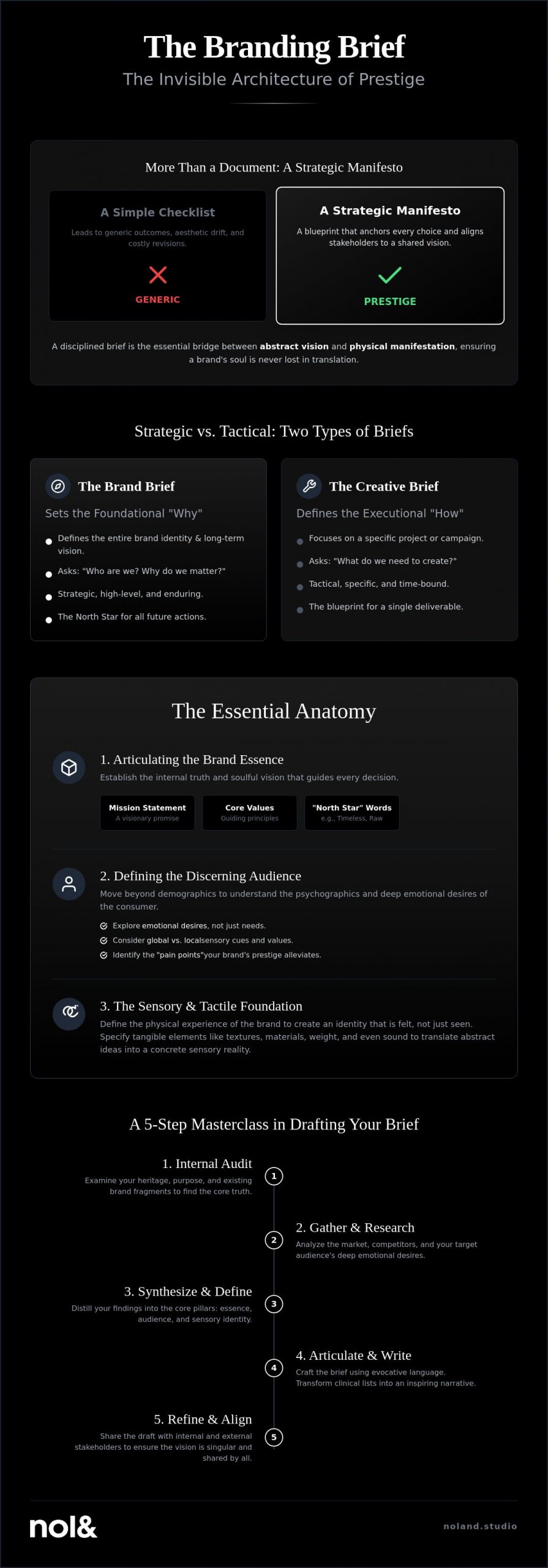
The branding brief is the invisible architecture that anchors every aesthetic choice. It serves as the primary bridge between the abstract world of ideas and the physical world of products. When considering how to write a branding project brief, you must view it as a strategic blueprint rather than a simple administrative task. A document that lacks depth will inevitably lead to generic outcomes. In the premium market, where discernment is the highest currency, a generic approach is a silent killer of prestige. It fails to capture the subtle nuances that distinguish a heritage brand from a temporary trend.
A well-crafted brief aligns global stakeholders around a single, soulful vision. It acts as a primary filter, allowing teams to evaluate every future creative decision against a defined standard of excellence. Without this structural base, projects often suffer from aesthetic drift, where the final identity loses the emotional resonance it was intended to carry. A disciplined brief ensures that everyone involved, from internal marketing teams to external artisans, moves in a synchronized rhythm toward a common goal of aesthetic excellence.
Beyond the Checklist: The Strategic Manifesto
True luxury demands a shift from “what we need” to “who we are” and “why we matter”. This transition elevates the brief from a basic checklist to a strategic manifesto. It establishes the emotional weight and aesthetic excellence required to resonate with a discerning audience. The document becomes a tool for discernment, refinement, and organization. It ensures that every color, texture, and word choice feels intentional rather than accidental. By focusing on internal essence, the brief gives physical form to abstract thoughts, creating an identity that is meant to be felt as much as it is seen.
The ROI of Articulation
Precision in the early stages of a project yields significant dividends. A precise brief reduces project friction and prevents the costly revisions that occur when a vision is misunderstood. By front-loading strategic positioning, you save time in the design phase and allow artisans to focus on craft rather than guesswork. While the Creative Brief Definition often focuses on tactical execution for a specific campaign, the branding brief sets the high-level strategic “Why” for the entire identity. It provides the clarity needed to transform abstract vision into tangible prestige. Ultimately, the branding brief is a living document that evolves alongside the brand, ensuring every future expansion remains rooted in the original essence.
The Essential Anatomy of a High-End Branding Brief
The anatomy of a luxury brief is the skeleton that supports the brand’s skin. It’s the structural base where heritage, purpose, and soul converge to guide the creative process. While a Killer Creative Brief provides a standard for general industry work, a luxury identity requires a more evocative approach. Understanding how to write a branding project brief for a high-end market involves moving beyond clinical lists. You must curate a document that acts as a bridge where internal essence meets physical presence, ensuring every touchpoint resonates with intentionality and aesthetic excellence.
Articulating the Brand Essence
Luxury begins with an internal truth. Your brief should craft a mission statement that feels like a visionary promise rather than a corporate goal. This involves identifying the core values that will guide your Naming & Verbal Identity. To ground the project, define your “North Star” in three evocative words; perhaps “Timeless, Raw, and Elevated”. These words serve as the ultimate filter for discernment, refinement, and organization throughout the brand’s evolution.
Defining the Discerning Audience
A premium consumer isn’t defined by demographics alone. You must explore psychographics and deep emotional desires to understand what truly moves them. Consider the global vs. local nuances of your audience; a client in Tokyo may value different sensory cues than one in Paris. Identify the specific “pain points” your solution alleviates. Does your brand provide the peace of exclusivity, the joy of craftsmanship, or the security of heritage? Clarity here prevents the generic design work that often plagues brands that try to speak to everyone at once.
The Sensory & Tactile Brief
Luxury is felt as much as it’s seen. Your brief must describe the intended “feeling” of the brand through vivid metaphors. Is the brand’s digital presence like a quiet gallery or a vibrant workshop? When briefing for Premium Packaging Design, specify the weight of the paper, the texture of the foil, and the sound of the box opening. These physical touchpoints are where abstract concepts take on a physical presence. Setting high expectations for craftsmanship ensures the final product carries the artistic weight your vision deserves. If you’re ready to transform your abstract ideas into a tangible identity, Noland Studio can help curate your brand’s future.
Distinguishing the Brand Brief from the Creative Brief
To master how to write a branding project brief, one must first recognize that it is distinct from a creative brief. While the terms are often used interchangeably, they serve different masters. The brand brief is the philosophical foundation. It addresses the high-level strategic “Why” and “Who” of the entire identity. It’s an enduring document that outlines the soul, heritage, and long-term trajectory of the brand. In contrast, a creative brief is a tactical implementation tool. It focuses on the “How” for specific deliverables, such as a single digital campaign or a new website launch. Luxury brands must master both to ensure that their internal essence remains consistent as it manifests across digital and physical realms.
Jumping straight into creative execution without a finalized brand brief is a dangerous shortcut. Without the strategic “Why,” visual work becomes hollow. It lacks the structural base needed to withstand market shifts or evolving trends. When you skip the foundational work, you risk receiving generic designs that fail to capture the subtle nuances of prestige. A disciplined approach ensures that every creative spark is grounded in a deeper strategic reality, transforming abstract vision into a tangible, high-end presence.
Strategic Positioning vs. Visual Execution
The brand brief is the guardian of longevity. It ensures that Brand Strategy & Positioning informs every subsequent creative decision. This strategic alignment ensures that the “verbal artisanship” of the brand remains consistent across all touchpoints, from the smallest digital interaction to the most grand physical installation. By defining the brand’s unique white space and heritage upfront, the brief prevents aesthetic drift. It provides a clear standard for discernment, refinement, and organization, allowing the brand to grow without losing its original soul.
Managing the Distributed Creative Network
In a global market, a unified brief is the only way to synchronize a distributed network of artisans. It empowers a multidisciplinary design collective to work in harmony, regardless of time zones or specialized roles. A well-articulated brief provides the high-level vision that guides digital creators, physical craftsmen, and strategic thinkers toward a singular outcome. It allows for a sensitive, localized touch within a global strategic framework. This ensures that the brand feels consistent and intentional, projecting a persona that is disciplined, intelligent, and deeply passionate about storytelling.
A Masterclass in Drafting: 5 Steps to Articulate Your Vision
The transition from abstract thought to physical presence requires a disciplined, multi-stage process. To master how to write a branding project brief, you must act as both an archaeologist and an architect. You begin by excavating the fragments of your brand’s soul, only to assemble them into a structural base that supports a future of aesthetic excellence. This is a journey of synthesis, moving from raw research to a cohesive strategic narrative that serves as a single source of truth for every artisan involved in the project.
Step 1: The Internal Discovery
Internal discovery is far more than a corporate audit; it’s a deep excavation of purpose. Conduct stakeholder interviews to find the “hidden” brand story that often lies buried beneath daily operations. At this stage, gathering competitive intelligence is vital. You aren’t looking to mirror the market, but to identify the “white space” where others are zigging while you zag. By identifying the emotional core of your heritage, you establish a narrative that will resonate deeply with a discerning audience.
Step 3: Visual & Verbal Synthesis
In the modern creative landscape, AI-enhanced tools can act as a powerful catalyst for inspiration. You can use these technologies to generate initial mood boards, word-clusters, or sensory metaphors that spark the imagination. However, true luxury remains a narrative of expert-led craft. While technology can provide the raw fragments of a vision, human discernment is required to select the right aesthetic path. This step culminates in writing the “Brand One-Liner”—a single, evocative sentence that encapsulates the entire project’s soul and direction.
Defining the technical scope is where the visionary meets the practical. Your brief must clearly outline requirements for everything from physical touchpoints to Digital Design & Web Development. In 2026, this also means considering the technical nuances of sensory branding and motion-first design. Ensure your brief accounts for modern regulations, such as AI disclosure requirements and WCAG 2.2 accessibility standards, to build a brand that is as responsible as it is prestigious.
Step 5: The Final Refinement
The final stage is one of radical distillation. Remove corporate jargon and replace it with evocative, purposeful language that inspires rather than instructs. A high-end brief should be “brief”—distilling complex ideas into their most potent, visionary form. Verifying that the document provides clear constraints is essential; true creativity doesn’t flourish in a vacuum, but within the elegant boundaries of a well-defined strategy. If you’re looking to refine your vision into a prestigious identity, partner with a design collective that understands the weight of your heritage.
From Document to Reality: Collaborating with a Design Collective
A branding brief is the spark, but the partnership is the fire. Once you have mastered how to write a branding project brief, the document transforms from a static record into an invitation to a transformative process. The document serves as the invisible architecture that allows a creative partner to build a world around your vision. However, the outcome depends entirely on the nature of that partnership. There is a fundamental difference between an agency that simply takes orders and a design collective that builds visions. Order-takers follow instructions literally, often producing generic work that lacks the soul and nuance required for the premium market. A vision-builder interrogates the brief, looking for the emotional resonance that creates true exclusivity.
Noland Studio acts as a curator of these identities, treating your brief as a sacred blueprint for physical manifestation. We integrate your strategic vision into a fixed-fee, end-to-end branding project, providing the certainty and transparency that luxury clients value. This approach removes the transactional friction often found in traditional agency models, allowing for a focus on time, consideration, and aesthetic excellence. By moving from the written word to a manifested identity, we ensure that the abstract concepts you’ve articulated take on a definitive, prestigious presence in the physical world.
The Artisan Approach to Implementation
Our distributed network of global experts brings a multidisciplinary depth to every brief we receive. We don’t just design; we curate, organize, and refine. The transition from strategic positioning to Art Direction & Content Creation is handled with a sensitive, localized touch. This ensures that the “soul” of your original brief is felt in every final deliverable, whether it’s a digital interface or a piece of premium packaging. By maintaining a single source of truth throughout the execution phase, we prevent the aesthetic drift that can dilute a brand’s heritage during the production process.
Manifesting Your Vision in 2026
The landscape of 2026 demands that a brief embraces both technological innovation and human-led sustainability. These are no longer optional additions; they are the core pillars of modern prestige. When you’re learning how to write a branding project brief for this new era, you must consider how your brand will navigate the complexities of AI disclosure and digital accessibility while remaining rooted in authentic craftsmanship. Choosing the right luxury branding agency is about finding a mentor who can bridge the gap between abstract ideas and enduring impact. If you’re ready to give shape to your vision and transform your brand’s soul into tangible prestige, Connect with Noland Studio today to begin your journey of manifestation.
Manifesting the Unseen: Your Journey to Tangible Prestige
The transition from abstract heritage to a physical brand identity requires more than just aesthetic intuition; it demands a disciplined, strategic blueprint. Mastering how to write a branding project brief ensures that your vision remains the North Star for every artisan involved, preventing the dilution of your brand’s soul into generic design. By distinguishing the high-level strategic “Why” from tactical execution and following a rigorous discovery process, you establish a structural base for an identity meant to be felt as much as it’s seen.
As a multidisciplinary collective of global digital artisans, Noland Studio specializes in luxury strategy and premium packaging. We offer fixed-fee contracts for end-to-end brand transformations, providing the certainty and focus needed to curate a truly exclusive presence. We invite you to partner with Noland Studio to manifest your brand’s soul and transform your visionary ideas into an enduring legacy. Your brand’s story is ready to take its final, prestigious form.
Frequently Asked Questions
What is the difference between a brand brief and a creative brief?
A brand brief defines the strategic foundation and the soul of the identity, while a creative brief acts as a tactical roadmap for specific deliverables. The brand brief is long-term and visionary; the creative brief is project-specific and implementation-focused. Mastery of both ensures that your aesthetic excellence remains consistent across every physical and digital touchpoint, acting as the bridge between abstract heritage and physical manifestation.
How long should a branding project brief be?
Potency is far more valuable than length in a high-end brief. Ideally, the document should be concise enough to serve as a visionary manifesto, typically ranging from three to five pages of high-density strategic thought. Distilling complex ideas into their most potent form ensures the document remains a single source of truth that is actually read and followed by expert artisans and stakeholders.
Who should be responsible for writing the brand brief?
The brand brief should be a collaborative effort led by the brand founder or internal strategic stakeholders in partnership with an expert branding collective. While the client provides the internal essence and heritage, the strategic partner helps synthesize these fragments into a cohesive narrative. This alignment ensures the final document reflects both the business purpose and the designer’s need for clear, actionable constraints.
Can I use AI to write my branding brief?
AI tools are excellent catalysts for gathering raw data, generating word-clusters, or creating initial mood boards during the discovery phase. However, when considering how to write a branding project brief for the luxury sector, human discernment must remain the final filter. Expert-led craft is required to translate abstract emotions into a prestigious identity, something technology cannot yet replicate with the necessary sensitivity.
What are the most common mistakes when writing a branding brief?
The most frequent error is producing a generic document that focuses on what needs to be made rather than why the brand exists. Skipping the internal discovery phase or failing to define a clear target audience leads to uninspired design work that lacks emotional resonance. Another mistake is using corporate jargon instead of evocative language that inspires the creative team to push the boundaries of craftsmanship.
How do I define a ‘luxury’ tone of voice in a brief?
A luxury tone of voice is defined by nuance, restraint, and an emphasis on heritage or craftsmanship. In your brief, describe the brand’s persona through metaphors that suggest exclusivity and intentionality. Focus on the sensory impact of the language; it should feel sophisticated and visionary, projecting an image of a brand that values time and consideration over quick, transactional interactions.
Should I include a budget in my branding project brief?
Including a budget range is vital for aligning expectations and ensuring the proposed creative solutions are feasible. It allows the design collective to understand the scale of the transformation and select the appropriate materials, technologies, and artisans for the project. Transparency regarding investment levels front-loads the strategic positioning and prevents friction during the later stages of the manifestation process.
How do I brief for a global brand identity versus a local one?
Briefing for a global brand identity requires a high-level strategic framework that can be adapted to various cultural contexts without losing its core essence. For a local identity, the brief should emphasize a sensitive, localized touch and specific regional nuances. A successful luxury brief balances these two forces, ensuring the brand feels globally connected while remaining deeply rooted in its specific environment and heritage.