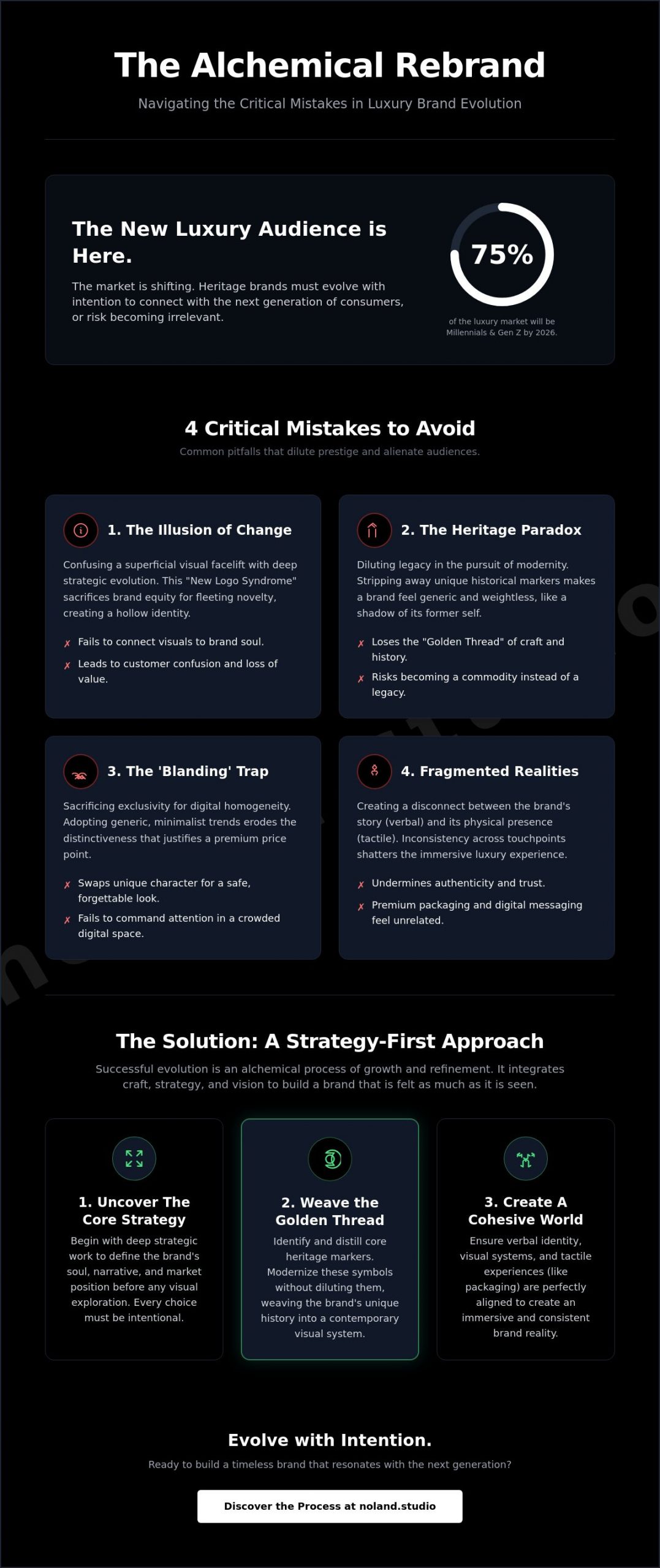
By the end of 2026, Millennials and Gen Z will constitute 75% of the global luxury market, yet many heritage houses are still speaking a language their new audience doesn’t recognize. It’s a profound challenge to modernize a legacy without shedding the prestige that defines its very existence. You understand that a brand is more than a mark; it’s a curated experience of history, emotion, and aesthetic excellence. However, the pressure to adapt often leads to trend-chasing that can alienate your most loyal high-net-worth patrons. Understanding the critical mistakes to avoid when rebranding a luxury business is essential for any leader who wishes to evolve with intention rather than desperation.
We agree that a brand’s soul must remain intact even as its visual identity shifts to meet a digital-first world. This guide promises to show you how to refine your positioning, elevate your visual systems, and manifest your values in a way that justifies premium pricing. We will explore a strategy-first approach that ensures your brand remains a timeless sanctuary of craft, connection, and enduring value across every touchpoint. By moving from abstract ideas to physical manifestation, you can build a brand that is felt as much as it is seen.
Key Takeaways
- Move beyond the surface level by treating rebranding as an alchemical process of growth, organization, and refinement rather than a mere cosmetic update.
- Balance the heritage paradox by learning the critical mistakes to avoid when rebranding a luxury business, ensuring your legacy is honored while your vision expands.
- Reject the digital homogeneity of “blanding” to protect your brand’s exclusivity through a bespoke visual identity that commands attention.
- Bridge the gap between abstract storytelling and physical presence by aligning your verbal identity with the sensory impact of premium packaging design.
- Leverage the intersection of human-centric expertise and AI-enhanced vision to curate an identity that resonates with the next generation of luxury consumers.
The Illusion of Change: Why Visual Facelifts Without Strategic Soul Fail
True luxury is never a surface-level affair. It’s a profound expression of heritage, craft, and intentionality that requires a disciplined approach to change. One of the most frequent mistakes to avoid when rebranding a luxury business is confusing a cosmetic facelift with a strategic evolution. A successful rebranding process must be an alchemical journey that gives physical form to abstract thoughts. It involves a deliberate process of growth, organization, and refinement.
When high-end sectors fall victim to “New Logo Syndrome,” they often sacrifice decades of built-up equity for a fleeting sense of novelty. They swap a classic serif for a minimalist sans-serif without questioning if that change serves the brand’s internal essence. This creates a hollow identity. Strategy-first design is the only way to preserve brand equity during a transition. It ensures that every aesthetic choice is rooted in a structural base that justifies your presence in the market. Your visual identity shouldn’t just be seen; it should be felt as a manifestation of your brand’s soul.
The Distinction Between Fashion and Luxury Strategy
Fashion lives in the ephemeral now; luxury resides in the eternal always. While fashion thrives on the seasonal and the fleeting, luxury demands a longer-term vision that transcends cycles. Chasing trends is a dangerous game for prestige houses because it erodes the very sense of timelessness that high-net-worth individuals seek. A luxury identity must act as a sanctuary of stability. When you align your visual identity with a core brand narrative rather than a mood board of the month, you protect the prestige that took years to build. Modernity should never come at the cost of your distinctive heritage markers.
The Cost of Strategic Misalignment
High-net-worth audiences possess a refined sense of discernment. They recognize immediately when a brand’s outward appearance doesn’t match its internal essence. This friction leads to confusion and a swift loss of perceived value. This is why Brand Strategy & Positioning is the non-negotiable first step in any creative process. Without a clear narrative, premium pricing feels arbitrary rather than earned. You cannot expect a consumer to pay a premium for a brand that doesn’t understand its own story. Inconsistency in strategy is among the costliest mistakes to avoid when rebranding a luxury business, as it dismantles the emotional resonance required for true loyalty.
The Heritage Paradox: Diluting Legacy in the Pursuit of Modernity
Luxury exists in a state of perpetual tension. It’s a delicate dance between honoring the archives and embracing a visionary future. When heritage houses attempt to “modernize,” they often strip away the very markers that signify their prestige. This dilution is one of the most critical mistakes to avoid when rebranding a luxury business. True evolution requires deep archival research before a single pixel is moved. You must identify the “Golden Thread,” that singular essence of craft and history, and weave it into a contemporary context. Without this structural base, the brand loses its weight and becomes a mere shadow of its former self.
To gain a deeper appreciation for how historical narratives and symbolism—such as the cultural significance of color—can inform a brand’s visual identity, you might visit Nicholas Wells Antiques to explore their insights on the fine and decorative arts.
The risk of losing your soul is real in a digital-first world. In an era where digital fluency is mandatory, brands often struggle with balancing accessibility with scarcity. If you lean too far into the modern, you risk becoming a commodity. If you stay too far in the past, you become a museum. The goal is to curate an identity that feels as much like a legacy as it does a revelation.
Modernizing Without Mimicry
Refining heritage symbols into a modern visual system isn’t about mimicry. It’s about distillation. By early 2026, we’ve seen a decisive shift away from the “blanding” era. Successful luxury houses are now reclaiming their unique flourishes. For example, several high-end European labels have recently reintroduced ornate crests and bespoke serifs that were previously discarded for minimalist fonts. They realized that distinctiveness is the ultimate currency. Avoid the “Not Your Mother’s” marketing trope; it’s a cliché that alienates loyal high-net-worth customers while feeling forced to younger generations. Instead, aim for a transformation that feels like a natural progression of the brand’s soul.
The Role of Heritage in New Luxury Brands
Even for brands born in the digital age, heritage can be intentionally curated. It’s not about inventing a fake history but about grounding the brand in tangible craftsmanship and strategic storytelling. This is where Naming & Verbal Identity becomes the invisible architecture of your legacy. For a new luxury brand, heritage is built through the sensory impact of artisanal techniques and the precision of your brand voice. By giving physical form to abstract values, you create an identity that feels established from day one. If you’re ready to refine your brand’s internal essence into a timeless visual identity, exploring a strategy-led approach can ensure your legacy remains unbroken.
The ‘Blanding’ Trap: Sacrificing Exclusivity for Digital Homogeneity
Luxury is a sanctuary of the singular. Yet, a silent epidemic of “blanding” has swept through high-end sectors, replacing distinctive heritage with interchangeable, minimalist masks. This trend toward sans-serif homogeneity is one of the most subtle yet damaging mistakes to avoid when rebranding a luxury business. When every brand adopts the same aesthetic language, the sense of exclusivity evaporates. You’re no longer selling a unique legacy; you’re participating in a race to the middle. Exclusivity dies when your identity becomes indistinguishable from a dozen others on a smartphone screen.
Luxury consumers don’t just buy products. They buy stories, textures, and the feeling of belonging to an elite circle. Generic design strips away the emotional style that justifies a premium. It replaces the “internal essence” of a house with a clinical, corporate shell. To stand out in a sea of digital interfaces, you must reclaim the artistic weight of your identity. This means moving beyond the safe and the standard. It requires the courage to be ornamental, complex, and deeply intentional. True prestige is felt through the friction of the unique, not the smoothness of the generic.
The Return of Tactility and Ornamentation
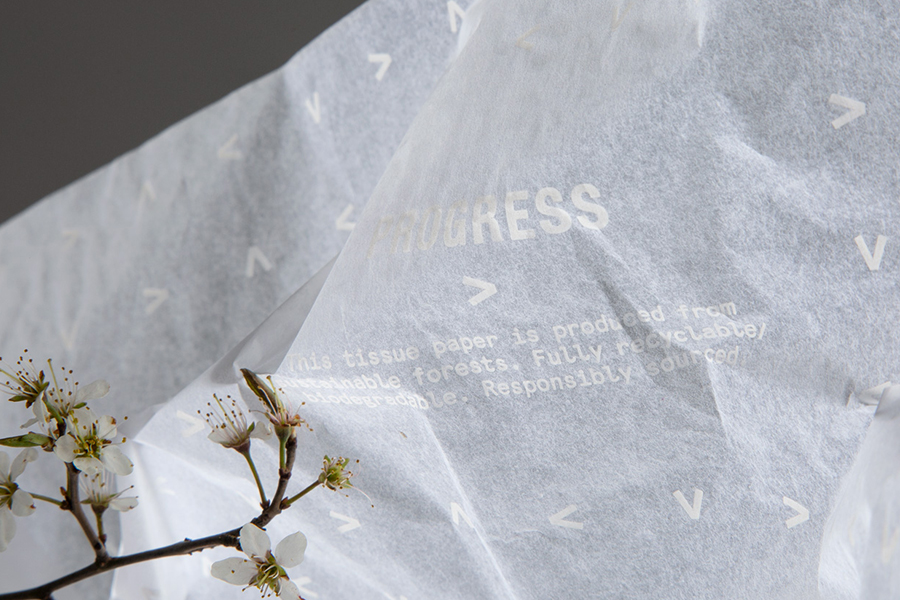
Digital smoothness often lacks the sensory impact that luxury demands. As we move through 2026, we see a powerful resurgence of tactility. Physical touchpoints like premium packaging and bespoke stationery must resist the pull of digital trends. Custom typography acts as the brand’s unique verbal signature. It provides a visual rhythm that a standard font can never replicate. By selecting materials that communicate weight and texture, you give physical form to abstract thoughts. This physical presence grounds the brand in reality, providing a necessary contrast to the ethereal nature of the digital world.
Digital Alchemy: Crafting Immersive Experiences
The digital realm should not be a place of compromise. Too often, luxury brands settle for standard e-commerce templates that feel cold and transactional. True digital alchemy involves crafting immersive worlds where the visitor feels the brand’s presence in every interaction. Through the intersection of Digital Design & Web Development and high-level artistry, you can restore the sensory impact lost in translation. 3D visualization and motion design are not mere ornaments. They are tools of discernment. They allow a brand to manifest its craftsmanship in a virtual space, ensuring the digital unboxing is as evocative as the physical one. Avoiding the trap of homogeneity is among the most vital mistakes to avoid when rebranding a luxury business in this hyper-connected era.
Fragmented Realities: The Risk of Inconsistent Verbal and Tactile Touchpoints
A luxury brand is a curated space, a sanctuary where every detail is intentional. One of the primary mistakes to avoid when rebranding a luxury business is allowing the brand to become a collection of disjointed fragments. A stunning visual identity system is only half the journey. If that visual excellence is paired with a generic, soulless brand voice, the consumer’s emotional resonance is severed. The transition from a sophisticated Instagram feed to a lackluster retail floor or a corporate-sounding email creates a jarring dissonance. This lack of continuity erodes the trust and exclusivity that high-net-worth individuals demand. They expect a brand to inspire, to connect, and to endure across every single touchpoint.
The unboxing experience serves as the most critical physical touchpoint in our digital-first era. It’s the moment abstract promises take on physical form. Every detail must be disciplined, intelligent, and deeply passionate about the brand’s story. The weight of the cardstock, the sound of the paper, and the scent of the packaging must mirror the digital performance. Art Direction is the discipline that ensures this unified visual universe remains intact. It acts as a bridge between the abstract world of ideas and the physical world of products, curating identities that are meant to be felt as much as they are seen.
Verbal Artisanship: The Invisible Architecture
Naming systems and verbal identities are the invisible architecture of luxury. They must be as considered as any visual system or physical structure. A common pitfall is falling back on corporate speak or industry jargon that lacks artistic weight. This clinical approach fails to evoke the internal essence of the house. Your verbal identity should be a curated blend of strategic business language and high-end design terminology. It should feel like a guided tour through a curated space, moving logically from philosophical foundations to strategic implementation. When your voice lacks discernment, your premium pricing loses its justification.
The Synergy of Packaging and Digital Presence
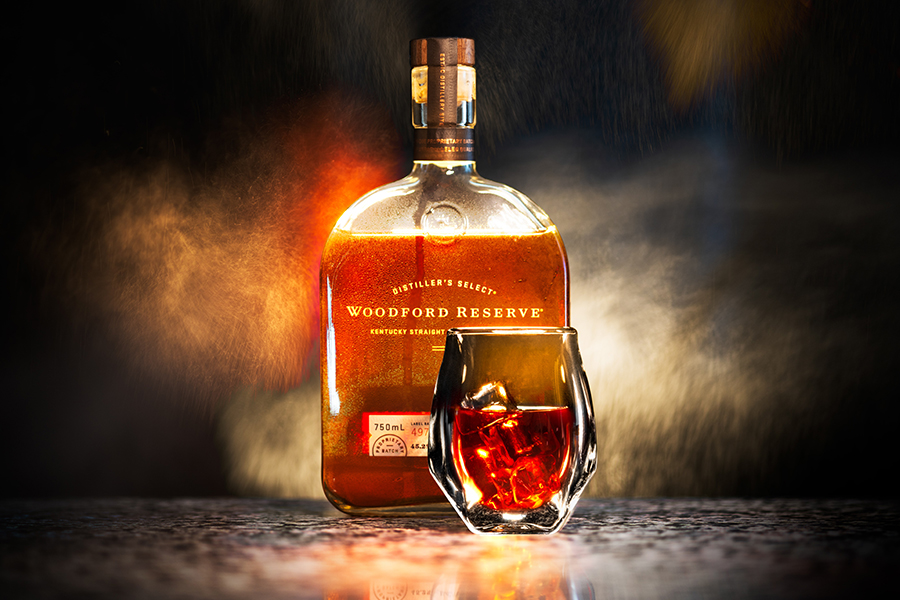
Modern prestige is increasingly defined by material innovation and the manifestation of sustainable values. High-end consumers now expect genuine environmental action to be woven into the brand’s aesthetic excellence. This synergy is perfectly captured through expert Art Direction & Content Creation, where the narrative of the product is told with the same level of craft in a film as it is in the hand. In sectors like luxury spirits, the tactile feel of a label must match the visual depth of the 3D visualization used online. If you are ready to give physical form to your brand’s abstract values, partner with a studio that understands the intersection of strategy and sensory impact.
The Alchemical Rebrand: Integrating Craft, Strategy, and AI-Enhanced Vision
Rebranding in 2026 is an alchemical process. It requires a fusion of high-level vision, sensitive touch, and strategic purpose. The traditional agency model often fails to provide the agility and depth needed for high-end sectors. Instead, a multidisciplinary collective offers a more rhythmic approach to growth, organization, and refinement. This distributed network of experts acts as a bridge between the abstract world of ideas and the physical world of products. One of the most forward-thinking mistakes to avoid when rebranding a luxury business is clinging to rigid, corporate structures that stifle the artistic weight of a house. A modern rebrand must be a curated manifestation of your brand’s internal essence, designed to be felt as much as it is seen.
The journey of transformation involves giving physical form to abstract thoughts. This process isn’t a frantic race toward the new; it’s a steady, intentional evolution. In a market where organic growth is projected at 6% for 2026, the need for a strategy-first approach is paramount. You must build a structural base that justifies your premium pricing while ensuring your story remains interpreted correctly by both human consumers and AI shopping agents. Avoiding the common mistakes to avoid when rebranding a luxury business means choosing a partner who prioritizes longevity and emotional resonance over fleeting, transactional trends.
Human Discernment in the Age of AI
AI is a tool for refinement, not a replacement for craftsmanship. In 2026, tools like Canva AI 2.0 and Midjourney V7 have become standard in the creative process, yet they lack the discernment of expert-led art direction. These technologies allow for rapid 3D visualization and motion design, but the soul of the work must still be guided by expert hands. We employ a human-centric approach to digital transformation. We use technology to enhance our vision, ensuring that abstract concepts take on a physical presence with precision. Expert-led craft remains the primary differentiator in a world of mere automation. It’s the difference between a generic digital interface and an immersive visual universe.
Building Soulful Brands for the Future
The Noland Studio philosophy is rooted in the intersection of luxury and strategic purpose. We are curators of identities that inspire a sense of transformation. Our process moves logically from philosophical foundations to strategic implementation, ensuring every visual identity system and naming project carries a sense of exclusivity and intentionality. We believe in building structural bases that allow brands to endure across all touchpoints, from digital design to premium packaging. The future of luxury belongs to those who can balance technological savvy with a disciplined, intelligent, and deeply passionate commitment to storytelling. Give shape to your brand’s next evolution with Noland Studio.
Manifesting Your Brand’s Eternal Future
Navigating a rebrand in 2026 requires more than a visual shift; it demands a profound distillation of your brand’s soul. We’ve explored how a strategy-first approach preserves your prestige and why honoring your heritage markers prevents the hollow anonymity of digital homogeneity. By internalizing the critical mistakes to avoid when rebranding a luxury business, you ensure that your house doesn’t just adapt to the future but actively shapes it. True transformation happens at the intersection of artisanal craft and strategic purpose.
As a Red Dot Design Award winner, Noland Studio operates as a distributed collective of global digital artisans dedicated to high-level vision. We specialize in luxury strategy and sustainable packaging design, giving physical form to abstract thoughts through disciplined expertise. If you’re ready to refine your identity and command emotional resonance across every touchpoint, we’re here to act as your visionary mentor. Elevate your brand with Noland Studio’s multidisciplinary expertise. Your journey toward a timeless legacy begins with a single, intentional step.
Frequently Asked Questions
What is the biggest mistake luxury brands make when rebranding?
The most significant error is treating a rebrand as a surface-level facelift rather than a strategic evolution. Many houses fall into “New Logo Syndrome,” discarding decades of heritage for a fleeting aesthetic. This is one of the primary mistakes to avoid when rebranding a luxury business because it fails to address the brand’s internal essence. Without a structural base of strategy and positioning, new visuals lack the artistic weight required to justify premium pricing.
How do you modernize a heritage brand without alienating long-time customers?
Modernization should feel like a revelation, not a replacement. You must identify the “Golden Thread” of your heritage through deep archival research before initiating any changes to visual identity systems. By distilling classic symbols into contemporary forms, you respect the loyalty of high-net-worth patrons while inviting a new generation. It’s a process of refinement, organization, and growth that preserves the brand’s soul while expanding its visionary reach.
Why is “blanding” a threat to luxury businesses in 2026?
Blanding creates a digital homogeneity that erodes the sense of rarity essential to luxury. When brands adopt interchangeable minimalist logos, they sacrifice their distinctive voice for mobile-first convenience. In 2026, exclusivity is the ultimate currency. Consumers seek the friction of the unique; they want to feel the artistic weight of a brand rather than encountering a clinical, corporate shell that looks like every other competitor in the digital space.
How often should a luxury brand update its visual identity?
A luxury brand shouldn’t chase seasonal cycles but should instead focus on enduring impact. While a visual identity system might be refined every decade to maintain digital fluency, the core strategy should remain a sanctuary of stability. Frequent changes suggest a lack of discipline and can confuse your audience. Instead of a complete overhaul, consider a steady, intentional evolution that reflects the brand’s maturation and its place in a shifting global market.
What is the role of verbal identity in a luxury rebrand?
Naming and verbal identity act as the invisible architecture of your brand’s presence. A beautiful visual universe is incomplete without a brand voice that carries the same level of aesthetic excellence. Overlooking the narrative is one of the common mistakes to avoid when rebranding a luxury business. If your voice sounds like “corporate speak” or generic marketing copy, you lose the emotional resonance and storytelling power that defines true prestige.
Can AI be used in high-end luxury branding without losing the human touch?
AI serves as a powerful tool for refinement and 3D visualization, but it cannot replace the discernment of expert-led craft. We use technology to give physical form to abstract thoughts with greater precision. However, the final output must be guided by expert hands to maintain the human-centric narrative. Luxury is defined by intentionality; it’s a sensory impact that requires a sensitive, localized touch that mere automation cannot replicate.
How do you ensure consistency between digital and physical luxury touchpoints?
Consistency is achieved through disciplined art direction that bridges the gap between the screen and the hand. The unboxing experience must match the digital design and web development performance in every detail. Whether it’s the tactile weight of premium packaging or the motion design on a website, every touchpoint must feel like a guided tour through a curated space. This unified vision ensures the brand’s story is felt consistently across the entire global journey.