Prestige is undergoing a profound, necessary transformation. As the global luxury beauty packaging market scales toward $19.73 billion in 2026, the definition of excellence has shifted from the weight of excess to the intelligence of restraint. You likely feel the tension between maintaining a high-end aesthetic and meeting the urgent demand for environmental integrity. There’s often a lingering fear that selecting sustainable luxury packaging materials means settling for a “crafty” or “cheap” finish that fails to resonate with a discerning audience.
We believe that sustainability isn’t a constraint on luxury; it’s the new medium for sensory storytelling, structural innovation, and emotional resonance. This guide provides a strategic roadmap to harmonizing environmental responsibility with uncompromising aesthetics. You’ll gain access to a curated selection of prestige-level materials, a framework for integrating these choices into your brand’s physical manifestation, and the confidence to lead in a circular economy. We’ll examine how to navigate the complexities of sourcing, durability, and the evolving global regulations that define the current landscape.
Key Takeaways
- Understand the fundamental shift from conspicuous consumption to conscious artisanship as the new benchmark for high-end brand identity.
- Identify high-performance sustainable luxury packaging materials like mycelium and algae that offer evocative textures and home-compostable properties.
- Learn the sensory secrets of “the thud factor” to maintain the structural weight and prestige of your brand through innovative sustainable composites.
- Gain a strategic framework for conducting Life Cycle Assessments to ensure your environmental claims are data-backed, transparent, and legally compliant.
- Discover how to leverage 3D visualization and global expert networks to transform visionary sustainable concepts into tangible, premium packaging realities.
The Evolution of Prestige: Why Sustainability Defines Luxury in 2026
Prestige has found a new language. It’s a dialect spoken through texture, origin, and restraint. In 2026, the global luxury market no longer measures value by the weight of gold foil or the gloss of virgin plastic. Instead, we’re witnessing a profound transition from conspicuous consumption to conscious artisanship. This shift isn’t merely a trend; it’s a fundamental evolution of the brand soul. High-end consumers now possess a sharpened discernment, recognizing that Sustainable packaging isn’t a compromise but a hallmark of true exclusivity. For these individuals, plastic has become a signifier of the mass market, while the use of innovative sustainable luxury packaging materials suggests a brand that values craft over convenience.
The “New Luxury” is defined by a triad: ethics, aesthetics, and enduring impact. When these three elements converge, packaging becomes more than a container. It acts as the first physical manifestation of a brand’s essence. It’s the moment an abstract identity takes on a physical presence, creating a feeling of intentionality that is felt as much as it’s seen. By prioritizing sustainable luxury packaging materials, creators can build a structural base that supports a narrative of expert-led craft and sensory excellence.
From Disposable to Collectible
We’re seeing a rise in “forever packaging,” particularly within the spirits and fragrance sectors. Objects are no longer designed to be discarded. They’re crafted to be kept, displayed, and cherished. This approach transforms a simple box into a decorative object, elevating the creative work into a form of transformative process. By designing for longevity, brands simultaneously reduce their carbon footprint and deepen brand recall. It’s a process of growth where the product’s vessel becomes as valuable as the contents themselves, ensuring a sense of exclusivity that lasts well beyond the initial unboxing.
The Strategic Advantage of Material Transparency
Trust is the ultimate luxury. Radical honesty about the supply chain creates a sense of intentionality that modern consumers crave. We can use tools like QR codes and digital twins to narrate a material’s origin story, moving from abstract concepts to verified facts. This level of transparency must be deeply rooted in your Brand Strategy & Positioning. When your material choices align with your internal essence, the result is a multidimensional experience that feels both visionary and grounded. It’s about building a structural base of trust that distinguishes a brand as one focused on enduring impact rather than fleeting trends.
The Material Palette: Innovative Substances Shaping the Future
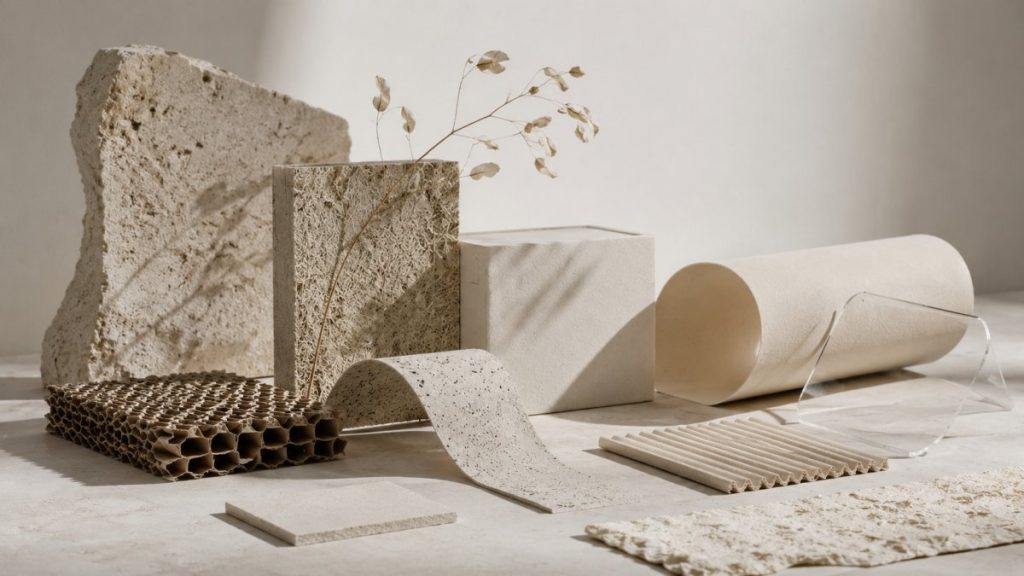
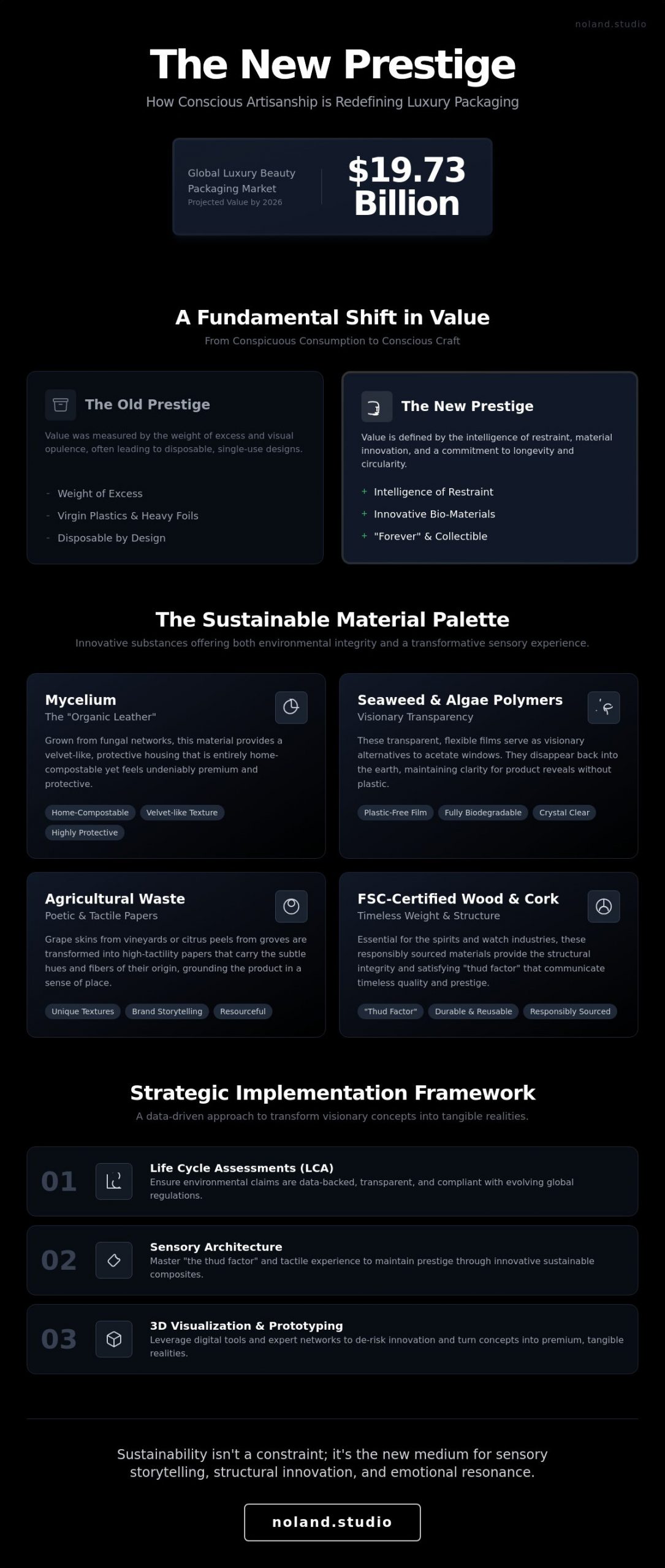
The transition from abstract brand values to physical form requires a curated palette. We’re moving beyond standard recycled cardstock into a territory where biology meets high-end design. To master sustainable luxury packaging materials, one must look toward substances that offer both environmental integrity and a transformative sensory experience. Mycelium-based packaging is a prime example. Grown from fungal networks, it acts as the “organic leather” of the structural design world. It provides a velvet-like, protective housing that is entirely home-compostable, yet feels undeniably premium. The EPA on Sustainable Packaging highlights the strategic importance of managing materials throughout their lifecycle; bio-based substances like mycelium represent the pinnacle of this circular philosophy.
Innovation continues with seaweed and algae polymers. These transparent, flexible films serve as visionary alternatives to traditional acetate windows. They disappear back into the earth without a trace, yet maintain the clarity required for luxury product reveals. For brands rooted in heritage, agricultural waste upcycling offers a poetic narrative. Grape skins from vineyards or citrus peels from groves are transformed into high-tactility papers. These materials carry the subtle hues and fibers of their origin, grounding the product in a specific sense of place. When paired with FSC-certified wood or cork, the result is a packaging suite that possesses the “thud factor” and timelessness essential for the spirits and watch industries. Even fashion waste finds a second life here. Repurposed leather and cotton fibers are pressed into rigid luxury boxes, merging the worlds of couture and structural engineering.
Cellulose and Paper Innovations
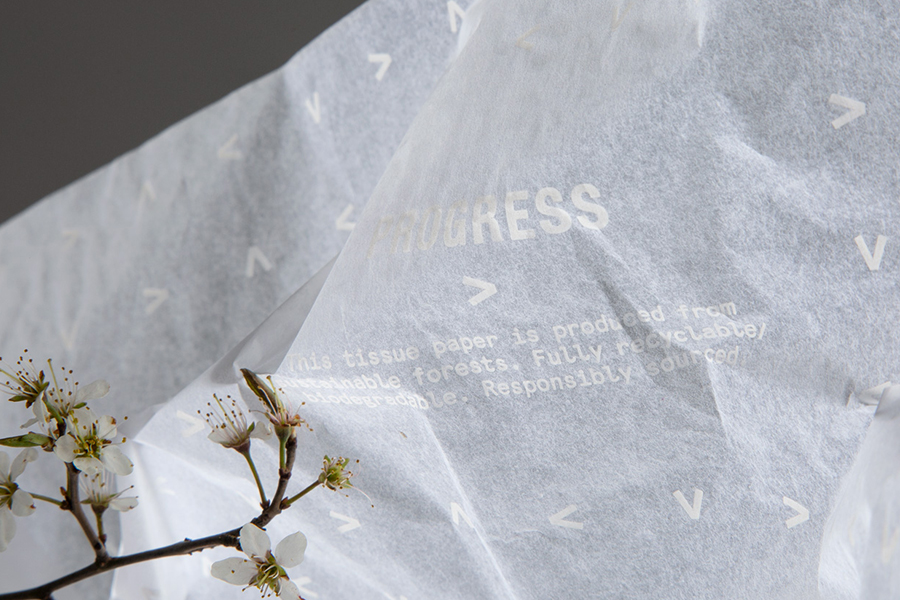
Micro-fibrillated cellulose (MFC) is revolutionizing structural strength. It allows us to create incredibly thin, lightweight containers that possess the rigidity of much heavier boards. For luxury cosmetics, stone paper offers a tree-free, water-resistant alternative made from calcium carbonate. It has a smooth, cool touch that feels like marble. We’re also seeing a return to raw, uncoated, high-grammage recycled boards. These materials embrace their imperfections, signaling a “quiet luxury” that values the unrefined and the authentic over the synthetic.
Bio-Polymers and Compostable Coatings
The era of plastic laminates is ending. We now utilize water-based, biodegradable varnishes that provide a protective sheen without compromising recyclability. PHA and PLA bio-polymers are increasingly common in high-end secondary packaging. These materials are engineered to ensure that “compostable” never equates to “fragile.” They withstand the rigors of global shipping while maintaining their aesthetic excellence. If you’re ready to evolve your brand’s physical identity, our studio provides expert Premium Packaging Design that bridges the gap between radical innovation and enduring prestige.
The Sensory Architecture of Sustainable Luxury
Luxury is a sensory dialogue. It is the silent communication between a brand’s essence and the consumer’s perception. While standard eco-options often feel lightweight or clinical, mastering sustainable luxury packaging materials requires an obsession with the “thud factor.” This is the satisfying weight that signals value, durability, and substance. By utilizing high-density sustainable composites and mineral-filled bio-polymers, we can replicate the gravitas of traditional luxury without the environmental debt. It is about giving physical form to an abstract promise of quality, ensuring the vessel feels as significant as the object it protects.
We move beyond the superficial shine of plastic foils. Instead, we utilize micro-embossing and deep debossing to create intricate, light-catching patterns directly into the fiber. This creates a visual depth that is tactile, sophisticated, and enduring. Soulful color palettes are achieved through natural pigments and mineral dyes, offering a richness that synthetic inks cannot mimic. These colors don’t just sit on the surface; they are integrated into the material’s very soul. Even the olfactory dimension is considered. The subtle, earthy scent of raw, untreated fibers or the faint aroma of upcycled citrus peels enhances the unboxing ritual. It grounds the experience in a moment of authentic connection that feels both visionary and grounded.
Tactility as a Brand Signature
The psychology of touch is a powerful tool for differentiation. Rougher, natural textures often signal a raw authenticity that high-gloss plastics lack. We often balance these matte, organic surfaces with high-gloss sustainable accents to create a rhythmic sensory experience of growth, organization, and refinement. The thoughtful selection of sustainable luxury packaging materials allows a brand to manifest its identity in a way that is felt as much as it is seen. This deliberate choice of material reinforces your Naming & Verbal Identity, ensuring that the physical touch of the box matches the sophisticated tone of your brand’s voice.
Sound and Kinetic Luxury
The acoustics of the unboxing are just as critical as the aesthetics. We engineer the perfect friction-fit lid to produce a controlled, air-cushioned “whoosh” upon opening. Magnetic closures are being replaced by innovative paper-based mechanical locks that provide a crisp, audible “click.” To perfect these movements, we employ advanced 3D visualization and motion design to test packaging kinetics long before a single prototype is manufactured. This digital artisanship allows us to simulate the physical resistance of fibers, the tension of paper hinges, and the structural integrity of the box. It ensures that every fold, slide, and seal performs with grace, precision, and intent.
Strategic Implementation: From Concept to Tangible Reality
The path from visionary concept to physical manifestation requires more than artistic intent; it demands a rigorous, strategic framework. As we enter the second half of 2026, the regulatory landscape has become a primary driver of innovation. The EU Packaging and Packaging Waste Regulation (PPWR) becomes applicable on August 12, 2026, mandating stricter traceability, waste reduction, and reuse across all member states. Simultaneously, the UK’s Plastic Packaging Tax rate has reached £228.82 per tonne for materials with less than 30% recycled content. To thrive, brands must employ a Life Cycle Assessment (LCA) to validate every choice. This ensures that sustainable luxury packaging materials aren’t just an aesthetic preference but a scientifically sound pillar of your brand’s longevity.
Transitioning from legacy materials doesn’t happen overnight. It’s a phased process of growth, organization, and refinement. We utilize advanced 3D visualization and AI-driven design tools to prototype shapes and textures, which minimizes physical waste during the early creative stages. This digital artisanship allows for high-level discernment before a single gram of material is sourced. By sourcing through distributed expert networks, we find the niche artisans capable of producing the rare, high-performance bio-materials your identity requires. If you’re ready to bridge the gap between abstract ideas and physical products, our studio provides the Premium Packaging Design expertise to lead this transformation.
Sourcing and Production Management
Precision in production is non-negotiable. We prioritize localizing production to reduce the “hidden” carbon costs of long-distance transport. This approach requires vetting every supplier for ethical labor practices, renewable energy use, and technical expertise. Coordinating with high-end manufacturing partners ensures that the intricate details of your visual identity are executed with the sensitivity and localized touch that luxury demands. It’s a multidimensional effort to ensure every touchpoint is disciplined, intelligent, and impactful.
Avoiding the Greenwashing Trap
Modern consumers possess a sensitive radar for inauthenticity. Simply labeling a box as “recyclable” is no longer sufficient; the focus has shifted toward true circularity and regeneration. Communicating these values requires a delicate balance to ensure the brand’s exclusive aura remains intact. In 2026, greenwashing in the luxury sector is the act of cloaking standard linear production in the language of circularity without the verifiable data or structural innovation to support the claim. We help brands move beyond vague promises toward a narrative of expert-led craft and enduring impact.
The Noland Studio Approach: Crafting Multidimensional Brand Journeys
At Noland Studio, we view the creation of packaging as a disciplined act of giving physical form to abstract thought. We believe that the vessel should be as intentional as the object it contains. This requires a seamless merger of digital artisanship with traditional physical craftsmanship. By integrating material science into our Art Direction & Content Creation, we ensure that every visual narrative is supported by a structural base of integrity. We don’t just select sustainable luxury packaging materials; we curate them to align with the internal essence of the brand, creating a feeling of exclusivity that is meant to be felt as much as it is seen.
Our process leverages advanced 3D visualization to bridge the gap between imagination and execution. This technology allows us to simulate the subtle interplay of light on bio-based polymers or the unique grain of upcycled stone before a single prototype is crafted. It provides a level of discernment that minimizes physical waste while maximizing aesthetic excellence. This is where modern innovation serves the expert hand, allowing us to refine, organize, and manifest visionary results. By testing the tactile soul of sustainable luxury packaging materials in a digital space, we ensure the final product carries a transformative weight and precision.
A Distributed Network of Excellence
We reject the compromises of mass-market retail distribution. Instead, we operate through a distributed network of global experts and niche material artisans. This multidisciplinary collective allows us to source the world’s rarest substances, from carbon-sequestering plant fibers to regenerative marine minerals. A recent transformation for a premium fragrance brand involved replacing traditional heavy-weighted plastics with a bespoke mycelium and stone-composite housing. The result was a packaging suite that maintained its prestige-level “thud factor” while achieving a 100% home-compostable profile, proving that environmental responsibility can enhance rather than diminish brand soul.
Building Soulful Brands for the Future
Every choice we make is guided by a commitment to longevity and emotional resonance. We aren’t interested in fleeting trends; we are focused on enduring impact and the building of structural bases for growth. By merging strategic business language with high-end design terminology, we act as a bridge between the abstract world of ideas and the physical world of products. Our persona is that of a thoughtful mentor and a sophisticated creator, guiding your brand toward a future of sensory excellence. If you are ready to evolve your brand’s physical presence, we invite you to collaborate with Noland Studio to redefine your brand’s physical presence.
Shaping the Physical Soul of Future Heritage
The transition toward a circular economy isn’t a regulatory burden; it’s a creative awakening. We’ve explored how the definition of prestige has evolved to prioritize conscious artisanship and sensory depth over mere excess. By mastering the use of sustainable luxury packaging materials, brands can create a structural base that resonates with the values of a discerning global audience. True exclusivity now lies in the intersection of biological innovation, technical precision, and emotional resonance. It’s about ensuring the “thud factor” and the acoustic profile of your vessel match the sophistication of your naming and verbal identity.
As a multidisciplinary design collective, we combine a global strategic vision with the expertise of digital artisans to transform abstract thoughts into tangible reality. Our approach ensures that every material choice is a deliberate act of growth, organization, and refinement. We invite you to elevate your brand with our premium packaging design services. The future of luxury is being written in the textures we choose and the stories we tell through our material manifestations. It’s time to build an identity that is both visionary and enduring.
Frequently Asked Questions
What are the most durable sustainable luxury packaging materials for 2026?
High-density mycelium composites and micro-fibrillated cellulose (MFC) represent the peak of durability for the current landscape. These substances provide the structural base required for global transit while maintaining a velvet-like tactile soul. Upcycled stone paper also offers exceptional water resistance and tear strength for the cosmetics sector. By selecting these innovative sustainable luxury packaging materials, brands ensure their physical manifestation remains pristine from the atelier to the consumer’s hands.
Can eco-friendly packaging maintain a premium ‘unboxing’ experience?
Eco-friendly packaging enhances the unboxing ritual by introducing authentic, organic textures that synthetic plastics cannot replicate. We focus on the “thud factor” and engineered friction-fit lids to create a controlled, air-cushioned opening. This kinetic luxury, paired with natural scent profiles and mineral dyes, transforms the unboxing into a multidimensional brand journey. It’s an expert-led craft that prioritizes emotional resonance and sensory impact over disposable, mass-market excess.
How do sustainable materials impact the cost of luxury packaging?
Transitioning to premium eco-materials involves a shift in strategic investment rather than a simple cost increase. While specialized bio-polymers may carry a higher unit price, they mitigate the financial impact of global plastic taxes, such as the UK’s £228.82 per tonne rate. Beyond compliance, these materials build a structural base of trust with discerning consumers. Investing in sustainable luxury packaging materials often results in higher customer loyalty and a more profound brand soul.
What is the difference between biodegradable and compostable luxury packaging?
Biodegradable is a broad term suggesting a material will eventually break down, but it lacks a defined timeframe or environmental safety standard. Compostable materials, such as those meeting the EN 13432 standard, are engineered to disintegrate into nutrient-rich soil within a specific window without leaving toxic residue. We prioritize compostable solutions for their radical transparency and verifiable circularity. This distinction is vital for brands aiming to avoid the greenwashing trap and ensure enduring impact.
How can a brand transition to sustainable materials without losing its identity?
A brand maintains its essence by aligning material innovation with its core Brand Strategy & Positioning. We treat the transition as a process of growth where the new material palette reflects the brand’s internal values. By utilizing 3D visualization, we simulate how your visual identity systems translate onto raw, uncoated boards or mycelium housings. This ensures the physical manifestation feels like a sophisticated evolution of your soul rather than a compromise on aesthetics.
Are there sustainable alternatives to plastic inserts and foam for fragile goods?
Molded pulp and wool felt offer sophisticated, protective alternatives to traditional foam inserts. These materials can be precision-engineered to cradle fragile goods with a localized, sensitive touch. We also utilize high-grammage corrugated inserts that provide structural rigidity through intelligent folding patterns. These solutions eliminate the need for synthetic polymers while adding a layer of tactile prestige that reinforces the brand’s commitment to craftsmanship, longevity, and intentionality.
How does Noland Studio manage the production of complex sustainable designs?
We manage complex packaging projects through a distributed network of global experts and niche material artisans. Our process begins with digital artisanship, using 3D visualization and motion design to test every fold and kinetic interaction before production. This multidisciplinary approach allows us to coordinate with high-end manufacturing partners for technical precision. We act as a bridge between abstract visionary concepts and the physical world of premium, multidimensional products.
What certifications should I look for in sustainable luxury materials?
Look for certifications that provide data-backed proof of environmental responsibility, such as FSC or PEFC for wood and paper origins. Cradle to Cradle (C2C) certification is a primary benchmark for circularity, assessing materials across five categories of human and environmental health. For bio-based plastics, the TUV OK Compost label ensures the material meets rigorous home or industrial composting standards. These markers provide the expert discernment needed to lead with confidence in a circular economy.