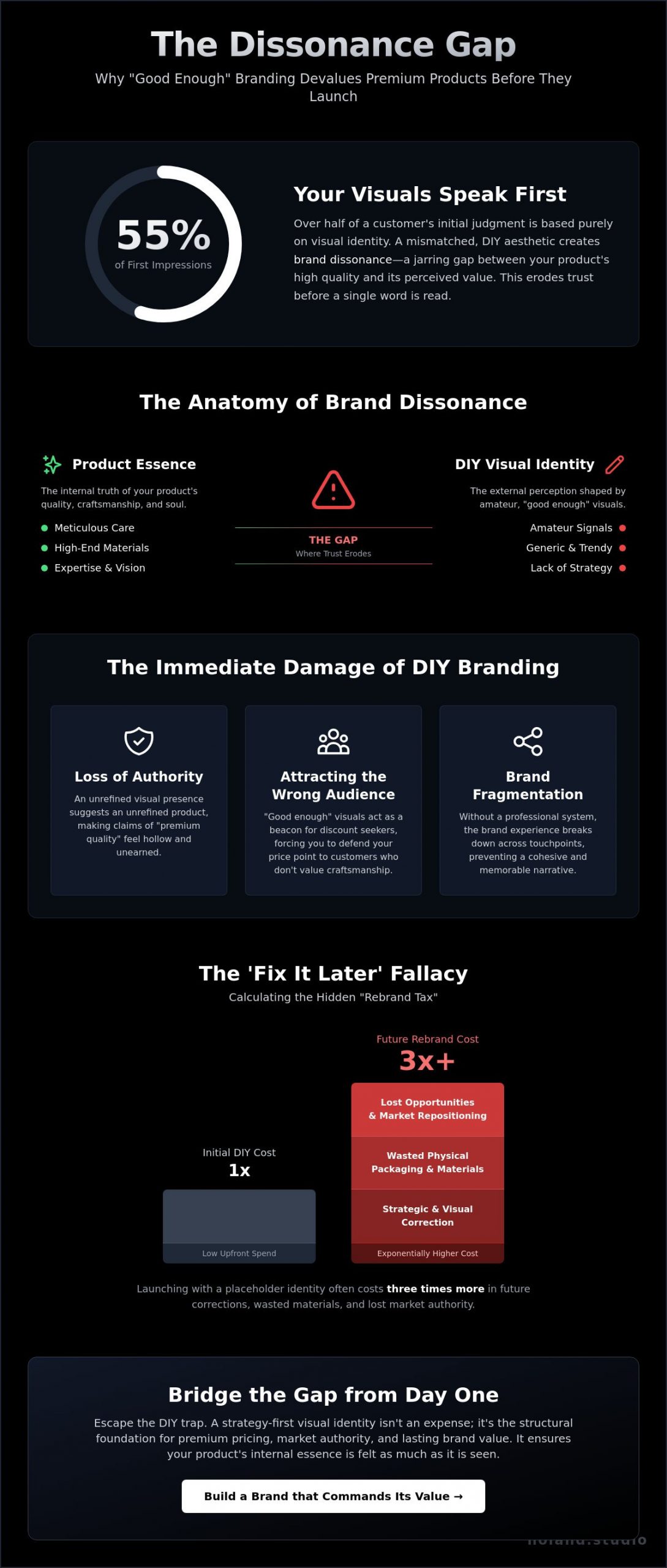
What if the very tools you’re using to save your budget are actually draining the soul out of your product’s market value? It’s tempting to believe that a “good enough” visual identity is a safe harbor while you scale, but the hidden risks of DIY branding for a premium product often manifest as a permanent ceiling on your growth. When 55% of a brand’s first impression is rooted purely in its visuals, a mismatched identity doesn’t just look amateur; it creates a profound dissonance that erodes trust before a single word is read.
We understand the tension between protecting your initial capital and the visceral fear of misrepresenting the craftsmanship you’ve poured into your creation. You want to command premium pricing immediately, yet the gap between your abstract vision and high-end market reality often feels vast. You’ll discover why a DIY approach actively devalues your work and how to bridge the distance between internal essence and external excellence. We’ll examine how to maintain a high perceived value from day one by evolving your brand from a simple aesthetic into a strategic, physical manifestation of your expertise.
Key Takeaways
- Define the concept of brand dissonance to understand how a mismatched identity actively erodes trust and diminishes your product’s internal essence.
- Examine the specific risks of DIY branding for a premium product, focusing on the immediate loss of authority and the inability to command high price points.
- Calculate the hidden “rebrand tax” to see why launching with a placeholder identity often costs three times more in future corrections and wasted physical packaging.
- Discover the artisan collective model as a visionary alternative to traditional agencies, offering a curated blend of strategic purpose and high-level craftsmanship.
- Learn how to bridge the gap between your abstract vision and market reality to ensure your brand is felt as much as it is seen.
The Illusion of the ‘Good Enough’ Start in Premium Markets
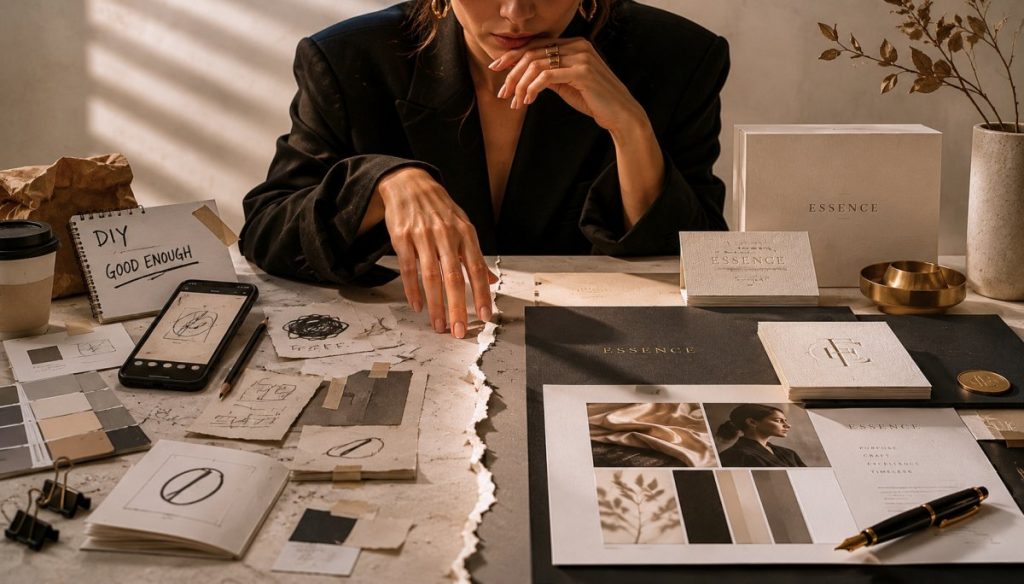
The “lean startup” mentality is a seductive trap for many founders. It suggests that you can launch with a placeholder identity and iterate as you grow. In mass-market sectors, this is efficiency. In luxury, it’s a liability. One of the primary risks of DIY branding for a premium product is the creation of brand dissonance. This is the jarring psychological friction felt by a consumer when your product’s high price point doesn’t align with its visual representation. It’s a gap where the internal essence of your creation fails to find its physical manifestation.
Premium consumers don’t just buy utility. They buy into a narrative of excellence, heritage, and meticulous care. When you rely on a DIY approach, you break the silent psychological contract that promises a high-end experience at every touchpoint. A “temporary” identity doesn’t just sit on the shelf; it begins to define your story. Once a brand is perceived as unrefined, reclaiming a position of sophisticated authority becomes a grueling, uphill battle. Professional brand management isn’t about decoration. It’s about the intentional construction of a structural base that supports your product’s soul and ensures its longevity.
The risks of DIY branding for a premium product extend to the very foundation of how your business is perceived by the market. If your first chapter is written in a generic font with stock imagery, you’ve already compromised the soul of your offer. You aren’t just saving money; you’re actively devaluing the craftsmanship you claim to provide. This creates a ceiling on your growth that no amount of marketing spend can truly break.
The Difference Between Aesthetic and Strategy
A pretty logo is not a strategy-first brand design. Real strategy acts as a bridge between abstract ideas and physical presence. It dictates how you occupy space in the market, how you speak to your audience, and how you evolve over time. Following fleeting design trends is the hallmark of the amateur. True premium branding prioritizes discernment and expertise, building a visual language that feels timeless rather than trendy. It requires an expert hand to ensure that every color choice and layout decision is rooted in strategic purpose.
The Premium Expectation Gap
Luxury buyers are hyper-sensitive. They detect amateur signals in the tight tracking of a font, the inconsistent use of color, or the cluttered use of white space. These aren’t just minor design choices. They are markers of efficacy. If the brand feels unconsidered, the consumer assumes the product is, too. High-end market reality requires a level of visual polish that signals your product is worth the investment. When your visual narrative is inconsistent, you lose the trust that is essential for long-term loyalty and emotional resonance.
The Dissonance Gap: Why DIY Erodes Premium Pricing
Perceived value is the delta between the hard cost of production and the intensity of emotional desire. In the high-end market, this gap is where your profit lives. One of the most damaging risks of DIY branding for a premium product is the immediate erosion of your pricing power. When you fail to strategically differentiate your brand through expert-led design, you invite doubt, hesitation, and price sensitivity. Sophisticated visual identity systems act as a silent justification for high margins, signaling to the consumer that every detail of the product has been curated with equal discipline.
DIY efforts often lead to three critical failures in market positioning:
- Loss of Authority: Expertise requires a structural base. An unrefined visual presence suggests an unrefined product, making your claims of “premium quality” feel hollow and unearned.
- Attracting the Wrong Audience: Visual cues that lean toward “good enough” act as a beacon for discount seekers. You’ll find yourself defending your price point to customers who don’t value the craftsmanship you offer.
- Fragmentation: Without a professional system, the brand experience breaks down across different touchpoints. This inconsistency prevents the formation of a cohesive narrative, leaving the consumer confused rather than compelled.
When these elements fail, your product is no longer an object of desire; it’s a commodity. To avoid this, many visionary founders choose to partner with a specialized studio to ensure their external presence matches their internal essence from the very first interaction.
The Psychology of Luxury Pricing
Luxury is a social currency that DIY cannot mint. Professional branding justifies high margins by fostering emotional resonance, transforming a simple purchase into an act of transformation. A premium brand serves as a status signal, providing the buyer with a sense of belonging and discernment. Without the expert hand of a designer to curate these subtle cues, your brand remains a collection of parts rather than a unified, evocative experience. You aren’t just selling a product; you’re selling a feeling of exclusivity and intentionality.
Verbal Identity: The Often-Forgotten DIY Risk
The architecture of trust is built on more than just symbols; it’s built on language. Generic naming and an inconsistent brand voice are significant risks of DIY branding for a premium product that many overlook. A professional Naming & Verbal Identity ensures your brand speaks with a singular, authoritative tone. Founder-led copy often lacks the necessary distance required for luxury positioning, frequently falling into the trap of over-explaining utility rather than evoking emotion. A disciplined verbal strategy gives physical form to your abstract vision, ensuring your story is felt as much as it is read.
The ‘Fix It Later’ Fallacy: The Real Cost of Rebranding
Many founders view initial branding as a temporary scaffold. They assume they’ll replace it once revenue flows. This is a fundamental misunderstanding of how luxury identities take form. The risks of DIY branding for a premium product aren’t just aesthetic; they’re financial. When you finally decide to invest in professional work, you aren’t just paying for a new look. You’re paying a “rebrand tax” to dismantle the old one, re-educate your market, and repair the fragmented narrative you’ve built. Doing it twice often costs three times more because you must invest in unlearning, restructuring, and rebuilding.
The physical costs are staggering. Imagine scrapping thousands of units of premium packaging design because your identity shifted and your labels no longer match your vision. This is physical manifestation turned into waste. Beyond the material, you face an equity drain. Early adopters build loyalty based on trust, emotion, and sensory impact. Changing your identity mid-stream creates confusion, erodes that emotional bond, and forces you to re-acquire the very people who were already in your corner.
The Technical Debt of DIY Digital Presence
DIY templates are designed for the average user, not the exceptional brand. They inherently limit the Digital Design & Web Development potential of your business. Attempting to integrate high-end e-commerce features into basic site builders often leads to technical debt. This is a tangled web of code that breaks the seamless luxury experience your customers expect. Poor digital performance isn’t just a nuisance. It’s a signal of unrefined expertise that luxury buyers detect immediately.
The Production Management Nightmare
Designing without a technical structural base often leads to a production nightmare. A DIY logo might look acceptable on a screen but prove impossible to foil-stamp or emboss on a physical box. Professional Art Direction & Content Creation ensures that your vision is actually manufacturable. Without this expert-led discernment, you risk investing in unprintable colors or unstable structural designs that fail during shipping. These are the tangible risks of DIY branding for a premium product that turn a cost-saving measure into a capital-draining mistake.
Identifying the ‘Artisan’ Alternative to Traditional Agencies
The choice between a bloated agency and a lonely DIY project is a false dichotomy. In 2026, the landscape has shifted toward the multidisciplinary design collective. This model prioritizes the expert artisan over the traditional account manager. It ensures your vision is translated by hands that actually do the work. By bypassing the risks of DIY branding for a premium product, you gain access to a distributed network of global experts. These collaborators understand the nuances of luxury across different cultures and markets, providing a localized touch that feels both intimate and global. They act as a bridge between your internal essence and the external market.
Modern technology now acts as a creative collaborator, but it remains guided by expert hands. While AI can generate patterns, it cannot sense the weight of an emotion or the structural base of a heritage brand. In the hands of a curator, these tools accelerate the creative process without sacrificing the human-centric touch that defines true luxury. This approach allows for a transformation of refinement, organization, and growth. It bridges the abstract world of ideas and the physical world of products with a precision that solo efforts cannot replicate.
Human Discernment vs. Algorithmic Templates
Canva and basic AI tools are built on averages. They lack the soul required to give physical form to a high-end vision. Luxury is defined by sensory impact and tactile prestige. It’s a narrative that should feel “found” rather than “made.” True discernment ensures your visual language isn’t just a collection of pixels. It must be an evocative identity meant to be felt. These are the hidden risks of DIY branding for a premium product that an artisan collective is uniquely equipped to navigate, ensuring your brand carries an artistic weight that resonates deeply.
The Strategic Partnership Model
The artisan model transforms the relationship from vendor to collaborator. A collective approach ensures your brand has a stable foundation across Naming & Verbal Identity, digital interfaces, and physical design. Many studios now offer a fixed-fee model. This provides budget predictability without the overhead of a large firm. If you’re ready to bridge the gap between your abstract ideas and high-end reality, you can partner with a specialized studio to begin your brand’s evolution into a curated identity.
Noland Studio: Giving Shape to Multidimensional Luxury
The risks of DIY branding for a premium product are often invisible until the moment of market entry. By then, the dissonance between your internal vision and your external visual presence has already begun to erode your pricing power and authority. Noland Studio exists to resolve this tension, acting as a disciplined bridge between abstract thought and tangible reality. We don’t just design; we curate identities that are meant to be felt as much as they are seen. Our work is deeply rooted in the intersection of luxury and strategic purpose, ensuring that every brand we touch possesses a structural base for enduring growth.
Our “Distributed Artisan” model rejects the traditional agency hierarchy in favor of a global collective of experts. This ensures that every project benefits from a multicultural perspective while retaining a sensitive, localized touch. We prioritize human-centric discernment over algorithmic templates, using modern technology as a creative collaborator guided by expert hands. This approach allows us to build identities that are meant to endure, focusing on longevity and emotional resonance rather than the frantic pace of fleeting trends. When you bypass the risks of DIY branding for a premium product, you aren’t just buying design; you’re securing your brand’s future heritage.
Sustainability is no longer a secondary consideration in the high-end sector; it’s a brand imperative. Our approach to premium packaging design balances aesthetic excellence with environmental responsibility. We ensure that the physical manifestation of your brand is as sophisticated as the product it contains, using 3D visualization to perfect every detail before production begins. This meticulous process ensures your brand’s soul is communicated through every sensory touchpoint.
Our Multidisciplinary Approach
From the foundational work of Brand Strategy & Positioning to the immersive world of motion design, our process is highly intentional. We move from philosophical foundations to strategic implementation with a steady, measured rhythm. This ensures your brand is felt as a cohesive, living visual universe. Our services include:
- Visual Identity Systems that serve as a structural base for global expansion.
- Premium Packaging Design that balances tactile prestige with sustainable discernment.
- 3D Visualization and Motion Design to give physical form to abstract concepts.
- Naming & Verbal Identity to build the architecture of trust through language.
Start Your Transformation
Investing in your brand’s soul is a requirement for market entry at the highest levels. The gap between your abstract ideas and a premium market reality is a space we specialize in navigating. We invite you to join our global collective and begin the process of refining your identity into a form that truly represents your craftsmanship. Connect with Noland Studio to shape your premium vision and ensure your first impression is one of enduring excellence.
Beyond the Placeholder: Securing Your Brand’s Heritage
Choosing to move past the “good enough” stage is the first step in giving physical form to your product’s internal essence. We’ve explored how the risks of DIY branding for a premium product extend far beyond mere aesthetics, impacting your price elasticity, technical infrastructure, and market authority. A fragmented identity isn’t just a temporary shortcut; it’s a structural base that can either support your growth or collapse under the weight of premium expectations. By investing in strategic discernment now, you avoid the compounding costs of the “fix it later” fallacy and ensure your story resonates with the emotional depth your audience demands.
Noland Studio acts as a bridge between your abstract vision and a high-end market reality. As a multidisciplinary collective of global experts, we specialize in luxury strategy and premium packaging with a commitment to fixed-fee transparency. Our model ensures that your brand is curated by expert hands who prioritize longevity over fleeting trends. Elevate your brand with Noland Studio’s expert artisans and transform your creation into a living visual universe. Your vision deserves a manifestation that is as disciplined and passionate as the craftsmanship behind the product itself.
Frequently Asked Questions
Is DIY branding ever acceptable for a premium product?
DIY branding is rarely acceptable for premium products because it lacks the strategic depth required to sustain high-end pricing. While a lean approach works for mass-market commodities, luxury consumers expect a level of intentionality that basic design tools cannot provide. This creates an immediate perception of unrefined expertise, which is one of the primary risks of DIY branding for a premium product.
What is the most common mistake in DIY luxury branding?
The most frequent error is prioritizing personal aesthetic preferences over a cohesive, strategy-led market position. Founders often select colors or typography because they find them “pretty” rather than because they communicate a specific sensory impact or heritage. This results in a brand that looks attractive in isolation but fails to justify its exclusive status to a discerning, global audience.
How does professional branding affect my product’s ROI?
Professional branding directly impacts ROI by increasing price elasticity and fostering long-term customer loyalty. Research shows that consistent brand presentation can increase revenue by up to 23% by building the trust necessary for consumers to pay a premium. By establishing a high perceived value from day one, you avoid the heavy financial burden of correcting a mismatched identity later.
Why is verbal identity just as important as visual identity?
Verbal identity acts as the invisible architecture of your brand’s trust and narrative resonance. While visuals capture the initial 55% of a first impression, your voice sustains the emotional connection over time. Without a disciplined verbal strategy, your story becomes fragmented. Professional naming and messaging ensure that your brand’s soul is felt as much as it is seen.
Can I use AI to create my premium brand identity?
AI should be viewed as a creative collaborator rather than a replacement for human discernment and expertise. While algorithms can generate infinite visual options, they lack the sensitive touch required to build a visionary luxury brand with emotional weight. Expert hands must guide these tools to ensure the results possess the strategic purpose that high-end consumers demand from a sophisticated creator.
What are the hidden costs of rebranding later?
The hidden costs include physical packaging waste, digital technical debt, and the loss of early adopter equity. Scrapping thousands of units of custom packaging because your identity shifted is a significant capital drain. These risks of DIY branding for a premium product often result in a rebrand tax that costs significantly more than investing in a professional structural base from the start.
How do I know if my brand needs a professional studio or just a freelancer?
You need a professional studio when your brand requires a multidimensional system rather than a single visual asset. If your project involves brand strategy, premium packaging, and digital development, a multidisciplinary collective is essential. A freelancer may handle a specific task, but a studio provides the structural base and global perspective needed for a cohesive, high-level market presence.
What is the ‘Status Signal’ in luxury branding?
The ‘Status Signal’ is the social currency a brand provides to its owner through exclusivity and craftsmanship. In luxury markets, consumers aren’t just buying utility; they’re buying an identity that reflects their own discernment and values. Professional branding curates these subtle cues of prestige, minting a social status that DIY efforts simply cannot replicate, which justifies your premium price point.